Best For
- SDR candidates
- New SDRs and BDRs
- Reps practicing role plays
- Founders doing outbound
Loading...
A 70-page cold calling and mock-call system for SDR candidates, BDRs, and working reps. Includes ten opener options, fifteen objection guides, five annotated practice scenarios, ten drills, a mock-call scorecard, a live-call review card, and three worksheets. Covers preparation, listening, voicemail, follow-up, meeting quality, and coaching.
Use it when phone confidence, cold-call structure, or mock-call performance needs work.
70 pages
Finished PDF playbook
20-page preview
Review the sample first
30-day guarantee
Instant access after checkout
Look inside
The full playbook runs 70 pages.
These 20 are the real thing, not a summary.
Page 1 / 20
Text from the same public sample shown above. Use the page images or PDF for diagrams, tables and original layout.
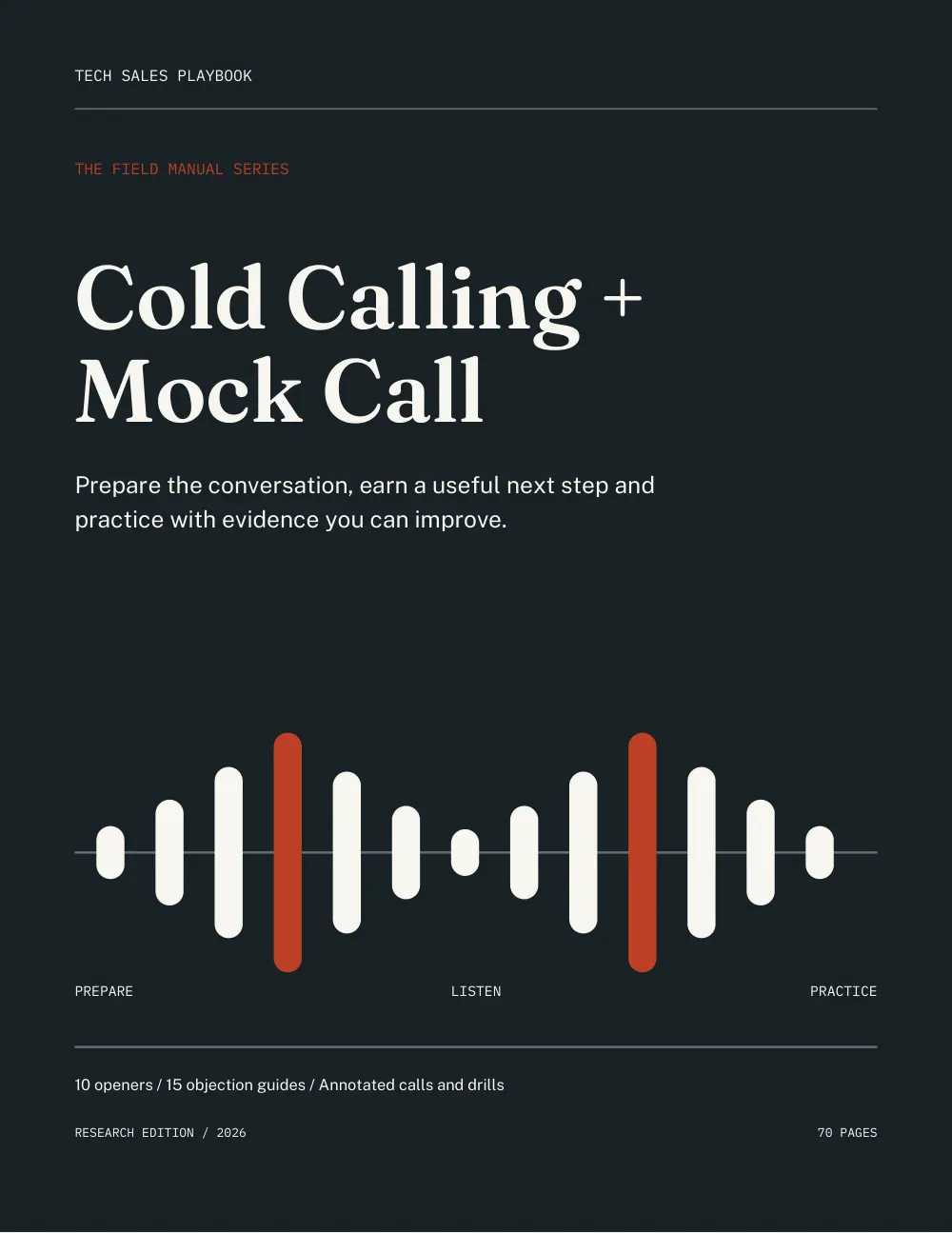
TECH SALES PLAYBOOK THE FIELD MANUAL SERIES Cold Calling + Mock Call Prepare the conversation, earn a useful next step and practice with evidence you can improve. PREPARE LISTEN PRACTICE 10 openers / 15 objection guides / Annotated calls and drills RESEARCH EDITION / 2026 70 PAGES
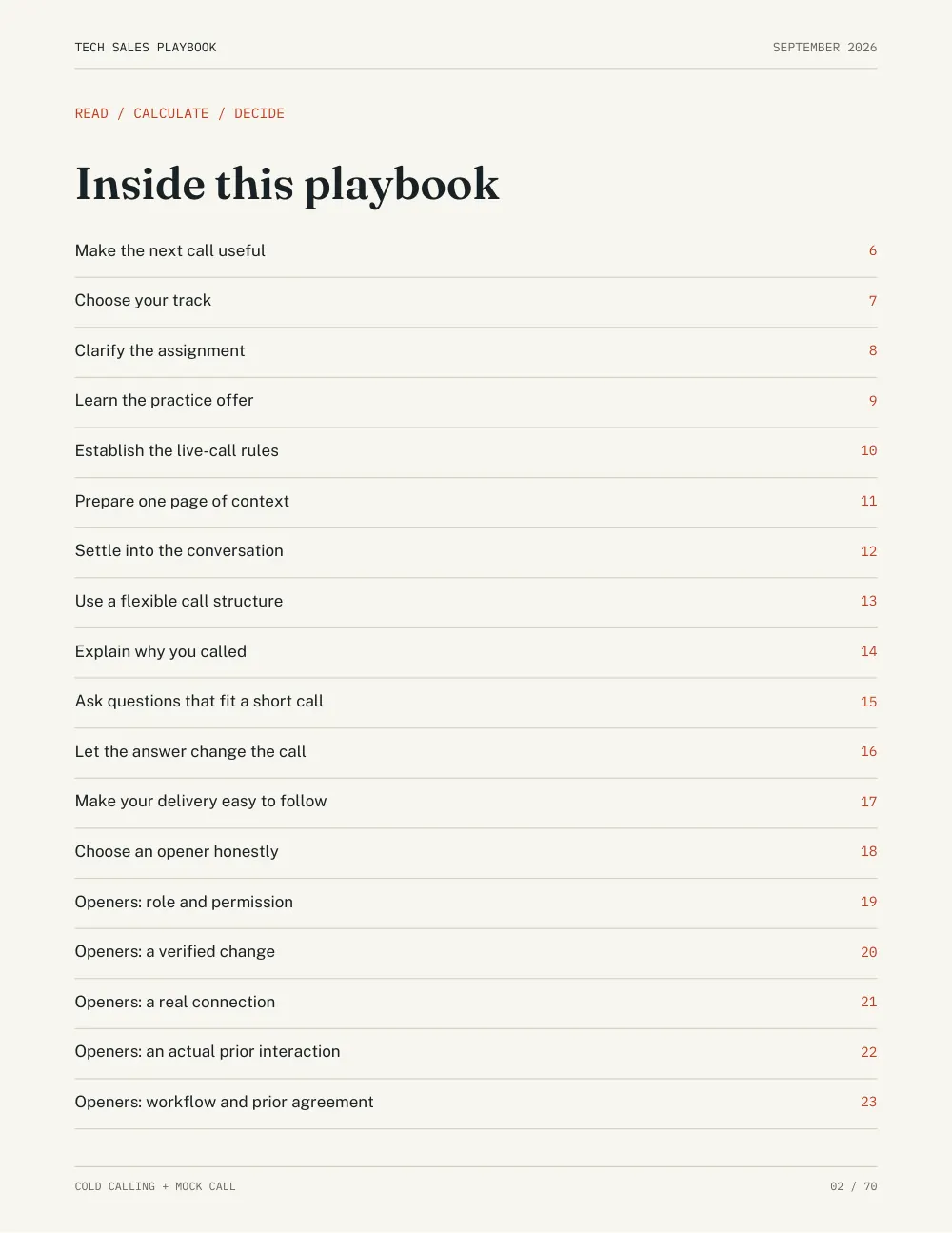
TECH SALES PLAYBOOK SEPTEMBER 2026 COLD CALLING + MOCK CALL 02 / 70 READ / CALCULATE / DECIDE Inside this playbook Make the next call useful 6 Choose your track 7 Clarify the assignment 8 Learn the practice offer 9 Establish the live-call rules 10 Prepare one page of context 11 Settle into the conversation 12 Use a flexible call structure 13 Explain why you called 14 Ask questions that fit a short call 15 Let the answer change the call 16 Make your delivery easy to follow 17 Choose an opener honestly 18 Openers: role and permission 19 Openers: a verified change 20 Openers: a real connection 21 Openers: an actual prior interaction 22 Openers: workflow and prior agreement 23
TECH SALES PLAYBOOK SEPTEMBER 2026 COLD CALLING + MOCK CALL 03 / 70 READ / CALCULATE / DECIDE Tools for the decision Treat objections as decisions 24 Not interested 25 I am busy 26 Send me information 27 We already use a vendor 28 We have no budget 29 This is not a priority 30 I am not the right person 31 How did you get my number? 32 Is this a sales call? 33 What does it cost? 34 Does it integrate with our system? 35 We tried something like this 36 Call me next quarter 37 We handle it internally 38 Remove me from your list 39 Work respectfully with a receptionist 40 Leave a clear voicemail 41
TECH SALES PLAYBOOK SEPTEMBER 2026 COLD CALLING + MOCK CALL 04 / 70 READ / CALCULATE / DECIDE Tools for the decision Ask for a meeting with a reason 42 Follow up in writing accurately 43 Write notes that help the next person 44 Build a workable call block 45 Measure a defined funnel 46 Diagnose where the problem sits 47 Test one change carefully 48 Set up a realistic mock 49 Score behavior, not personality 50 Assess your own attempt 51 Make the redo visibly different 52 Ask useful questions after the mock 53 Scenario 1: find the real problem 54 Scenario 1: agree on a useful review 55 Scenario 2: time and information 56 Scenario 2: the record and follow-up 57 Scenario 3: skepticism and uncertainty 58 Scenario 3: when there is no fit 59
TECH SALES PLAYBOOK SEPTEMBER 2026 COLD CALLING + MOCK CALL 05 / 70 READ / CALCULATE / DECIDE Tools for the decision Scenario 4: the routing conversation 60 Scenario 4: after a permitted transfer 61 Scenario 5: the coaching redo 62 Five drills for the conversation 63 Five drills for follow-through 64 Use a seven-day practice plan 65 Worksheet: the call brief 66 Worksheet: objection decisions 67 Worksheet: call review and redo 68 Live-call review card 69 Sources and edition notes 70
TECH SALES PLAYBOOK SEPTEMBER 2026 COLD CALLING + MOCK CALL 06 / 70 01 / START HERE Make the next call useful A useful cold call establishes who is calling, why the conversation could be relevant and whether there is a reason to continue. Sometimes the right result is a meeting. Sometimes it is a corrected contact, requested information or a clear stop. This playbook helps you choose and execute the appropriate next step. It serves two audiences: candidates preparing for a mock call and SDRs or BDRs making approved live calls. The underlying skills overlap, but the conditions differ. An interview is a bounded simulation under an employer's instructions. A live call involves a real recipient, real communication rules and a real record of commitments. What you will build A one-page call brief and a flexible conversation structure. Ten opener options with conditions for using them truthfully. Fifteen objection responses with follow-up choices and stopping rules. Meeting, voicemail and written-follow-up workflows. Five annotated practice scenarios, including a visible coaching redo. A ten-drill practice system, a mock-call scorecard, a live-call review card and three worksheets. All dialogues, rubrics, schedules and fictional company details are original teaching material. They are not validated hiring criteria, universal conversion benchmarks or promises that you will get a job. Use the employer's actual instructions when they differ from a practice exercise here. Read a section, speak it aloud, then change the wording until it sounds natural while preserving the meaning. The goal is not to memorize every line. It is to recognize the situation, listen to the answer and make the next decision clearly. Before practicing, name one behavior you want an observer to see. “Sound better” is vague. “Ask one question, then let the buyer finish” can be observed and repeated.
TECH SALES PLAYBOOK SEPTEMBER 2026 COLD CALLING + MOCK CALL 07 / 70 02 / INTERVIEW OR LIVE CALL Choose your track For interview preparation, begin with the assignment brief and fictional offer. Practice the basic structure, two openers and the objections most relevant to the scenario. Then use the mock setup, scorecard, annotated calls and redo exercises. Finish by rehearsing a concise self-assessment and questions for the interviewer. For live calling, begin with the operating rules and call brief. Confirm the list, contact context and approved product claims. Use the opener and objection library as options, then record actual outcomes. Review the measurement and call-block sections with your manager so the definitions match your team's workflow. A short preparation session Spend ten minutes understanding the scenario, ten drafting a call brief and ten speaking a first attempt with a partner. Use the final ten minutes to identify one correction and repeat the relevant exchange. This forty-minute session is an original practice suggestion, not a scientifically optimal duration. If your interview is tomorrow, prioritize the task instructions, a truthful reason for calling, two useful questions, a meeting ask and a graceful exit. Do not spend the entire evening collecting new scripts you will not practice. If you are already in the role, choose the part of the call where evidence shows friction. Low answer rates may involve list quality or contact timing; difficulty after an answer may involve relevance or delivery. Avoid assuming that every weak result is an objection-handling problem. Keep interview results separate from live metrics. A partner can simulate a difficult buyer consistently, but that exercise does not estimate real-market conversion. Its value is a visible improvement in a defined behavior.
TECH SALES PLAYBOOK SEPTEMBER 2026 COLD CALLING + MOCK CALL 08 / 70 03 / BEFORE A MOCK CALL Clarify the assignment Read the employer's instructions first. Confirm the role you are playing, product, buyer persona, call context, objective, preparation time and permitted materials. Ask whether the exercise includes feedback or a retry. Do not assume every company uses the same format or a hidden universal scorecard. GitLab's candidate handbook is one example of an employer describing different interview types and inviting candidates to ask the recruiter what to expect. It does not establish the format at another company. The useful habit is to obtain the actual instructions. To prepare for the exercise, could you confirm the buyer persona, whether this is a first cold call or a follow-up, the objective and any materials I may use? Will there be a feedback or redo portion? If the employer gives little information, state reasonable assumptions before the role-play: I will treat this as a first call to an operations manager, with the goal of assessing relevance and agreeing on a next step if there is fit. Invite correction. Separate facts supplied in the assignment from facts you researched and assumptions you invented for practice. Do not turn a fictional customer result into a claim about the employer's product. If a capability is unknown, say what you would verify rather than improvising a guarantee. Ask the recruiter about accessibility or setup needs through the appropriate process. Test your audio and permitted notes before the session. A clear brief lets you demonstrate selling judgment instead of spending the exercise guessing what task the interviewer intended.
TECH SALES PLAYBOOK SEPTEMBER 2026 COLD CALLING + MOCK CALL 09 / 70 04 / FICTIONAL SCENARIO CARD Learn the practice offer The examples use Flowline, a fictional workflow-software provider, and Cedar, a fictional business customer. Jordan is the seller. Avery manages operations at Cedar. These names and capabilities exist only for practice; they are not a claim about any real business with a similar name. Flowline's assumed capability Flowline routes incoming service requests to an assigned owner and shows unresolved handoffs in a shared queue. The intended users are operations teams that currently coordinate handoffs manually. Assume this basic capability is available in the practice scenario. Integration details, pricing, security and performance results are not supplied. Cedar's assumed context Cedar has several teams receiving service requests. Avery may or may not have a routing problem. The seller must ask rather than declare that the current process is broken. The practice goal is a relevant workflow review with the appropriate specialist if the buyer identifies a useful reason. I am Jordan with Flowline. We provide software for assigning service requests and making unresolved handoffs visible. I wanted to understand whether handoffs between teams create extra coordination work at Cedar. Do not promise that Flowline cuts work by a specific percentage or integrates with a named platform. Those facts are intentionally absent so you can practice handling uncertainty honestly. For your own product, replace this card with verified information: intended customer, problem addressed, supported capability, approved evidence and limits. Keep it small enough to review before a call. A strong card tells you what you can say confidently and what needs a specialist's answer.
TECH SALES PLAYBOOK SEPTEMBER 2026 COLD CALLING + MOCK CALL 10 / 70 05 / BEFORE THE FIRST DIAL Establish the live-call rules Use your company's approved calling process for the recipient's location, number type and calling technology. Check applicable do-not-call and suppression requirements, permitted hours, identification and recording rules before calling. This book does not determine whether a particular campaign is authorized. 47 CFR 64.1200 contains federal restrictions whose application depends on factors including technology, called number and consent. A business contact's mobile number is not automatically unrestricted. State and other jurisdictional rules may add requirements. The FTC's 2024 B2B telemarketing update extended prohibitions on misrepresentations to business-to-business telemarketing. Do not rely on old blanket claims that B2B calls are exempt from every rule. Your operating check Confirm the approved list source, suppression status, accurate caller identity and permitted tool configuration. Know how to record a stop request so it takes effect. If recording is not authorized under the relevant rules and company process, use permitted written notes or simulated practice instead. Never imply a prior conversation, referral or relationship that does not exist. Do not impersonate a colleague to bypass a receptionist. If the recipient asks you to stop calling, end the sales conversation and use the required suppression workflow promptly. Technology changes the analysis. Approval for a manual live call does not automatically cover prerecorded messages, automated dialing, AI voices or voicemail-drop tools. Ask the responsible team to assess a new channel or tool before using it. A script is not permission to place a call.
TECH SALES PLAYBOOK SEPTEMBER 2026 COLD CALLING + MOCK CALL 11 / 70 06 / THE CALL BRIEF Prepare one page of context Prepare enough context to make the call relevant without writing a research report for every contact. Record the buyer role, a verified observation, your hypothesis, one question and the next step you could reasonably offer. Field Flowline practice example Person and role Avery, operations manager; responsibility still to confirm. Observation Cedar has several teams handling requests in the fictional brief. Hypothesis Handoffs may require manual coordination. Question How do requests move between teams today? Possible next step A workflow review if a relevant problem is confirmed. Claim limits No supplied ROI, price or named integration proof. For live calls, include the source and date of the observation and any previous contact history. Verify that an apparent trigger is current and belongs to the correct company or business unit. A funding announcement does not prove an operations problem. Write a second question that follows from an answer rather than repeating the first in different words. If Avery says requests get reassigned manually, a useful follow-up might be: Where does that create extra work? If Avery says routing is already reliable, acknowledge that and reassess relevance. Choose the exit conditions before calling: wrong number, explicit stop request, no relevant need or an unsupported requirement. Preparation should make those outcomes easier to recognize. Keep the brief close enough to consult but avoid reading it as a monologue. It is a decision aid. The buyer's answer should change your next sentence when the facts differ from your hypothesis.
TECH SALES PLAYBOOK SEPTEMBER 2026 COLD CALLING + MOCK CALL 12 / 70 07 / COMPOSURE WITHOUT A PERFORMANCE ACT Settle into the conversation You do not need to feel fearless before making a call. Prepare the first sentence, check your audio, sit or stand comfortably and know where you will record the outcome. A simple routine reduces avoidable setup friction; it is not a treatment for anxiety or a guarantee of performance. Speak the opener once at a comfortable pace before the block. Notice whether the company name and reason for calling are clear. If you tend to rush, mark a pause after your introduction and after the first question. Practice leaving that space without immediately filling it. A brief reset after a difficult call Record the disposition and any required stop action first. Then write one factual observation: I interrupted the answer, or the number was incorrect. Choose whether there is a behavior to adjust. Avoid turning a single rejection into a conclusion about your ability or the whole market. If a call was abusive, use your organization's support and escalation process. You do not need to stay in an abusive conversation to prove resilience. A professional ending can be the right response. I understand. I will end the call here. Goodbye. For practice, repeat a short exchange after one correction. Do not rehearse failure for an hour without changing the task. If repeated attempts are becoming less attentive, take a break and return with a specific target. Measure readiness by observable preparation: accurate context, a clear opening, the ability to listen and a next-step decision. Trying to sound like an imagined top performer can distract from the person actually speaking to you.
TECH SALES PLAYBOOK SEPTEMBER 2026 COLD CALLING + MOCK CALL 13 / 70 08 / IDENTIFY, EXPLAIN, ASK, LISTEN, DECIDE Use a flexible call structure Use five moves to organize a short call. Identify yourself and your company. Explain the relevant reason for calling. Ask a focused question. Listen and clarify the answer. Decide together whether to continue, arrange a next step or end. This is an original practice structure, not a validated universal sales method. The moves can overlap, and the buyer may interrupt before you reach the second one. Respond to what they say rather than restarting your script from the top. A compact example Hi Avery, I am Jordan with Flowline. We provide request-routing software. I am calling because your operations role may include handoffs between teams. Is it worth a brief question about how those are handled? If Avery agrees, ask one question and let the answer finish. If they ask what you sell, answer directly. If they decline, do not treat the permission question as meaningless and continue pitching anyway. The next step depends on the evidence. A specific workflow problem may justify a review. A wrong-role answer may justify asking for the correct function if the person is willing. A clear stop request requires ending and suppressing contact through the appropriate process. Write your own version in ordinary language. Remove unsupported proof, jargon and stacked questions. Then practice a buyer interrupting at three different points. You should be able to answer naturally without needing to recover a memorized sequence. A framework should help you notice what is missing. It should not make you ignore an answer because the script expects a different one.
TECH SALES PLAYBOOK SEPTEMBER 2026 COLD CALLING + MOCK CALL 14 / 70 09 / THE REASON-FOR-CALL STATEMENT Explain why you called A useful reason connects your actual capability to a plausible responsibility or confirmed context. It should be specific enough for the recipient to understand and modest enough to be corrected. Avoid declaring a problem you have not established. Three levels of evidence Role relevance: I am calling operations managers about how requests move between teams. This is a hypothesis based on role, not a personal insight. Verified trigger: Your company announced a new service team. I wondered whether request handoffs are part of that change. The announcement is evidence of the change, not proof of pain. Prior conversation: You asked me to call after your workflow review. This is appropriate only when that conversation and request actually occurred. Flowline assigns incoming requests and makes unresolved handoffs visible. I wanted to understand whether your team has extra coordination work in that area. Use product proof only when it is approved, relevant and accurately scoped. A named customer result belongs to that customer's context; do not promise the same result for the person you are calling. If no proof is supplied in an interview, explain the capability without inventing a customer logo or percentage. Practice a one-sentence reason, then a slightly fuller explanation for a buyer who asks for detail. The short version opens the conversation; the fuller version answers an actual question. Neither needs to contain every feature. If the reason depends on several unverified assumptions, simplify it. A plain role-based question is more defensible than elaborate personalization that gets the buyer's situation wrong.
TECH SALES PLAYBOOK SEPTEMBER 2026 COLD CALLING + MOCK CALL 15 / 70 10 / A SMALL AMOUNT OF DISCOVERY Ask questions that fit a short call A cold call usually begins with limited context and attention. Ask enough to determine relevance and the value of a next step. Do not try to complete an entire discovery methodology before the buyer has agreed to a substantive conversation. Original question menu Workflow: How do requests move from one team to another today? Friction: Where does that process require extra coordination, if anywhere? Consequence: What happens when a request reaches the wrong owner? Priority: Is that something the team wants to change, or is the current process adequate? Next step: What would be useful to examine before deciding whether a review is worthwhile? Choose the question that follows from the buyer's last answer. If they already explained the workflow, do not ask them to repeat it simply because that question comes first on your page. Avoid asking several questions at once. “Who owns this, what system do you use, how many requests do you handle and what is the budget?” asks the buyer to organize your interview. Start with the most relevant uncertainty and listen. For sensitive information, explain why you need it and accept a refusal. You do not need a confidential budget or customer data to establish whether a workflow conversation could be useful. Write down the buyer's words accurately. If Avery says handoffs sometimes require reminders, do not upgrade that to a critical operational failure. A useful next meeting can begin from a modest, specific problem. Exaggerating it damages the record you will hand to the AE.
TECH SALES PLAYBOOK SEPTEMBER 2026 COLD CALLING + MOCK CALL 16 / 70 11 / LISTENING AND FOLLOW-UP Let the answer change the call Listening is visible in the question you ask next. Reflect the important fact in a short sentence, then check your understanding. Do not repeat every word or turn mirroring into an unnatural performance. Avery: Requests are assigned correctly. The problem is knowing whether the next team accepted them. Jordan: Assignment works, but acceptance is hard to see. How do you check whether the handoff happened? The seller follows the correction. Continuing to pitch better assignment would ignore the buyer's actual issue. If the product cannot address acceptance visibility, acknowledge the limitation rather than stretching the capability to preserve the meeting. When an answer is unclear Ask for one concrete example: Could you walk me through the last time that happened? If the buyer does not have time, suggest a next conversation only if they see value in it. Do not demand a detailed story from someone who already said they need to leave. When the answer removes relevance It sounds as though the current process is working for what you need. I do not have a clear reason to ask you for a meeting on that basis. Thanks for clarifying. You can ask whether another related issue is relevant if the buyer is still willing to talk, but avoid endlessly searching for a problem after a clear no. After practice, have the observer identify the moment the buyer supplied new information. Did your next line use it? This is a more concrete review than asking whether you sounded consultative. The skill is responding to the conversation that occurred.
TECH SALES PLAYBOOK SEPTEMBER 2026 COLD CALLING + MOCK CALL 17 / 70 12 / TONE, PACING AND PAUSES Make your delivery easy to follow Aim for clear speech, an audible introduction and enough space for an answer. There is no single voice, accent or speaking speed that every buyer prefers. Practice intelligibility and responsiveness rather than imitating someone else's personality. Record a practice opener with consent from anyone participating. Listen for clipped company names, long sentences and questions that sound unfinished. Ask a partner to repeat what you sell and why you called. If they cannot, simplify the wording before changing your vocal style. Three practical adjustments Shorten a sentence when you run out of breath or lose its meaning. Pause after a question rather than adding a second question. If the buyer asks you to repeat something, say it more simply and check whether it is clear. I said that too quickly. Flowline helps teams assign requests and see unresolved handoffs. I was asking whether that is part of your operations work. Use a calm, direct tone when challenged. You can acknowledge a concern without apologizing for every sentence or matching a buyer's irritation. Avoid exaggerated familiarity, forced enthusiasm and theatrical silence designed to make someone uncomfortable. If the connection is poor, address the connection. Do not mistake audio delay for resistance or repeatedly talk over the buyer. Offer to end or use an agreed channel if the call cannot continue clearly. For an interview, ask whether your audio is clear before the exercise starts. Then focus on the task. Delivery should make the meaning accessible; it should not become a separate performance that obscures whether you understood the buyer.
TECH SALES PLAYBOOK SEPTEMBER 2026 COLD CALLING + MOCK CALL 18 / 70 13 / HOW TO USE THE TEN OPTIONS Choose an opener honestly The next five pages contain ten original opener options. Each has a condition for use and a question it can lead to. They are a library of approaches, not a ranking by proven conversion rate. Use the option whose premise is true. Every live opener should accurately identify the caller and company through the approved process. These examples assume that any required additional disclosure is handled according to your campaign rules. Do not remove required identification to make a script shorter. Choose by evidence Use a role-based opener when you only know the person's likely responsibility. Use a trigger when you verified the event and its relevance is still a question. Use a referral, callback or prior-conversation opener only when the relationship or request exists. If a buyer interrupts to ask who you are or what you sell, answer directly. A clever opening is not useful if it obscures the basic facts. If your permission question receives a no, respect it. Avoid “How have you been?” as a device to imply a relationship with a stranger. Avoid “Following up” when there was no prior interaction. Truthful specificity gives you a sounder basis for the conversation than a manufactured recognition moment. Practice two options first. Ask your partner to respond with interest, a clarification and a decline. You should be able to handle all three without arguing with the answer. Add more options only when you understand why you would choose them. An opener earns the next exchange. It does not entitle you to finish a pitch after the recipient has declined the conversation.
TECH SALES PLAYBOOK SEPTEMBER 2026 COLD CALLING + MOCK CALL 19 / 70 14 / OPENER LIBRARY - 01 AND 02 Openers: role and permission 01 - Direct role relevance Hi Avery, I am Jordan with Flowline. We provide request-routing software. Does your operations role include how work moves between teams? Use this when role relevance is your main evidence. The first question checks responsibility before asserting a problem. If Avery says yes, ask how the workflow is handled. If they say no, thank them and ask about the responsible function only if they are willing to help. Do not use this as a disguised survey. You have already identified the commercial context by explaining what your company provides. If asked whether this is a sales call, answer yes. 02 - Brief permission request Hi Avery, Jordan with Flowline. This is a sales call about request handoffs between teams. Is it worth a brief question to see whether it is relevant? Use this when you want an explicit check before continuing. “Brief” is a promise about how you will behave: ask one focused question and let the buyer decide whether to continue. If they decline, end or follow their stated preference. Practice variation Have a partner ask what Flowline does before answering either question. Respond with the supported one-sentence capability, then let them decide. Do not repeat the entire opener. After three attempts, choose the wording you can deliver clearly. The right practice result is accurate identification and a natural response to the buyer. A partner agreeing to continue is not evidence that the opener will produce a particular live conversion rate.
TECH SALES PLAYBOOK SEPTEMBER 2026 COLD CALLING + MOCK CALL 20 / 70 15 / OPENER LIBRARY - 03 AND 04 Openers: a verified change 03 - Public operating change Hi Avery, I am Jordan with Flowline, a request-routing software provider. Your company announced a new service team. I wondered whether handoffs between teams are part of that change. Use only when the announcement is real, current and correctly attributed. The change is a reason to ask; it does not prove that the company has a routing problem. If Avery says the initiative is unrelated, accept the correction. 04 - A role-specific hiring signal Hi Avery, Jordan with Flowline. I saw your team's current posting for an operations coordinator. We work on request assignment and handoff visibility. Is that part of the responsibility you are adding, or is the role focused elsewhere? Use only after reading the actual posting. Do not infer that a vacancy means the team is struggling, underfunded or dissatisfied with its tools. A person being hired may be doing work your product cannot replace or improve. The correction branch Thanks for clarifying. I connected the posting to the wrong workflow. Is request handoff something you manage, or should I leave it there? If the buyer wants to leave it there, end. Do not keep adding speculative triggers until one seems to land. Before practice, write the exact public fact and the separate hypothesis. Ask your partner to challenge the hypothesis. Your task is to acknowledge the distinction without sounding defensive. This habit transfers to any research-based opener and reduces the chance that personalization becomes an inaccurate claim.
This is meant to be opened while you work. The sections are concrete enough to copy, practice, adapt, and reuse during applications, interviews, calls, and weekly execution.
Cold-call opener and permission-based script framework
Mock-call prep for SDR and BDR interviews
Objection handling scripts for common pushback
Voicemail and follow-up message templates
Call scoring rubric for practice sessions
Daily dial workflow and confidence drills
Manager-ready talk tracks for coaching review
Open calls with a clear reason and permission-based structure.
Handle reflex objections without arguing or freezing.
Practice mock calls with a scoring rubric and daily drills.
The sample exists so buyers can inspect the writing style, structure, and depth before purchase. If the sample feels useful, the full PDF continues with the same practical format.
What you are buying
Before you decide
Start with the question that matters to you. You can use the free material without making a purchase.
Try one relevant task first. If that resolves your immediate question, keep using the free resources. Inspect the book’s sample when you need more structured practice.
Try the related free resourceUse it when phone confidence, cold-call structure, or mock-call performance needs work.
Use this as a self-study routine, adjusting it to the material. Completing a session is not a certification or an assessment of hiring readiness.
Choose one book for a focused gap. Consider a bundle only if you will use its listed books; compare the exact contents and avoid paying twice for material you already own.
A PDF is self-directed preparation. Individual feedback on your own resume is a separate service with its own scope and availability.
Compare the resume serviceCheck the current price, included files, delivery instructions and refund terms before opening checkout.
Read the actual sample and file details on this page. If you need help with an order or access, contact support with your question rather than placing a second order.
Read purchase and refund termsAsk a product or access question$29 PDF download
$29 PDF download
$39 PDF download
$19 PDF download
$19 PDF download
$19 PDF download
$19 PDF download
$19 PDF download
$19 PDF download