Best For
- SDR and BDR candidates
- Career changers
- AE candidates
- Anyone preparing for mock calls
Loading...
A 70-page field manual for recruiter screens, manager and peer interviews, role-plays, assignments, final presentations, and offer conversations. Includes four background-specific introductions, eight behavioral exercises, annotated simulations, SDR and AE ramp plans, six drills, a practice rubric, and three reusable worksheets.
Use it when interviews, mock calls, role plays, or final rounds are the bottleneck.
70 pages
Finished PDF playbook
20-page preview
Review the sample first
30-day guarantee
Instant access after checkout
Look inside
The full playbook runs 70 pages.
These 20 are the real thing, not a summary.
Page 1 / 20
Text from the same public sample shown above. Use the page images or PDF for diagrams, tables and original layout.
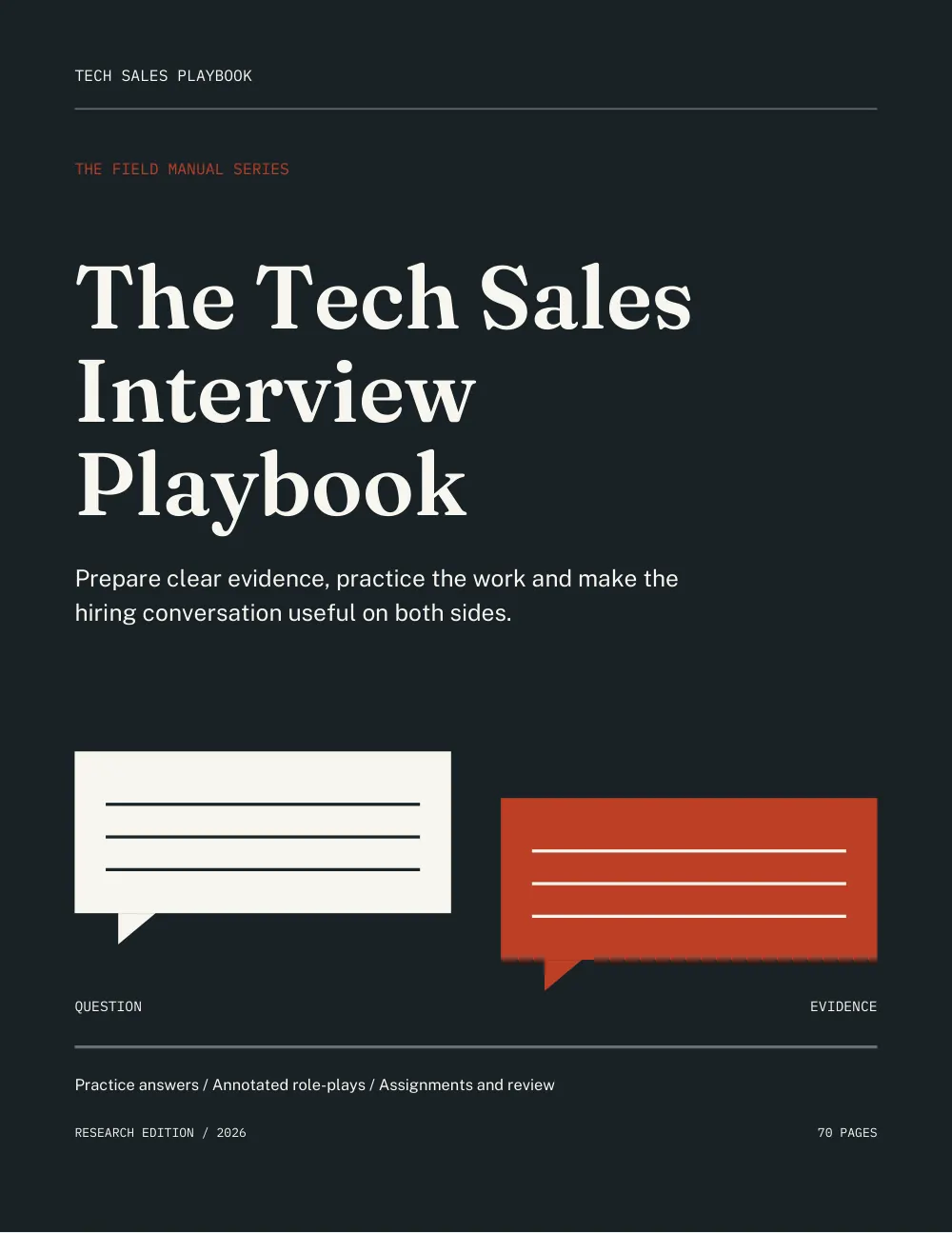
TECH SALES PLAYBOOK THE FIELD MANUAL SERIES The Tech Sales Interview Playbook Prepare clear evidence, practice the work and make the hiring conversation useful on both sides. QUESTION EVIDENCE Practice answers / Annotated role-plays / Assignments and review RESEARCH EDITION / 2026 70 PAGES
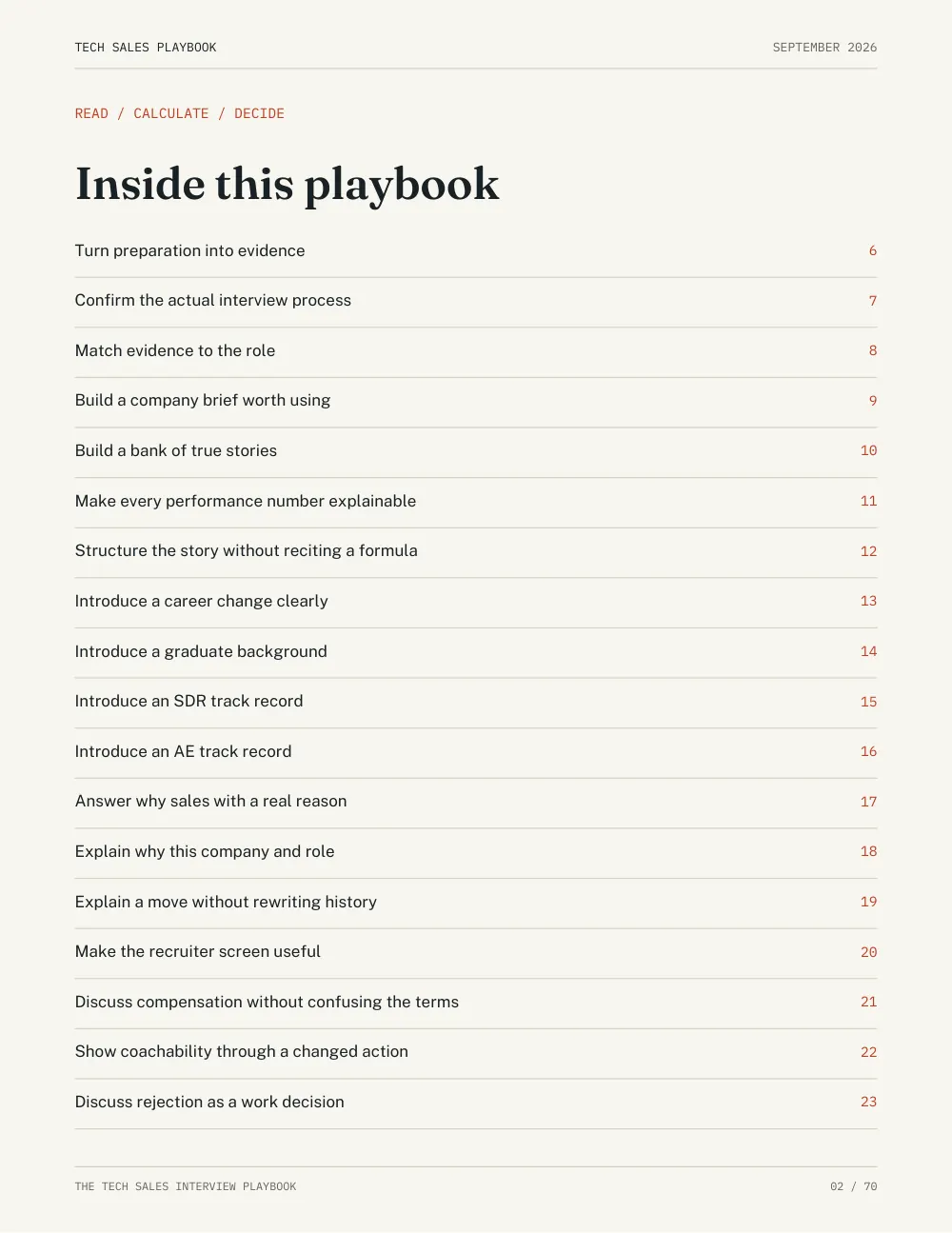
TECH SALES PLAYBOOK SEPTEMBER 2026 THE TECH SALES INTERVIEW PLAYBOOK 02 / 70 READ / CALCULATE / DECIDE Inside this playbook Turn preparation into evidence 6 Confirm the actual interview process 7 Match evidence to the role 8 Build a company brief worth using 9 Build a bank of true stories 10 Make every performance number explainable 11 Structure the story without reciting a formula 12 Introduce a career change clearly 13 Introduce a graduate background 14 Introduce an SDR track record 15 Introduce an AE track record 16 Answer why sales with a real reason 17 Explain why this company and role 18 Explain a move without rewriting history 19 Make the recruiter screen useful 20 Discuss compensation without confusing the terms 21 Show coachability through a changed action 22 Discuss rejection as a work decision 23
TECH SALES PLAYBOOK SEPTEMBER 2026 THE TECH SALES INTERVIEW PLAYBOOK 03 / 70 READ / CALCULATE / DECIDE Tools for the decision Own a failure and its limits 24 Explain disagreement constructively 25 Show how you prioritize competing work 26 Demonstrate ownership within your authority 27 Handle ambiguity without inventing facts 28 Show integrity in a concrete decision 29 Answer gaps and weaknesses directly 30 Work through numbers aloud 31 Explain an SDR process in working terms 32 Present a won deal with clear ownership 33 Review a lost deal without blaming everyone 34 Explain pipeline and forecast judgment 35 Discuss stakeholders and commercial choices 36 Rehearse questions across the role 37 Set up a bounded role-play 38 Open the mock cold call 39 Follow the objection's meaning 40 Ask for a next step with a purpose 41
TECH SALES PLAYBOOK SEPTEMBER 2026 THE TECH SALES INTERVIEW PLAYBOOK 04 / 70 READ / CALCULATE / DECIDE Tools for the decision Run discovery as a conversation 42 Calculate impact without inventing ROI 43 Handle a technical question you cannot answer 44 Approach an unfamiliar selling exercise 45 Use the redo to show a specific change 46 Read the email assignment before drafting 47 Explain the choices in your email 48 Build a research assignment that shows reasoning 49 Prepare a demo around a question 50 Propose an SDR thirty/sixty/ninety-day plan 51 Propose an AE thirty/sixty/ninety-day plan 52 Clarify the final presentation brief 53 Use a clear presentation outline 54 Present the Cedar case honestly 55 Handle panel questions in the moment 56 Ask questions that help you decide 57 Close the interview clearly 58 Follow up and debrief while details are fresh 59
TECH SALES PLAYBOOK SEPTEMBER 2026 THE TECH SALES INTERVIEW PLAYBOOK 05 / 70 READ / CALCULATE / DECIDE Tools for the decision Handle the offer conversation with specifics 60 Prepare references and practical logistics 61 Use AI for practice you can inspect 62 Practice with a useful review partner 63 Use six focused drills 64 Build a flexible practice week 65 Review practice with an explicit rubric 66 Worksheet: the evidence story 67 Worksheet: the interview brief 68 Worksheet: the practice review 69 Sources and edition notes 70
TECH SALES PLAYBOOK SEPTEMBER 2026 THE TECH SALES INTERVIEW PLAYBOOK 06 / 70 01 / START HERE Turn preparation into evidence An interview gives an employer a limited view of your work. Your job is to make that view accurate and useful: explain relevant experience, demonstrate how you think and respond to the actual question. Preparation helps you do that without inventing a perfect professional history. This book serves SDR and BDR candidates, career changers, graduates and account executives. Choose the examples that match your level of responsibility. A first-time candidate can demonstrate transferable skills and thoughtful practice; an experienced seller should be ready to explain the work, numbers and decisions behind their results. The toolkit Four background-specific introduction examples. Behavioral stories, follow-up probes and revision guidance. SDR and AE process questions, deal reviews and commercial reasoning. Cold-call, discovery, product and feedback role-plays. Email, research, demo and presentation assignments. SDR and AE thirty/sixty/ninety-day plan examples. Candidate questions, follow-up and offer conversations. Practice drills, a review rubric and three reusable worksheets. Every candidate, company and result in the worked examples is fictional. Use the structure, then replace the facts with your own. The scripts are practice material, not accounts of real hires or promises of interview success. Start with the employer's instructions. Confirm the next stage, build an evidence brief and practice the relevant task aloud. After each attempt, identify one change and try it again. Reading a polished answer is only the first step; the useful skill is explaining your own work when someone asks an unexpected follow-up.
TECH SALES PLAYBOOK SEPTEMBER 2026 THE TECH SALES INTERVIEW PLAYBOOK 07 / 70 02 / ASK BEFORE ASSUMING Confirm the actual interview process Interview formats differ by employer, role and location. GitLab's candidate handbook describes several possible interview types and invites candidates to ask their recruiter what to expect. Treat that as an employer-specific example, not a universal sequence. GitLab candidate guidance Salesforce's Trailhead sales-interview unit discusses manager conversations, panels and presentations, including communicating business value. It illustrates possible assessment work; your current recruiter brief determines the actual process. Salesforce sales-interview preparation A preparation request Thank you for arranging the next stage. Could you confirm the format, participants, expected duration and any materials I should prepare? If there is an exercise, please share the brief, permitted resources and how the work will be discussed. Record what is known Detail Why it matters Role and level Sets the relevant scope of evidence Interview format Determines whether to practice discussion, simulation or presentation Task and deliverable Prevents preparing the wrong artifact Resource rules Clarifies notes, outside help and AI use Timing and logistics Makes attendance and preparation workable If instructions conflict, ask for clarification. Do not rely on an anonymous account of another person's interview as though it overrides your invitation. Likewise, do not assume a difficult question is a secret test with one mandatory phrase. Keep a separate note of unknowns. You can prepare for uncertainty without pretending to know the interviewer's private scoring system. The goal is to arrive ready for the stated work and able to adapt when the conversation changes.
TECH SALES PLAYBOOK SEPTEMBER 2026 THE TECH SALES INTERVIEW PLAYBOOK 08 / 70 03 / RESPONSIBILITY BEFORE TITLE Match evidence to the role Read the actual responsibilities and identify what the employer needs to assess. SDR, BDR and AE titles can cover different motions. Compare inbound and outbound work, customer segment, territory, qualification criteria and ownership of later sales stages. Original evidence map Responsibility Evidence to prepare Account research A specific research decision and its reasoning First conversations Listening, clear questions and appropriate next steps Qualification How you distinguish confirmed fit from assumptions Opportunity ownership A deal decision you personally managed Team collaboration A handoff, disagreement or shared delivery example Performance management Defined results, feedback and changed behavior Choose the strongest evidence you can support. A customer-service example can show follow-through, but it does not become quota-carrying sales experience because the new role is in sales. A sourced opportunity does not become your personally closed deal unless you held that responsibility. Prepare a gap statement My experience covers [actual responsibility]. I have not yet owned [specific new responsibility]. To prepare, I have [truthful practice or learning], and I would want to understand how your team coaches and assesses that work. This makes the boundary clear and gives the interviewer a useful next question. It is stronger than listing tools you cannot demonstrate or claiming that every previous job was effectively enterprise sales. Before the interview, connect three role responsibilities to three examples. Identify one material gap and a question about it. That compact map keeps your preparation focused and helps you avoid answering every question with the same unrelated success story.
TECH SALES PLAYBOOK SEPTEMBER 2026 THE TECH SALES INTERVIEW PLAYBOOK 09 / 70 04 / FACTS, HYPOTHESES AND QUESTIONS Build a company brief worth using Prepare a short brief that helps you discuss the employer's customers and work. Use current company materials and the role description. Link sources and distinguish what you observed from what you inferred. The five-part brief Product or service; target customer; problem addressed; sales responsibilities in the posting; and questions that remain. You do not need to memorize every product feature. You need to explain a supported capability and why a customer might care. Fictional example Cedar Systems sells workflow software that assigns incoming requests and shows whether handoffs were accepted. Its supplied SDR brief emphasizes operations teams, account research and qualified first conversations. No pricing, integration compatibility or measured ROI is supplied. Candidate Maya can say: My understanding is that Cedar helps teams see who owns a request and whether the next team has accepted it. I would want to learn which operations workflows create the strongest fit. The SDR posting's emphasis on clear handoffs interests me because I have maintained follow-up records in customer service. Test the reasoning Can you identify the source of each claim? Does the customer problem follow from the supported capability? Which statement is only a hypothesis? What would you ask to verify it? A public expansion announcement might suggest a changing workflow, but it does not prove that the company has a problem or budget. Use uncertain observations to form questions. Avoid invented customer relationships, fabricated product use or exaggerated enthusiasm that cannot survive a follow-up. Bring the brief as preparation, not a speech to recite regardless of the question. The interviewer may correct your understanding; treat that as new information and adjust.
TECH SALES PLAYBOOK SEPTEMBER 2026 THE TECH SALES INTERVIEW PLAYBOOK 10 / 70 05 / EXPERIENCE YOU CAN EXPLAIN Build a bank of true stories List situations involving learning, setbacks, customer communication, priorities, collaboration and judgment. Include employment, education, volunteering and clearly labeled practice. Choose examples with enough detail to explain your own actions. For each story, record the setting, responsibility, choice, action, result and lesson. Add what you can verify and what should remain confidential. A story bank is a preparation document, not a collection of impressive claims to copy into every answer. Useful evidence prompts When did feedback change how you worked? When did a plan fail, and what did you do next? When did you clarify a customer's real request? When did two priorities compete for your time? When did you disagree and still work constructively? When did you decide not to make a claim you could not support? Choose range, not perfection Prepare examples with different outcomes. A setback can show reasoning and accountability even when it did not later become a dramatic success. Do not rewrite every difficult event into a guaranteed win. Maya might use a shift-handoff problem for coachability and a delayed customer request for prioritization. Eli, a fictional graduate, might discuss a student sponsor-research project. Jordan, a fictional SDR, can explain accepted meetings and handoff feedback. An AE example should make opportunity ownership explicit. Keep a short index linking stories to likely questions. One story may illustrate several skills, but use it only when it answers the question asked. If you lack a relevant past example, say so and distinguish a hypothetical approach from something you actually did.
TECH SALES PLAYBOOK SEPTEMBER 2026 THE TECH SALES INTERVIEW PLAYBOOK 11 / 70 06 / METRIC, PERIOD AND OWNERSHIP Make every performance number explainable Prepare the definitions behind any number you plan to use. An interviewer may ask what counted, over which period, against what target and under which conditions. A percentage without that context can mislead even when the arithmetic is correct. Fictional SDR example Jordan created 27 accepted meetings against a quarterly target of 24. The stated attainment is 27 / 24 x 100 = 112.5%. The team uses a defined acceptance standard. This is not the same as meetings booked, meetings held or opportunities closed. Question What Jordan needs to explain What counted? Accepted meetings under the team's criteria Which period? The specified quarter What was the target? Twenty-four accepted meetings What did you own? Research, first conversation and handoff work What was shared? AE acceptance and later opportunity management For an AE Define whether a figure is bookings, recognized revenue, annual contract value or another employer metric. Do not use those terms interchangeably. Explain territory, segment, ramp status and your own contribution where relevant and permitted. If you cannot share a confidential figure, explain the restriction and offer an appropriate alternative, such as a permitted aggregate or a qualitative decision example. Do not bring private customer lists or internal dashboards into an interview without authorization. If a number is uncertain, verify it before the interview or leave it out. A precise-looking estimate is not better evidence than an accurate explanation of what you know and what you cannot confirm.
TECH SALES PLAYBOOK SEPTEMBER 2026 THE TECH SALES INTERVIEW PLAYBOOK 12 / 70 07 / STAR AND A PRACTICAL REFLECTION Structure the story without reciting a formula STAR stands for situation, task, action and result. Amazon's recruiting guidance uses it to organize behavioral examples and emphasizes explaining personal contribution. That source describes Amazon's approach; it does not establish a required format for every employer. Amazon interview guidance Use the structure to keep an answer understandable. Set the scene briefly, state your responsibility, explain the decisions and actions, then give the supported result. Add a concise reflection when it helps answer what you learned. The reflection is an editorial extension used in this book. A fictional outline Situation: weekend staff could not easily identify unresolved customer requests. Task: Maya needed to make her handoffs clearer. Action: she asked what information was missing, revised the log and tested a short checklist with the next shift. Result: colleagues could identify the owner and next action in the reviewed cases. Reflection: she would involve the receiving team earlier next time. What to avoid Do not spend most of the answer describing the company while leaving your action vague. Do not say “we improved everything” without explaining your role. Do not add a percentage improvement when the example only supports a qualitative observation. Practice the answer in your own words, then invite follow-up questions. You should be able to explain why you chose that action, what alternatives existed and how you knew the result. A memorized paragraph that collapses under those questions is not ready. Use the structure flexibly. A direct question about availability needs a direct answer, not a full story. The purpose is clarity, not forcing every exchange into an acronym.
TECH SALES PLAYBOOK SEPTEMBER 2026 THE TECH SALES INTERVIEW PLAYBOOK 13 / 70 08 / MAYA'S OPENING ANSWER Introduce a career change clearly When asked to introduce yourself, connect your current background, relevant evidence and reason for exploring the role. Choose enough detail to start a useful discussion. You do not need to recount your entire life or apologize for every skill you have not yet learned. Fictional practice answer I work in customer service, where I explain options, track unresolved requests and coordinate follow-up. One improvement I made after feedback was a shift-handoff checklist so the next associate could see the owner and next action. I'm exploring sales development because I enjoy understanding a question, communicating clearly and improving through practice. I've started building the sales-specific skills with labeled research exercises and mock calls. This role interests me because the posting describes structured coaching and clear qualification expectations. Why it is useful The answer identifies real work, gives a specific example and explains the transition. It does not claim customer service proves quota performance. The final sentence points to something the candidate can ask about, rather than declaring that the company is perfect. Likely follow-up probes What changed after the checklist? Why sales development rather than customer success? What have you learned from a mock call? What part of the SDR role do you expect to find difficult? Maya needs truthful answers to those questions. If her practice is limited, she should say so and describe the next step. For your version, replace every detail with your own experience. Keep the transition logic, but do not borrow Maya's accomplishment as though it happened to you.
TECH SALES PLAYBOOK SEPTEMBER 2026 THE TECH SALES INTERVIEW PLAYBOOK 14 / 70 09 / ELI'S OPENING ANSWER Introduce a graduate background A graduate can draw on projects, part-time work and volunteering when those experiences relate to the role. Label the setting accurately. Specific work is more useful than claiming to be a natural salesperson without an example. Fictional practice answer I recently graduated and am seeking a sales-development role. In a student organization, I researched 24 potential event sponsors over six weeks, documented relevance and contact routes, and drafted outreach for committee review. I also worked at a campus service desk, where I clarified questions and logged follow-up. Those experiences made me interested in research and first conversations. I know I still need to learn a commercial product and qualification process, so I'm looking for a team where I can practice those skills with clear feedback. Keep ownership precise Eli researched potential sponsors; he did not personally close 24 sponsorships. The committee approved final decisions. His service-desk work supports communication and follow-through, not enterprise account management. Prepare the next layer Explain how the sponsor list was built, what made a potential sponsor relevant and how feedback changed a draft. If the project had disappointing results, discuss them accurately. The example can still show useful reasoning. For your own introduction, choose one project with decisions you can explain. A small genuine example is easier to assess than a large invented accomplishment. If you have little relevant experience, distinguish what you have done from a practice exercise you are currently building. Finish with a role-specific reason for interest. Avoid treating any sales opening as interchangeable; the employer should understand why the actual work fits what you want to learn and contribute.
TECH SALES PLAYBOOK SEPTEMBER 2026 THE TECH SALES INTERVIEW PLAYBOOK 15 / 70 10 / JORDAN'S OPENING ANSWER Introduce an SDR track record An experienced SDR introduction should show the motion, responsibilities and evidence behind the results. Keep it concise enough to invite a deeper discussion. Do not overload the opening with every activity metric you have ever tracked. Fictional practice answer I'm an SDR working with operations accounts in an outbound motion. My responsibilities include account research, initial conversations and handoff notes for AEs. In the stated quarter I created 27 accepted meetings against a target of 24, or 112.5% attainment under our team's criteria. I've also worked on making handoff notes more precise after AE feedback. I'm exploring this opening because it includes a more technical buyer group, and I want to understand how the team develops that product knowledge and assesses qualification quality. Explain what the number does not show The attainment figure does not establish closed revenue, customer retention or mastery of another territory. Jordan should explain the accepted-meeting definition, the period and what he personally controlled. He should also be able to discuss rejected meetings and lessons from them. Useful follow-up questions What did an accepted meeting require? How did you prioritize accounts? What changed in the handoff notes? Where did your performance fall short? What is different about the new buyer group? Prepare answers that reveal the operating work. If the target role is inbound, enterprise or more technical, explain the transfer and the gap rather than assuming that one percentage proves universal readiness. Use actual authorized figures in your version. When sharing is restricted, explain the limitation and choose another permitted way to discuss your contribution.
TECH SALES PLAYBOOK SEPTEMBER 2026 THE TECH SALES INTERVIEW PLAYBOOK 16 / 70 11 / PRIYA'S OPENING ANSWER Introduce an AE track record An AE introduction should clarify what you owned across the opportunity. Segment, deal complexity and collaboration matter alongside results. Avoid implying that an attractive logo or contract value explains the quality of your work by itself. Fictional practice answer I'm an account executive working with mid-market operations teams. I own discovery, evaluation coordination, commercial discussions and the path to signature, with technical validation handled alongside a solutions engineer. One recent case involved teams disagreeing about rollout scope. I helped separate the initial deployment from later expansion and documented the decision owners and remaining approvals. I'm interested in this role because it involves broader stakeholder coordination. I'd like to understand how your team shares account planning and technical evaluation work. Add results only when supported This teaching answer demonstrates scope without a fabricated quota history. In your version, include a permitted, defined result if it adds useful evidence. Be ready to explain the period, credit rules and your contribution. Prepare a deeper deal review What customer problem was confirmed? Why did the evaluation change? Who disagreed? What did the solutions engineer own? Which commercial concessions were approved? What happened after signature, if you know? The interviewer may care about the decisions more than the headline outcome. An answer that explains a tradeoff and its limits gives them more to assess than a list of adjectives about your selling style. If you are an SDR applying for an AE role, use your actual current title and distinguish supervised later-stage practice from ownership. Do not adopt Priya's introduction before you have done the work it describes.
TECH SALES PLAYBOOK SEPTEMBER 2026 THE TECH SALES INTERVIEW PLAYBOOK 17 / 70 12 / MOTIVATION THAT SURVIVES FOLLOW-UP Answer why sales with a real reason Explain what attracts you to the work and what experience supports that interest. Enjoying conversation is relevant, but sales also involves research, follow-through, uncertainty, feedback and commercial accountability. Show that you have investigated the role beyond its compensation headline. A useful answer shape Name a part of the work; connect it to a real experience; acknowledge a challenge; explain why you still want to pursue it. You do not need to claim that you have dreamed of prospecting since childhood. Fictional example I enjoy clarifying what someone needs and organizing a useful next step. In customer service I learned that a good conversation was incomplete if the follow-up disappeared. Sales development interests me because it adds research and qualification to that work. I also understand that many contacts will not be interested, so I'm practicing how to listen, handle that professionally and review my approach without taking every response as a personal verdict. Make room for honest incentives It is reasonable to care about pay and career development. Explain those alongside the responsibilities you want to perform. Do not pretend money is irrelevant or make it the only evidence that you understand the role. Practice the challenge question If asked why not another customer-facing role, explain the distinction you have considered. If you are still exploring, say what you need to learn. A candid answer about the work you want is more useful than saying sales is the fastest guaranteed route to a particular income. For your version, remove any sentence you cannot support with an experience, an observed responsibility or a considered preference.
TECH SALES PLAYBOOK SEPTEMBER 2026 THE TECH SALES INTERVIEW PLAYBOOK 18 / 70 13 / SPECIFIC INTEREST WITHOUT FLATTERY Explain why this company and role Choose two or three supported reasons that connect the employer's work to your interests and evidence. A product, customer problem, sales motion or coaching structure can supply a reason. Generic praise tells the interviewer little about your decision. Fictional example The supplied Cedar brief focuses on request ownership and handoff visibility. That problem is understandable to me because I've seen unresolved service requests become difficult to track. The SDR posting also describes account research and clear qualification criteria, which are skills I'm developing. I'd like to learn how the team coaches those skills and which customer situations tend to fit the product. Separate fact from hope If the posting says coaching is provided, you can discuss that statement and ask how it works. You cannot yet claim the manager is exceptional or that promotion is guaranteed. If you have not used the product, do not say you love using it. Prepare a useful question The role description emphasizes [responsibility]. How does that work in practice, and what distinguishes strong performance after ramp? The answer may strengthen or weaken your interest. That is useful information. You are assessing fit as well as explaining why the employer should consider you. Avoid rehearsing a corporate history lesson. A short, accurate explanation of the customer and role is more relevant than reciting acquisition dates without connecting them to the job. Before the interview, check that the opening is still the one you researched and that your examples refer to the correct company. A reused answer with another employer's name can undermine otherwise thoughtful preparation.
TECH SALES PLAYBOOK SEPTEMBER 2026 THE TECH SALES INTERVIEW PLAYBOOK 19 / 70 14 / WHY LEAVE, WHY NOW Explain a move without rewriting history Discuss the move in terms of the work and conditions you are seeking. Keep the explanation accurate and proportionate. You do not need to attack a former manager or invent a more flattering reason for leaving. Moving toward a different scope I've learned [specific skill] in my current role. I'm now looking for [actual responsibility or environment], and this opening appears to include it. I would like to understand [important question] before deciding whether the move fits. A role that ended State the relevant fact briefly, then explain what you learned or what you are seeking next. Distinguish a layoff, contract end, resignation and performance-related departure accurately. Do not present one as another to avoid an uncomfortable conversation. A difficult working relationship Focus on the specific operating issue and your response. For example: expectations changed without a clear review process; you asked for clarification and now want to understand how this team sets priorities. Avoid broad judgments about another person's character. What the interviewer may probe What did you do to address the issue? What would be different in the new role? What feedback did you receive? How would you handle a similar situation again? Prepare answers that show your contribution and limits. You can acknowledge a mistake without turning the interview into a long defense of every event. If a detail is private, give an appropriate concise explanation and return to the role. Do not fabricate dates, employment status or competing opportunities. Consistency across the resume, conversation and later reference process matters more than a perfectly polished narrative.
TECH SALES PLAYBOOK SEPTEMBER 2026 THE TECH SALES INTERVIEW PLAYBOOK 20 / 70 15 / PRACTICAL FIT AND NEXT STEPS Make the recruiter screen useful Prepare direct answers about your background, interest, availability and essential work conditions. The recruiter may not be able to answer every technical or team-level question, so ask who can clarify the remaining points. Before the conversation Have the role description, submitted resume and a short question list available. Confirm the time zone and contact route. Know which constraints are firm and which are preferences. Useful questions What responsibilities distinguish this opening from adjacent sales roles? How is the role divided between inbound and outbound work? What does the remaining interview process involve? Is there an exercise, and when will the brief be shared? Which location, schedule or travel expectations should I understand? Where can I review the compensation structure and ramp terms? A concise clarification Before we go further, could you confirm [material condition]? I want to make sure the role is workable and use the team's time appropriately. Do not turn the screen into an interrogation or demand answers the recruiter does not have. Prioritize the conditions that determine whether it makes sense to continue, then save deeper operating questions for the relevant interviewer. After the call, record the facts, unresolved questions and next action. Separate a positive conversation from an actual invitation to the next stage. If the recruiter promised a timeline, note it accurately rather than inventing urgency. Use the conversation to improve your preparation. If you learn that the role is mostly inbound, revise the examples you emphasize while keeping the underlying facts unchanged.
This is meant to be opened while you work. The sections are concrete enough to copy, practice, adapt, and reuse during applications, interviews, calls, and weekly execution.
Four introduction examples and recruiter-screen preparation
Eight behavioral exercises with follow-up probes
SDR process questions and AE deal reviews
Annotated cold-call and discovery simulations
Email, research, demo, and presentation assignments
SDR and AE thirty/sixty/ninety-day plan examples
Six drills, a practice rubric, and three worksheets
Answer recruiter and hiring-manager questions with cleaner sales language.
Walk into mock calls and role plays with a repeatable structure.
Build story examples for coachability, resilience, curiosity, and commercial thinking.
The sample exists so buyers can inspect the writing style, structure, and depth before purchase. If the sample feels useful, the full PDF continues with the same practical format.
What you are buying
Before you decide
Start with the question that matters to you. You can use the free material without making a purchase.
Try one relevant task first. If that resolves your immediate question, keep using the free resources. Inspect the book’s sample when you need more structured practice.
Try the related free resourceUse it when interviews, mock calls, role plays, or final rounds are the bottleneck.
Use this as a self-study routine, adjusting it to the material. Completing a session is not a certification or an assessment of hiring readiness.
Choose one book for a focused gap. Consider a bundle only if you will use its listed books; compare the exact contents and avoid paying twice for material you already own.
A PDF is self-directed preparation. Individual feedback on your own resume is a separate service with its own scope and availability.
Compare the resume serviceCheck the current price, included files, delivery instructions and refund terms before opening checkout.
Read the actual sample and file details on this page. If you need help with an order or access, contact support with your question rather than placing a second order.
Read purchase and refund termsAsk a product or access question$29 PDF download
$39 PDF download
$29 PDF download
$19 PDF download
$19 PDF download
$19 PDF download
$19 PDF download
$19 PDF download
$19 PDF download