Best For
- First-time SDR candidates
- Career changers
- Recent grads
- Applicants not getting enough interviews
Loading...
A 65-page field manual for career changers, graduates, and current SDRs. Build a focused target list, present credible experience, and manage applications through interviews and offers. Includes three resume examples, sixteen outreach templates, compensation scenarios, a thirty-day activity plan, and three reusable worksheets.
Use it when you need a better system for finding roles, applying, tracking, and following up.
65 pages
Finished PDF playbook
20-page preview
Review the sample first
30-day guarantee
Instant access after checkout
Look inside
The full playbook runs 65 pages.
These 20 are the real thing, not a summary.
Page 1 / 20
Text from the same public sample shown above. Use the page images or PDF for diagrams, tables and original layout.
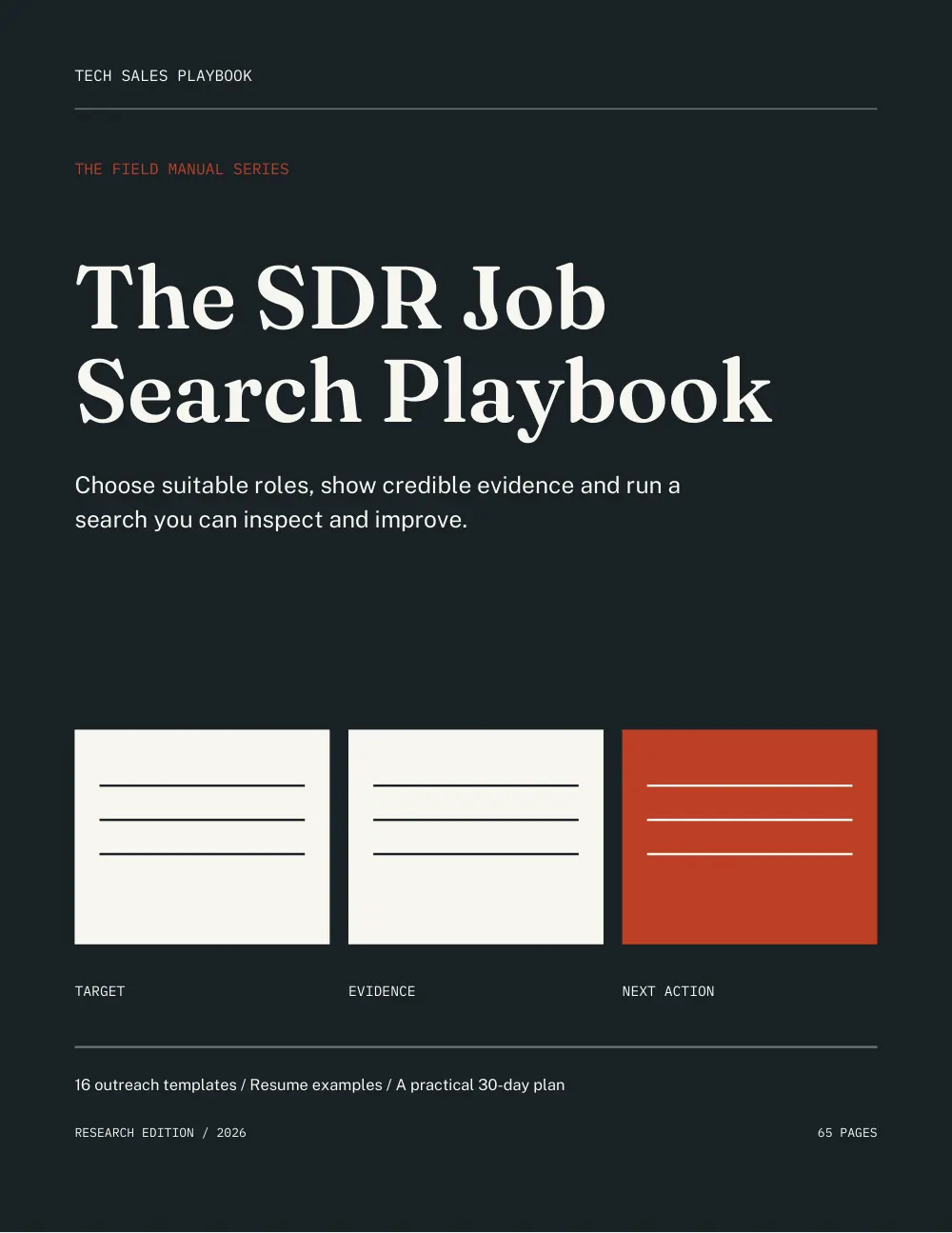
TECH SALES PLAYBOOK THE FIELD MANUAL SERIES The SDR Job Search Playbook Choose suitable roles, show credible evidence and run a search you can inspect and improve. TARGET EVIDENCE NEXT ACTION 16 outreach templates / Resume examples / A practical 30-day plan RESEARCH EDITION / 2026 65 PAGES
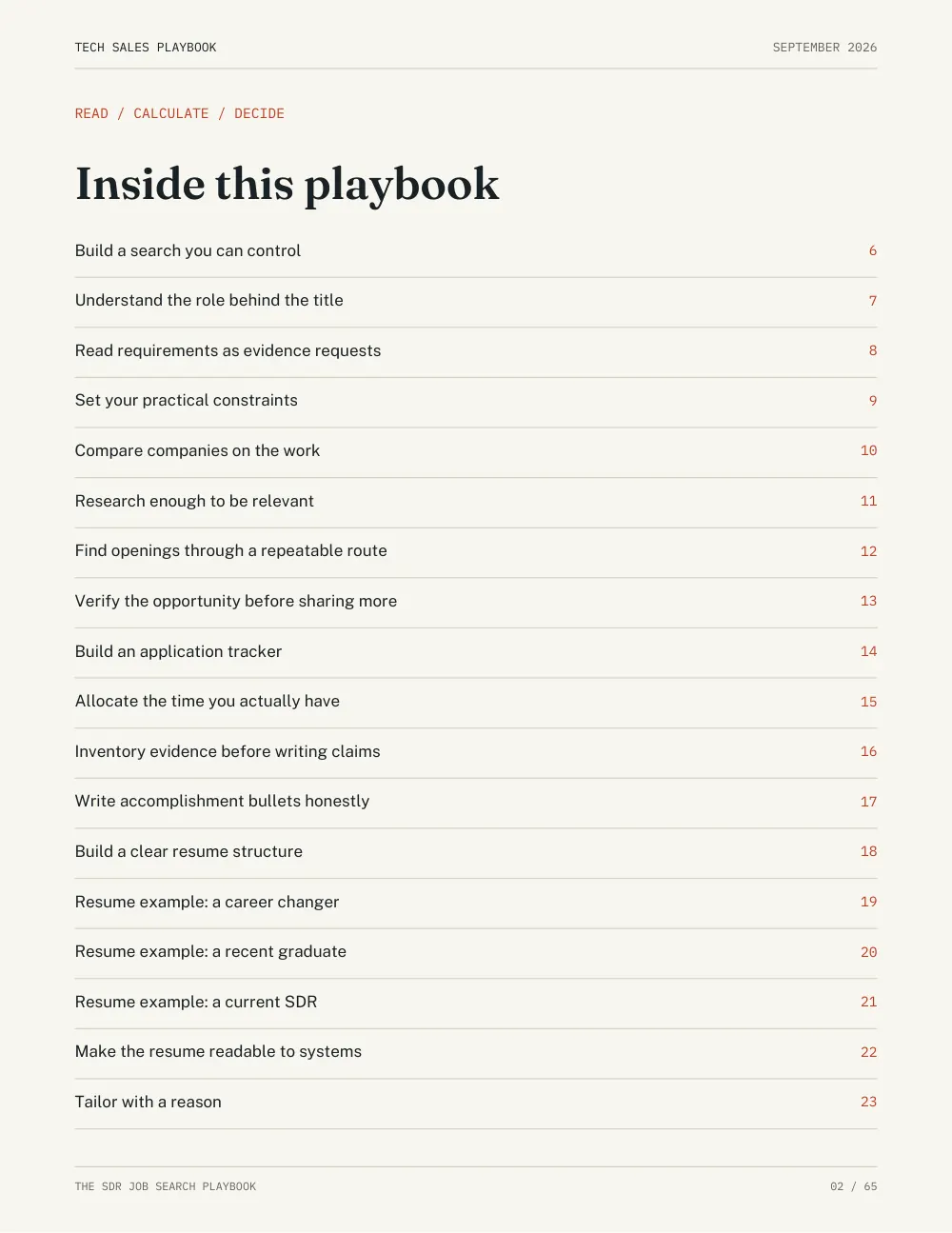
TECH SALES PLAYBOOK SEPTEMBER 2026 THE SDR JOB SEARCH PLAYBOOK 02 / 65 READ / CALCULATE / DECIDE Inside this playbook Build a search you can control 6 Understand the role behind the title 7 Read requirements as evidence requests 8 Set your practical constraints 9 Compare companies on the work 10 Research enough to be relevant 11 Find openings through a repeatable route 12 Verify the opportunity before sharing more 13 Build an application tracker 14 Allocate the time you actually have 15 Inventory evidence before writing claims 16 Write accomplishment bullets honestly 17 Build a clear resume structure 18 Resume example: a career changer 19 Resume example: a recent graduate 20 Resume example: a current SDR 21 Make the resume readable to systems 22 Tailor with a reason 23
TECH SALES PLAYBOOK SEPTEMBER 2026 THE SDR JOB SEARCH PLAYBOOK 03 / 65 READ / CALCULATE / DECIDE Tools for the decision Write a useful profile headline 24 Build an About section with evidence 25 Show selected work clearly 26 Choose profile visibility deliberately 27 Map a network you can approach respectfully 28 Run an informational conversation 29 Ask for a referral without overstating it 30 Build evidence when experience is limited 31 Complete a sample research exercise 32 Use outreach to make a clear request 33 Start a learning conversation 34 Use shared context respectfully 35 Make a referral easy to assess 36 Connect evidence to an opening 37 Follow the process clearly 38 Handle scheduling professionally 39 Communicate after the interview 40 Close the conversation well 41
TECH SALES PLAYBOOK SEPTEMBER 2026 THE SDR JOB SEARCH PLAYBOOK 04 / 65 READ / CALCULATE / DECIDE Tools for the decision Complete the application carefully 42 Follow up with a purpose 43 Prepare for the recruiter screen 44 Build a focused interview brief 45 Handle work assignments thoughtfully 46 Ask the questions behind an offer 47 Calculate compensation correctly 48 Compare offers under explicit assumptions 49 Make and communicate the decision 50 Prepare for the first month 51 Measure the search pipeline consistently 52 Diagnose before changing everything 53 Change one thing carefully 54 Work through Maya's search decision 55 Thirty-day plan: establish the foundation 56 Thirty-day plan: apply and learn 57 Thirty-day plan: inspect and adjust 58 Search while employed 59
TECH SALES PLAYBOOK SEPTEMBER 2026 THE SDR JOB SEARCH PLAYBOOK 05 / 65 READ / CALCULATE / DECIDE Tools for the decision Keep the plan sustainable 60 Use AI as a reviewed assistant 61 Worksheet: the role brief 62 Worksheet: the opportunity record 63 Worksheet: the weekly review 64 Sources and edition notes 65
TECH SALES PLAYBOOK SEPTEMBER 2026 THE SDR JOB SEARCH PLAYBOOK 06 / 65 01 / START HERE Build a search you can control A job search contains work you can control and decisions you cannot. You can choose roles carefully, present accurate evidence, prepare for interviews and follow through professionally. You cannot guarantee an employer's headcount, timing or selection decision. Build a system around the first group and track the second honestly. This playbook is for first-time SDR and BDR candidates, career changers, graduates and current reps seeking another development role. It covers targeting, research, resumes, profiles, networking, applications, interview preparation, offers and the transition into work. It assumes a US-focused technology-sales search; verify location and work requirements for each opening. What you will build A role brief, company comparison and prioritized target list. Evidence-based resume bullets and profile copy, with three fictional background examples. A small work-sample portfolio clearly distinguished from employment results. Sixteen outreach and follow-up templates with conditions for use. An application tracker, funnel review and flexible thirty-day activity plan. Offer questions, worked compensation scenarios and three reusable worksheets. The examples, counts, scripts and schedules are original educational material. Fictional candidates are not testimonials. No page promises a hiring deadline, referral multiplier, ATS pass rate or guaranteed income. Platform-specific statements have linked source notes and may change after this edition. Use the book in working sessions. Complete a tool, apply it to an actual role and inspect the result before adding more activity. A large spreadsheet of companies is not progress if you cannot explain which roles fit or what to do next. Start with one sentence: I am seeking [role type] in [location/work arrangement], where my evidence in [skills] matches the work described. Then test that sentence against real openings.
TECH SALES PLAYBOOK SEPTEMBER 2026 THE SDR JOB SEARCH PLAYBOOK 07 / 65 02 / SDR AND BDR TARGETING Understand the role behind the title Read the duties rather than relying on the title alone. An SDR or BDR role may emphasize inbound qualification, outbound prospecting, a particular customer segment or a mixture of responsibilities. Employers use titles differently, so confirm how the work is organized. Identify who the rep contacts, through which channels, for what next step and under what qualification criteria. Ask how the role partners with AEs, marketing and sales operations. These details affect what evidence you should present and what the day-to-day work would involve. Posting detail Question it helps answer Inbound or outbound mix Will you respond to requests, create new conversations or both? Target customer Which business problems and roles must you understand? Success measures Are meetings, accepted opportunities or other outcomes assessed? Territory and accounts What scope would you own, and how are accounts assigned? Coaching and ramp How will you learn the product, process and expectations? An entry-level label does not tell you whether the role is suitable for your circumstances. Review travel, schedule, location, work authorization, compensation and required experience separately. A prestigious company can still offer a role that does not fit your constraints. For a current SDR, compare the actual work with your experience. A strong inbound record does not automatically prove outbound prospecting skill; describe the distinction and show relevant practice or results where available. Write the role in plain language before applying: This team needs someone to contact operations leaders, identify relevant workflow issues and create qualified next conversations. That explanation should guide your resume and interview preparation.
TECH SALES PLAYBOOK SEPTEMBER 2026 THE SDR JOB SEARCH PLAYBOOK 08 / 65 03 / THE JOB-DESCRIPTION MAP Read requirements as evidence requests Separate stated requirements, preferred experience and unclear language. Then map each important responsibility to evidence you can honestly provide. A posting is a source of questions as well as a list of qualifications. Original requirement map Employer asks for Evidence you might have Clear communication Customer explanation, teaching, service recovery or a relevant work sample. Organized follow-up Documented case tracking, project coordination or scheduling responsibility. Rejection and persistence A real example of adapting after setbacks without ignoring boundaries. Research A concise account brief using verified public information. Coachability A specific correction you received and the behavior you changed. Do not rename unrelated work as sales experience. Explain the transferable behavior and acknowledge what is new. “Handled customer questions and documented follow-up” can be credible. “Owned enterprise pipeline” is not credible if you have never done that work. For a requirement you do not meet, decide whether it is a clear eligibility barrier, a skill gap you can address or an ambiguity to ask about. Do not invent a universal rule that candidates should apply at a particular percentage match. The importance of each requirement differs. If the role requires a specific license, location or authorization, verify that condition before investing heavily. If wording is unclear, ask through the employer's appropriate channel. Do not assume a preferred qualification is mandatory or a mandatory one is negotiable without evidence. Finish with three strongest matches, one material gap and a question for the recruiter. That compact assessment is more useful than copying every keyword into your resume without understanding the work.
TECH SALES PLAYBOOK SEPTEMBER 2026 THE SDR JOB SEARCH PLAYBOOK 09 / 65 04 / DEFINE A WORKABLE SEARCH Set your practical constraints Write down the conditions that make a role feasible: location, schedule, work arrangement, travel, start timing and minimum dependable income. Distinguish firm constraints from preferences so you do not reject a useful role for a minor difference or accept an unworkable one because the title sounds attractive. Three categories Required: a condition you must meet, such as a compatible location or schedule. Preferred: something you value but can trade off. Unknown: a material fact you need to verify with the employer. Use dependable income carefully. Advertised OTE includes at-target variable pay; it is not a guaranteed paycheck. If you need a particular cash floor, compare the written base and any verified guarantee terms, not an optimistic commission scenario. The compensation modules later in the book show the distinction. Before I invest in the process, could you confirm the work location, expected schedule and base/variable structure for this opening? Ask concise questions when the posting leaves a material issue unclear. You do not need to disclose unnecessary personal details to explain every constraint. State the work condition you need to assess. For an employed candidate, include interview availability and an appropriate transition period. For a caregiver, student or person managing other obligations, build a search schedule that fits actual capacity. A plan requiring hours you do not have will become a source of inaccurate tracking rather than useful discipline. Review the constraints when circumstances change. Keep a note of why you declined a role so you can distinguish a practical mismatch from an application that needs better evidence or preparation.
TECH SALES PLAYBOOK SEPTEMBER 2026 THE SDR JOB SEARCH PLAYBOOK 10 / 65 05 / AN ORIGINAL TARGETING RUBRIC Compare companies on the work Use a short rubric to organize research, not to produce a supposedly objective hiring probability. Score each dimension 0 for a poor fit or unresolved concern, 1 for partial evidence and 2 for a clear fit. Keep important unknowns visible beside the number. Dimension Evidence to seek Role fit Responsibilities match your target and strongest evidence. Practical fit Location, schedule and employment conditions work for you. Product understanding You can explain the customer problem and why the product is relevant. Learning environment Specific coaching, ramp and support information. Compensation clarity Written base/variable structure and understandable success measures. Hiring process A verifiable opening and a clear application route. The maximum is twelve, but there is no universal accept/apply threshold. A high total cannot cancel a deal-breaking location mismatch or a serious legitimacy concern. Use the score to compare where you should spend research time next. Fictional comparison Company A has clear duties and compatible location, but ramp support is unknown. Company B has an attractive product and a higher advertised OTE, but the base and work arrangement are unclear. The next action is to resolve the material unknowns, not automatically choose B's larger headline number. Use direct employer information where possible and treat employee anecdotes as perspective, not a representative dataset. Ask about team structure and current expectations rather than assuming a review from another year or department applies. Revisit the rubric after recruiter and manager conversations. A company can move up or down as evidence improves. The tool should help you ask better questions and allocate effort, not conceal uncertainty behind a decimal score.
TECH SALES PLAYBOOK SEPTEMBER 2026 THE SDR JOB SEARCH PLAYBOOK 11 / 65 06 / THE COMPANY BRIEF Research enough to be relevant Create a one-page brief for a high-priority role. Include the product, target customer, problem addressed, sales motion described in the posting and one reason your evidence fits the work. Link the sources and record the date. Separate observation from inference. A company announcing a new product is a fact if verified. Your belief that the SDR team will target a new buyer group is a hypothesis until confirmed. Use the hypothesis as a question rather than stating it as inside knowledge. Original brief example Fictional Cedar Systems provides workflow software to operations teams. Its SDR posting emphasizes outbound research and clear AE handoffs. Candidate Maya has customer-service follow-up experience and a labeled account-research exercise. Her question: How does the team decide whether a first conversation is ready for an AE? Do not manufacture personal affinity or claim to have used a product you have not used. A specific reason for interest can be modest: the customer problem is understandable, the role emphasizes a skill you want to develop and the available evidence suggests a plausible match. The posting emphasizes research and handoff quality. I have experience documenting customer follow-up, and I built a short research exercise to practice the account-selection part. I would like to understand how those skills are assessed on your team. Stop researching when you can explain the role and ask a useful question. Additional hours reading company news may not improve the application. Save deeper preparation for a scheduled interview, where the specific stage and participants tell you what further work matters.
TECH SALES PLAYBOOK SEPTEMBER 2026 THE SDR JOB SEARCH PLAYBOOK 12 / 65 07 / JOB BOARDS AND COMPANY LISTS Find openings through a repeatable route Use job boards and professional networks to discover possibilities, then verify the opening through the employer's official careers route. Search by several relevant titles and the actual work, because title conventions vary. Keep location and employment conditions in the search rather than filtering them only after applying. A practical sourcing loop Start with a small group of companies whose products and roles you can understand. Check their careers pages and any relevant job-board results. Record the requisition identifier, location, application link, date checked and important requirements. Remove duplicates before counting new opportunities. Searches might combine sales development representative, business development representative, inbound qualification or outbound prospecting with your location and preferred sector. Verify that a business-development role is actually the sales-development work you want; some titles refer to partnerships or other responsibilities. Set a manageable review rhythm. You do not need to refresh every board all day. Reserve time to assess fit, complete good applications and follow through on active interviews. Discovery volume is useful only when it feeds a workable process. If a posting appears on a board but not on the employer's site, investigate through an official contact route. It may be closed, managed by an authorized agency or simply outdated. Do not assume either legitimacy or fraud from that mismatch alone. Keep a separate watchlist for companies without a current suitable role. A watchlist is not an application pipeline. Record the trigger for checking again, such as a scheduled careers-page review, so speculative interest does not inflate your active search counts. Avoid paying for access merely because a service promises exclusive openings. Evaluate the actual service, terms and evidence before spending money on a search tool.
TECH SALES PLAYBOOK SEPTEMBER 2026 THE SDR JOB SEARCH PLAYBOOK 13 / 65 08 / JOB-SCAM CHECKS Verify the opportunity before sharing more The FTC's job-scam guidance warns about payment demands, fake checks and schemes seeking personal information. A message using a real company's name is not proof that the sender represents it. Verify the role and contact through an independently located official route. Pause if someone asks you to pay to obtain a job or deposit a check and send money onward. The FTC explains that an apparently available check balance does not prove the check is valid. Do not buy equipment or transfer funds on that basis. A practical verification sequence Check the company careers page and requisition. Confirm the recruiter's identity through the company's published contact process when needed. Inspect the actual destination of application and onboarding links. Treat unexpected requests for financial or identity information with care until the employer and stage are verified. Legitimate onboarding may eventually require sensitive information. The question is whether the employer, request and secure process are authentic and appropriate to the stage. A polished logo or familiar job-board interface is not enough evidence. I would like to verify the opening and the requested onboarding process through the company's official contact route before providing additional information. If you suspect a scam, stop the interaction and preserve relevant records. Use the FTC's reporting and recovery guidance as applicable. If you already sent money, contact the payment provider promptly and ask what recovery options exist. Do not turn a lack of online complaints into proof that an opportunity is safe. Verification is a decision based on the actual sender, role and process. The purpose is to protect your search and information while continuing with credible opportunities.
TECH SALES PLAYBOOK SEPTEMBER 2026 THE SDR JOB SEARCH PLAYBOOK 14 / 65 09 / ONE RECORD PER OPENING Build an application tracker Track the opening rather than creating a new row for every message. A single role may involve an application, referral, recruiter exchange and several interviews. Link those activities to one record so your totals do not confuse contacts with opportunities. Field What to record Role identity Company, title, requisition, location and verified application URL. Fit Required conditions, strongest evidence and material gaps. Application Submission date, resume version and requested materials. Contact history Person, channel, date, purpose and actual response. Current stage Applied, screen scheduled, interview, assessment, offer or closed. Next action Specific task, owner and due date or waiting condition. Outcome Decision, date and feedback separated from your interpretation. Use a spreadsheet, document table or a tool you already manage well. You do not need a complex CRM to begin. Avoid storing sensitive identity documents or unnecessary private information in a broadly shared tracker. Original row Cedar Systems SDR, requisition C104, location confirmed. Applied September 8 using Maya-resume-v2. Status: submitted, acknowledgement received. Next action: follow the published process and prepare questions for a conversation if invited. Coaching and compensation details still to confirm. Keep stage definitions simple and consistent. A recruiter viewing your profile is not a scheduled screen. An automated application acknowledgment is not a positive hiring response. A networking conversation is not an interview unless the employer says it is part of the process. Review overdue actions and stale records at a regular time. A tracker should make the next useful task obvious, not become a place where unanswered applications remain active forever without a review date.
TECH SALES PLAYBOOK SEPTEMBER 2026 THE SDR JOB SEARCH PLAYBOOK 15 / 65 10 / A WEEKLY OPERATING PLAN Allocate the time you actually have Begin with available time, then choose a balanced set of tasks. A search needs sourcing, applications, relationships, practice and review. Spending every hour on only one of those can leave an important part of the process unattended. Original six-hour week Work Minutes Role sourcing and company research 90 Tailored applications 90 Networking and appropriate follow-up 60 Interview and work-sample practice 60 Tracker review and next-week planning 60 The total is 360 minutes, or six hours. This is an illustrative allocation, not an optimal formula or an application quota. A scheduled interview may justify shifting time toward preparation. A weak target list may require more sourcing first. Write the intended output for each block: two role assessments, one reviewed application, a practiced answer with feedback or a corrected tracker. “Work on job search” is too vague to evaluate afterward. If you have less time, reduce the scope rather than assuming you can perform the same work faster indefinitely. If you have more time, add useful evidence and practice before simply multiplying messages. Reserve time for promised follow-through. A thoughtful networking request loses value if you do not attend the agreed conversation or send the material requested. Keep your calendar and tracker aligned. At the end of the week, compare planned and completed outputs without moralizing the difference. Identify the practical cause: unclear task, underestimated effort, changed obligations or a new interview. Adjust the next plan using that evidence. Consistency comes from a workable schedule, not a permanently unrealistic one.
TECH SALES PLAYBOOK SEPTEMBER 2026 THE SDR JOB SEARCH PLAYBOOK 16 / 65 11 / YOUR EXPERIENCE BANK Inventory evidence before writing claims List real situations in which you researched, communicated, organized work, handled setbacks, learned a process or acted on feedback. Include employment, education, volunteering and personal projects, clearly labeled. The goal is to find evidence, not to make every activity sound like revenue ownership. For each situation, record the context, your responsibility, action, outcome and what you can verify. Distinguish what you did from what the team achieved. If a number is estimated, decide whether it is reliable enough to use and label it appropriately when needed. Original evidence prompts When did you explain something complex to a customer or colleague? When did you track follow-up so an issue did not disappear? When did you change your approach after feedback? When did a setback require a different plan rather than more repetition? When did you research a decision and explain the reasoning? A retail candidate might have handled returns and documented unresolved cases. A graduate might have coordinated sponsor outreach for a student event. A current SDR might have improved handoff quality under a defined process. Those are different kinds of evidence; none needs to be disguised as another. Keep confidential employer or customer information out of application materials. Use permitted summaries and aggregate information when appropriate. Do not bring internal customer lists, recordings or proprietary dashboards into a portfolio without authorization. Choose a few strong examples and prepare to explain them in detail. A recruiter can ask what you actually did, how the result was measured and what you learned. A claim is useful when you can answer those questions accurately, not merely when it sounds impressive on the page.
TECH SALES PLAYBOOK SEPTEMBER 2026 THE SDR JOB SEARCH PLAYBOOK 17 / 65 12 / ACTION, CONTEXT AND RESULT Write accomplishment bullets honestly Write what you did, in what context and with what observable result. Use a number only when it adds meaning and you can support it. A specific qualitative result is better than a fabricated percentage. Before and after - fictional examples Before: Responsible for customer service. After: Resolved customer order questions, documented unresolved cases and coordinated follow-up with the fulfillment team. Before: Great communicator and team player. After: Created a handoff checklist for weekend staff and used it to clarify open customer issues at shift changes. Before: Increased sales by 40%. After, when only contribution is known: Supported a store promotion by explaining product options and tracking customer questions for the manager. Do not claim the total sales increase as your individual result without evidence of that responsibility and measurement. Add scope carefully If records support the count, a fictional candidate could write: Researched 24 potential event sponsors across a six-week student project. The count and period clarify scope; they do not turn the project into paid sales employment. Avoid importing unfamiliar jargon into a bullet solely because it appears in an SDR posting. If you tracked service cases, say that. You can explain its relevance to organized follow-up in your summary or interview. Read each bullet aloud and answer three questions: What did I personally do? How do I know the outcome? Why is this relevant to the role? If a sentence cannot survive those questions, revise it before sending. Keep the underlying evidence in your private preparation notes so later tailoring does not gradually inflate the claim.
TECH SALES PLAYBOOK SEPTEMBER 2026 THE SDR JOB SEARCH PLAYBOOK 18 / 65 13 / MAKE THE EVIDENCE EASY TO FIND Build a clear resume structure Use a straightforward document with your name and contact information in normal body text, clear section headings and consistent dates. Put the most relevant evidence where a reader can find it quickly. Follow the employer's requested file type and application instructions. A practical structure Contact information and location; a concise role-focused summary if it adds useful context; relevant experience; clearly labeled projects or volunteering; education; and skills you can actually demonstrate. The order can vary with your background and the role. Keep actual job titles and employers accurate. If a title is obscure, add a plain-language explanation without changing the official role into something it was not. Use full, understandable terms where abbreviations would confuse the reader. Summary example - fictional Customer-service professional moving into sales development. Experience explaining product options, organizing unresolved customer follow-up and improving shift handoffs. Building prospect research and cold-call skills through clearly labeled practice work. This summary explains the transition and the evidence. It does not claim the candidate already owns a sales pipeline or guarantees they will be a top performer. Choose length based on relevant content and readability rather than padding or shrinking text to meet a mythical universal rule. Remove repeated claims, unrelated detail and unsupported skill lists. A reader should be able to understand the work and ask a sensible follow-up question. Before exporting, check dates, spelling, links and consistency with the application form. A polished layout does not compensate for contradictory employment history. Keep a master version and save role-specific copies so you can reconstruct exactly what you submitted.
TECH SALES PLAYBOOK SEPTEMBER 2026 THE SDR JOB SEARCH PLAYBOOK 19 / 65 14 / MAYA'S EVIDENCE Resume example: a career changer Maya is a fictional customer-service associate applying to an outbound SDR role. The example illustrates positioning; it is not a resume to copy as your own history. Replace every fact with evidence you can support. Profile Customer-service associate transitioning to sales development, with experience explaining options, documenting unresolved questions and coordinating follow-up. Interested in roles combining account research, clear communication and structured coaching. Relevant experience Explained product and order options to customers, clarified questions and escalated issues outside the role's authority. Maintained a shared follow-up log so unresolved cases had an owner and next action. Introduced a shift-handoff checklist after feedback that open cases were difficult for the next associate to understand. Clearly labeled practice project Sales-development practice portfolio: researched a fictional target account using a supplied brief, drafted two outreach messages and recorded a simulated cold call. Revised the call after feedback to ask one question at a time. Why the example works The bullets show relevant behaviors without claiming paid SDR experience. The project demonstrates deliberate practice and separates simulation from customer results. Maya can explain the original feedback, what changed and what remains new to her. What still needs work She must learn the target employer's product, customer and qualification process. The resume does not prove outbound performance simply because she has service experience. In the interview, she should connect the transferable skills and be candid about that gap. For your version, choose one or two actual examples that match the posting's responsibilities. Do not invent a CRM tool, quota or revenue figure to make the transition sound complete before it is.
TECH SALES PLAYBOOK SEPTEMBER 2026 THE SDR JOB SEARCH PLAYBOOK 20 / 65 15 / ELI'S EVIDENCE Resume example: a recent graduate Eli is a fictional recent graduate whose relevant experience comes from a student organization and a part-time campus role. The purpose is to show the work accurately, not to disguise a project as employment. Profile Recent graduate seeking a sales-development role. Experience researching potential event sponsors, organizing outreach records and presenting recommendations to a student committee. Practicing account research and concise prospect communication. Student project Researched 24 potential sponsors for a campus event and recorded relevance, contact route and next action over six weeks. Drafted outreach for committee review and updated the tracker after responses; the committee, not Eli alone, approved the final sponsorship decisions. Presented a short review of which outreach questions received useful responses and proposed revisions for the next event. Part-time work Answered student questions at a campus service desk, clarified requests and routed unresolved issues to the appropriate office. Used a shared log to document outstanding follow-up. Why the example works The scope is specific and ownership is bounded. The sponsor count describes research, not signed revenue. The service role supports communication and follow-through. Neither activity is called enterprise account management. Eli should prepare one detailed story about a response that changed the outreach plan and one about feedback on the presentation. Those stories can demonstrate learning more credibly than a list of adjectives. If you lack a similar project, do not invent one. Build a small, ethical practice exercise and label it as such. The portfolio modules later in the book provide a way to demonstrate reasoning without contacting real prospects or claiming results that did not happen.
This is meant to be opened while you work. The sections are concrete enough to copy, practice, adapt, and reuse during applications, interviews, calls, and weekly execution.
SDR and BDR role targeting framework
Job-board and company-list workflow
Application tracking and weekly pipeline plan
Sixteen networking, referral, and follow-up templates
Three resume examples and profile positioning checks
Interview preparation and offer comparison scenarios
Thirty-day activity plan and three reusable worksheets
Build a tighter target-company list instead of spraying applications.
Run your job search like a sales pipeline with next steps and follow-up.
Use referral, recruiter, and LinkedIn messages that sound like a seller.
The sample exists so buyers can inspect the writing style, structure, and depth before purchase. If the sample feels useful, the full PDF continues with the same practical format.
What you are buying
Before you decide
Start with the question that matters to you. You can use the free material without making a purchase.
Try one relevant task first. If that resolves your immediate question, keep using the free resources. Inspect the book’s sample when you need more structured practice.
Try the related free resourceUse it when you need a better system for finding roles, applying, tracking, and following up.
Use this as a self-study routine, adjusting it to the material. Completing a session is not a certification or an assessment of hiring readiness.
Choose one book for a focused gap. Consider a bundle only if you will use its listed books; compare the exact contents and avoid paying twice for material you already own.
A PDF is self-directed preparation. Individual feedback on your own resume is a separate service with its own scope and availability.
Compare the resume serviceCheck the current price, included files, delivery instructions and refund terms before opening checkout.
Read the actual sample and file details on this page. If you need help with an order or access, contact support with your question rather than placing a second order.
Read purchase and refund termsAsk a product or access question$29 PDF download
$39 PDF download
$29 PDF download
$19 PDF download
$19 PDF download
$19 PDF download
$19 PDF download
$19 PDF download
$19 PDF download