How a recoverable commission draw changes your first sales paycheck
A draw can move cash forward while leaving future commissions to cover the advance. The word guarantee is insufficient to model it.
Photo by Annie Spratt on Unsplash
Loading page…
Tactical field notes for breaking in, booking meetings, passing interviews, running discovery, negotiating compensation, and moving toward better tech sales roles.
A sales engineer’s occupational wage is a useful benchmark only after you identify what the employer calls base, variable and total pay.
Photo by Annie Spratt on Unsplash
The blog is organized like a working sales library: break in, book meetings, run interviews, handle discovery, evaluate comp, and move into AE or enterprise selling.
143
free guides
19
sales topics
143 guides
A draw can move cash forward while leaving future commissions to cover the advance. The word guarantee is insufficient to model it.
Photo by Annie Spratt on Unsplash
The same contract can produce very different earnings depending on which revenue measure receives credit.
Photo by Annie Spratt on Unsplash
When variable pay mixes team and individual performance, personal wins only move one part of the check.
Photo by Annie Spratt on Unsplash
Two teams may both quote a meeting rate while paying for different stages of the handoff. Follow one cohort through the actual rules.
Photo by Annie Spratt on Unsplash
A commission credited at signature may be reversed when a customer cancels inside the written window. Separate the original sale from its later adjustment.
Photo by Annie Spratt on Unsplash
A promotion date splits both pay and performance periods. A headline OTE for the new role rarely describes the actual transition year.
Photo by Annie Spratt on Unsplash
Expansion booked on one product can be offset by a contraction elsewhere in the account. Measure the account change the plan actually recognizes.
Photo by Annie Spratt on Unsplash
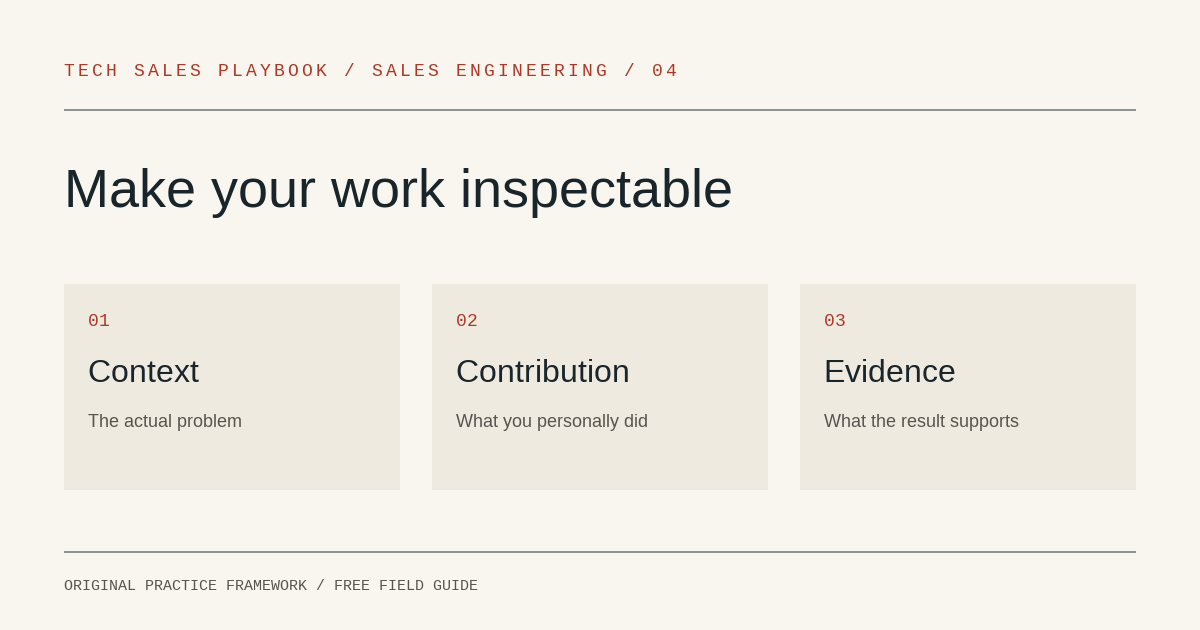
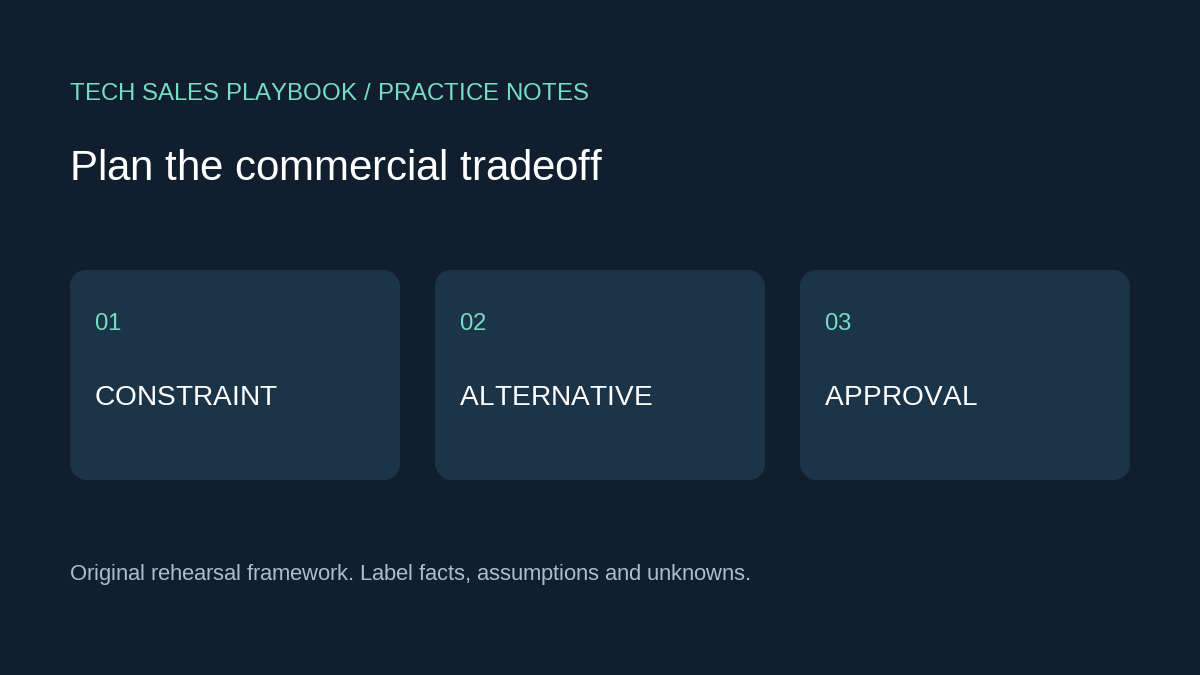
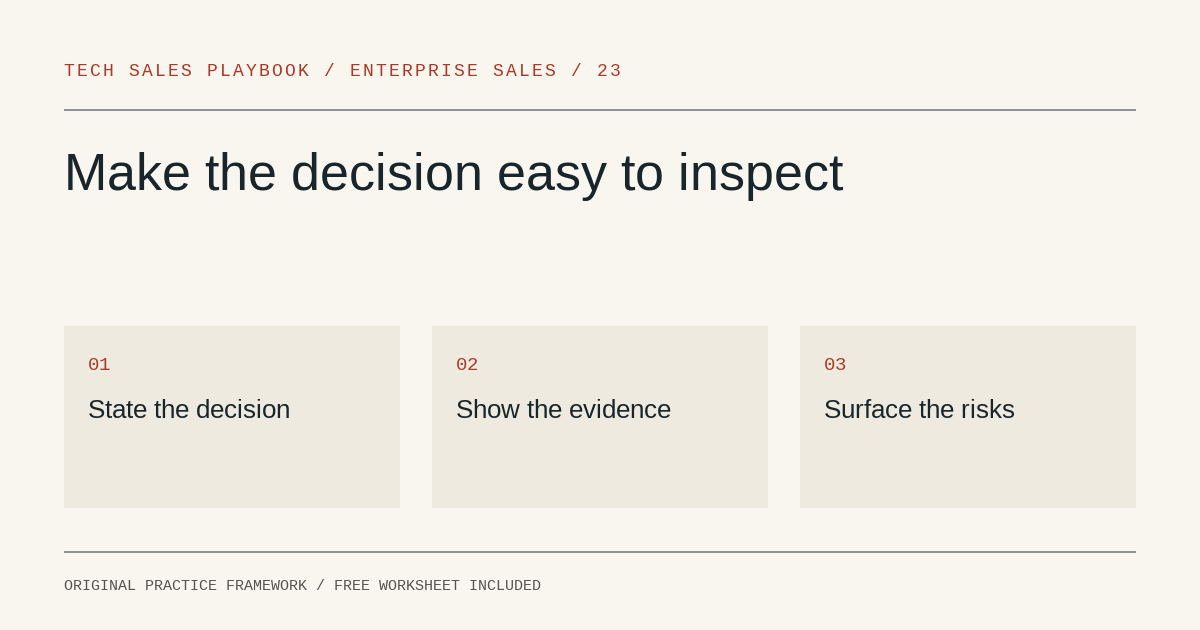
Prepare a concession worksheet with a fictional scope tradeoff, conditional language and a clear approval record.
Original practice diagram by Tech Sales Playbook.
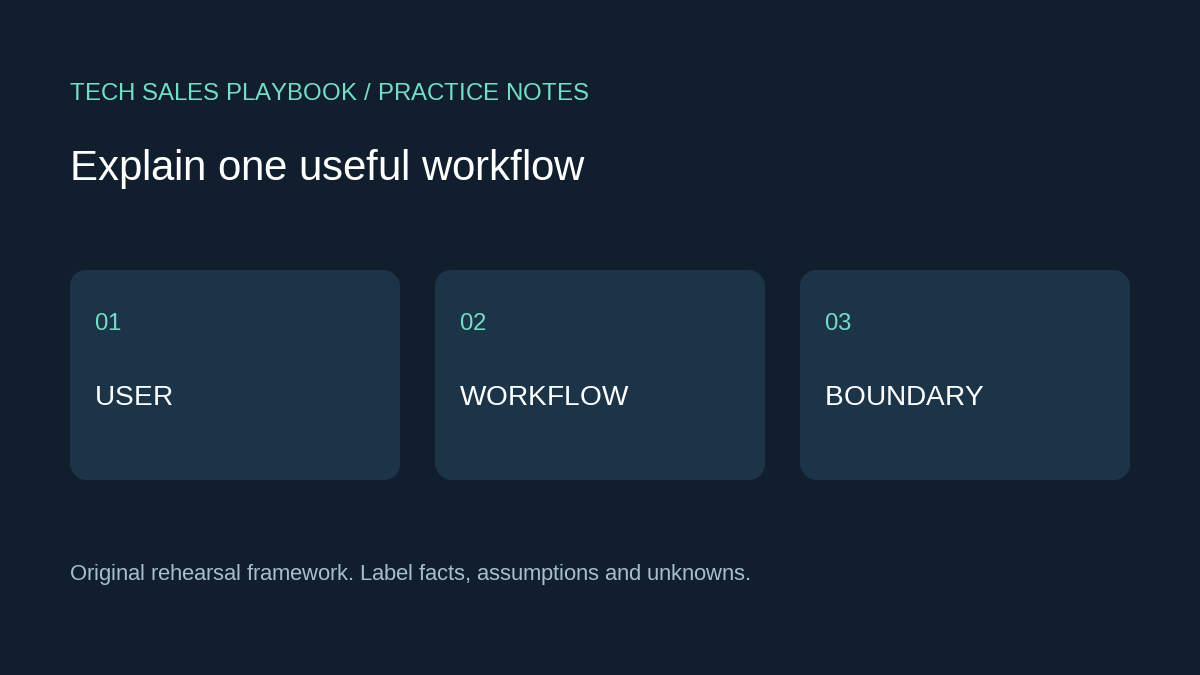
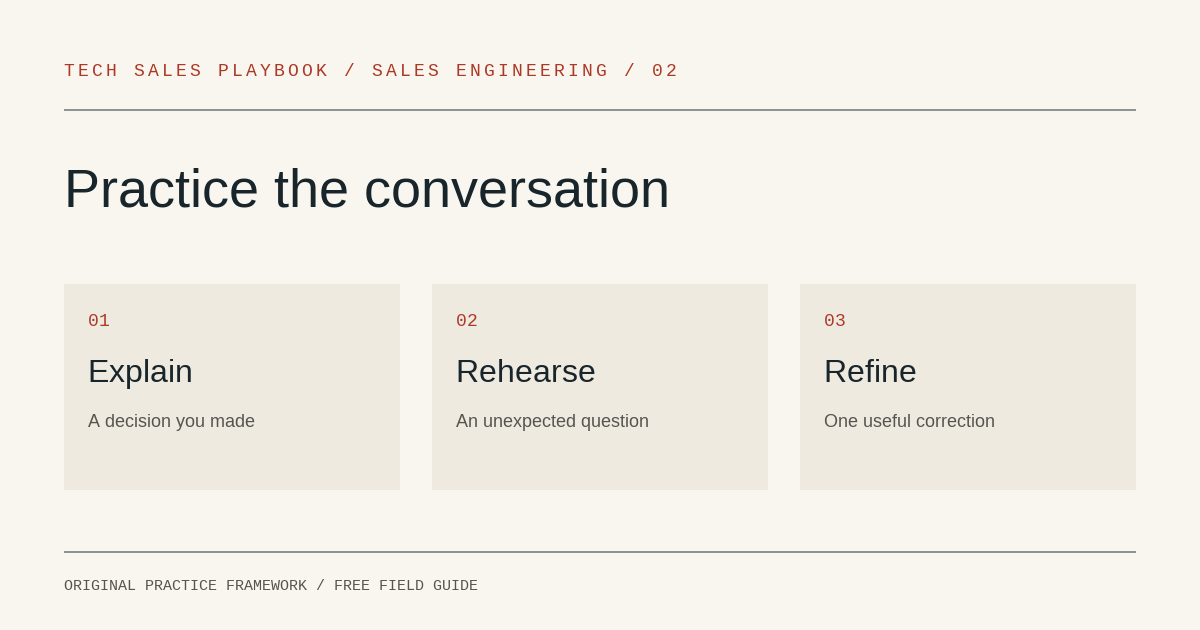
Practice explaining one product workflow with a timed outline, fictional example and listener comprehension check.
Original practice diagram by Tech Sales Playbook.
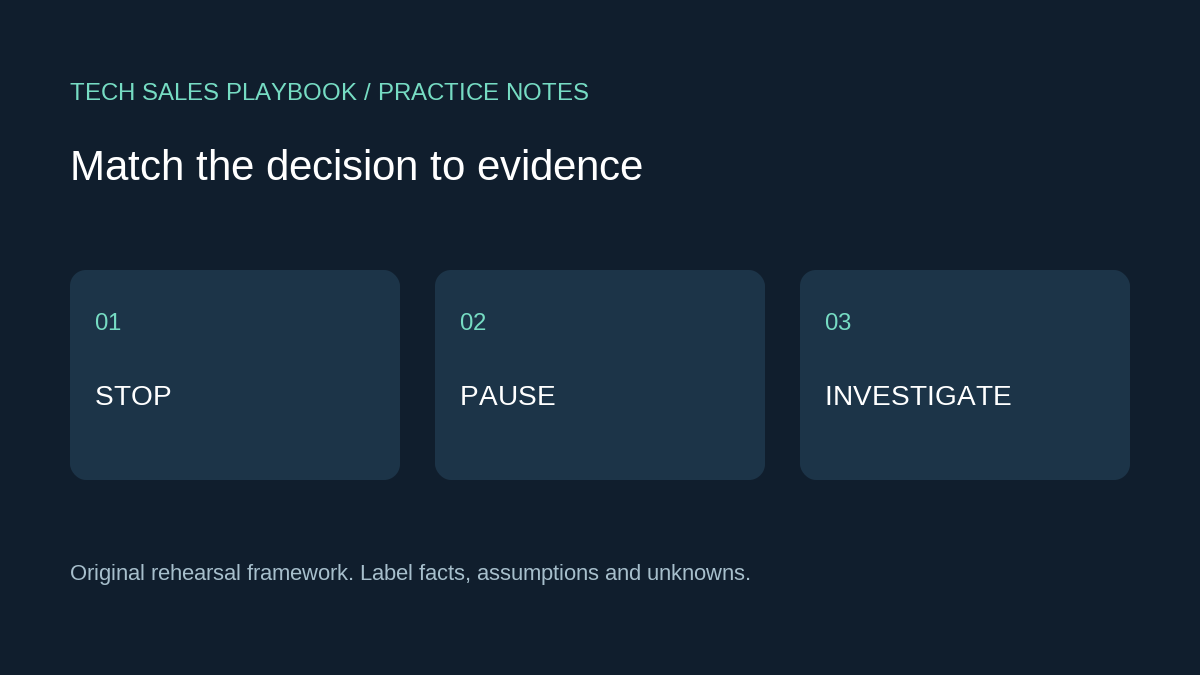
Distinguish confirmed fit problems from unknowns with three fictional cases and a copyable opportunity decision record.
Original practice diagram by Tech Sales Playbook.
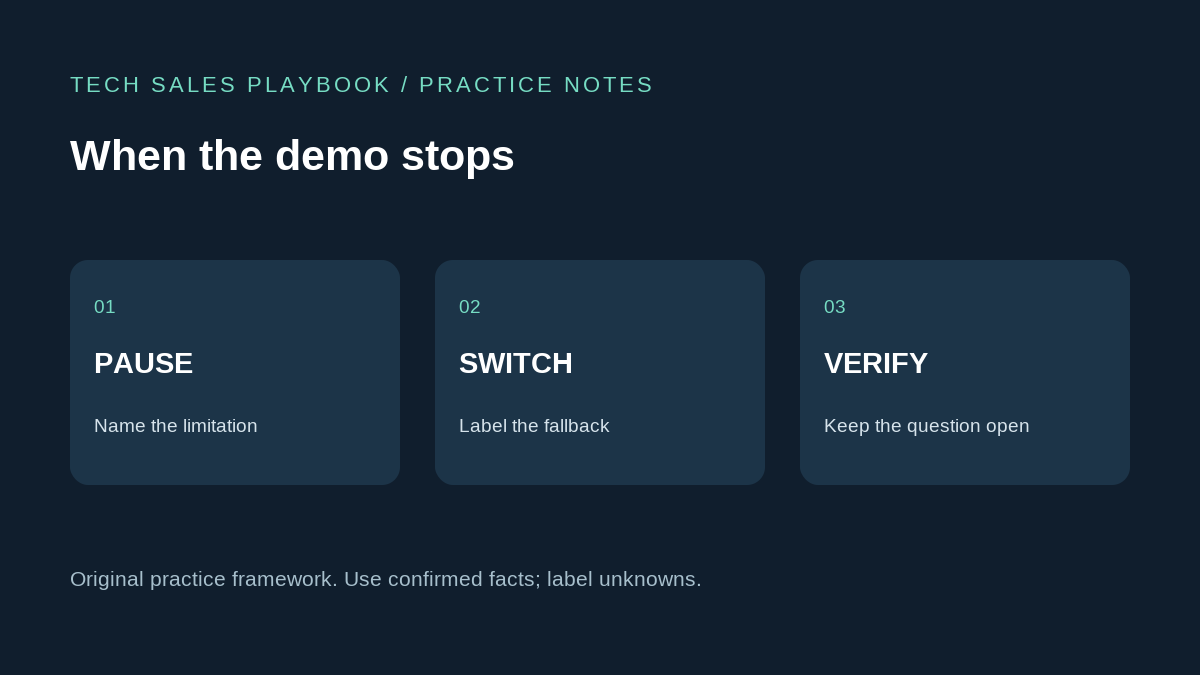
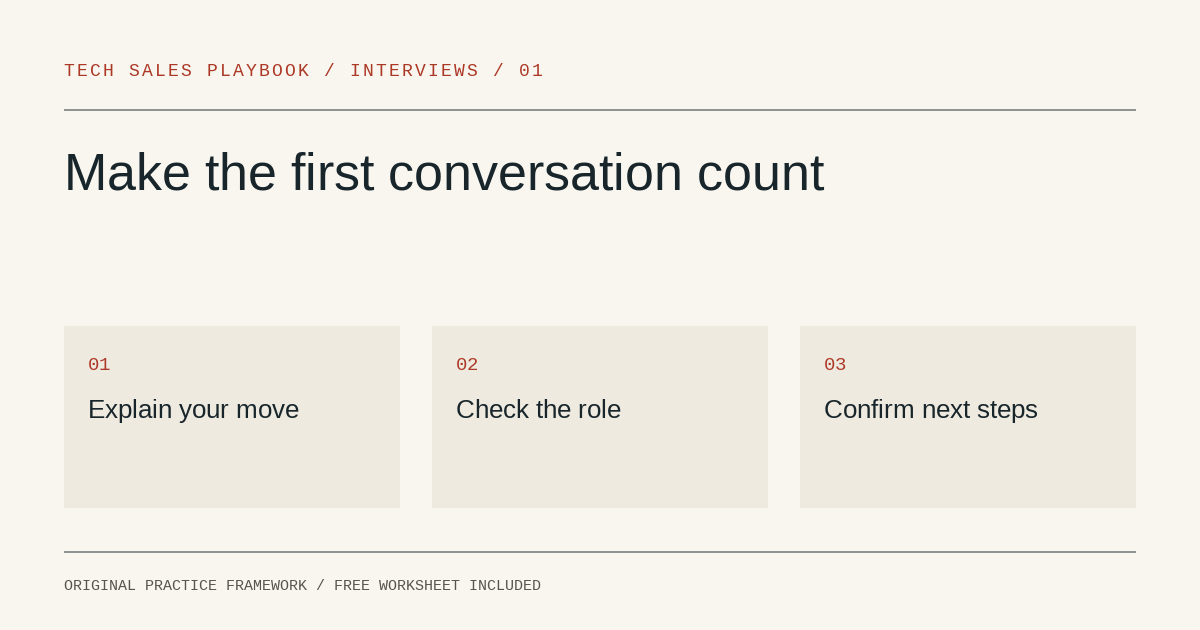
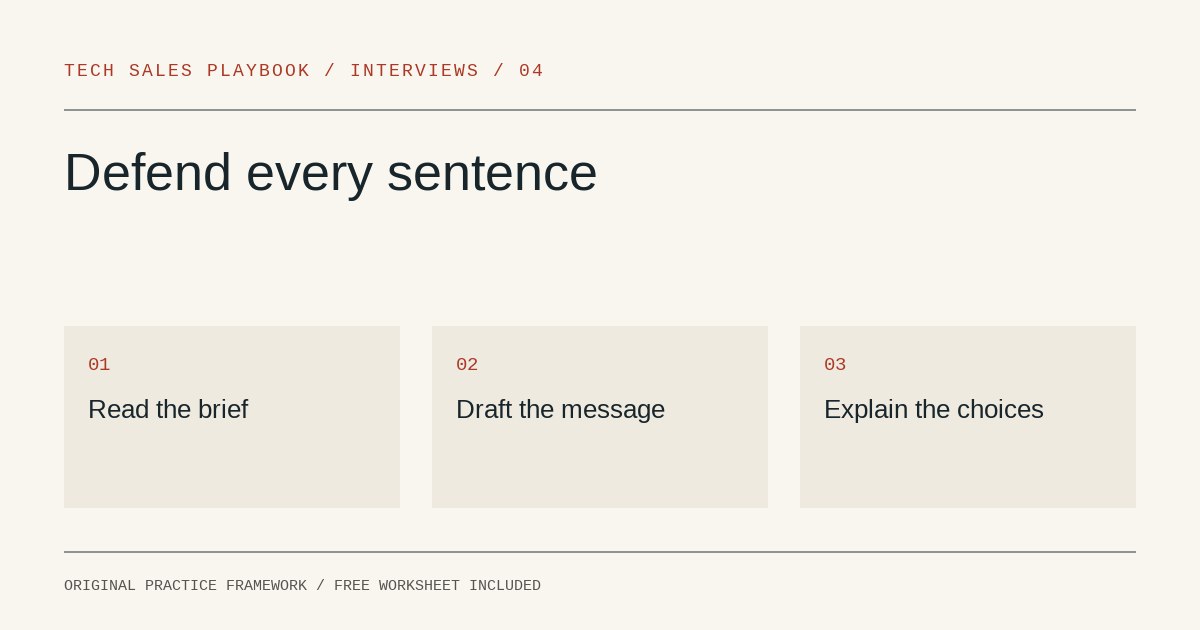
Prepare a fallback, explain what failed, distinguish recorded evidence from live proof, and agree on a useful follow-up with this fictional drill.
Original practice diagram by Tech Sales Playbook.
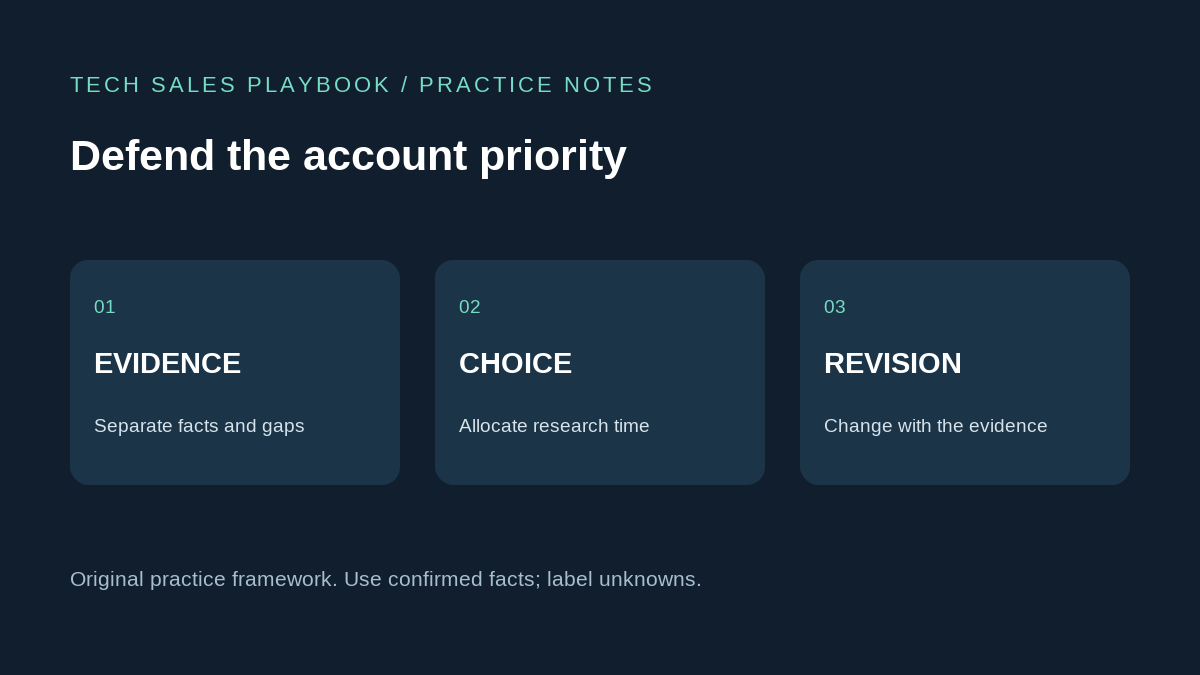
Build a defensible territory case with a fictional three-account comparison, explicit unknowns, a research budget and a revised priority after new evidence.
Original practice diagram by Tech Sales Playbook.
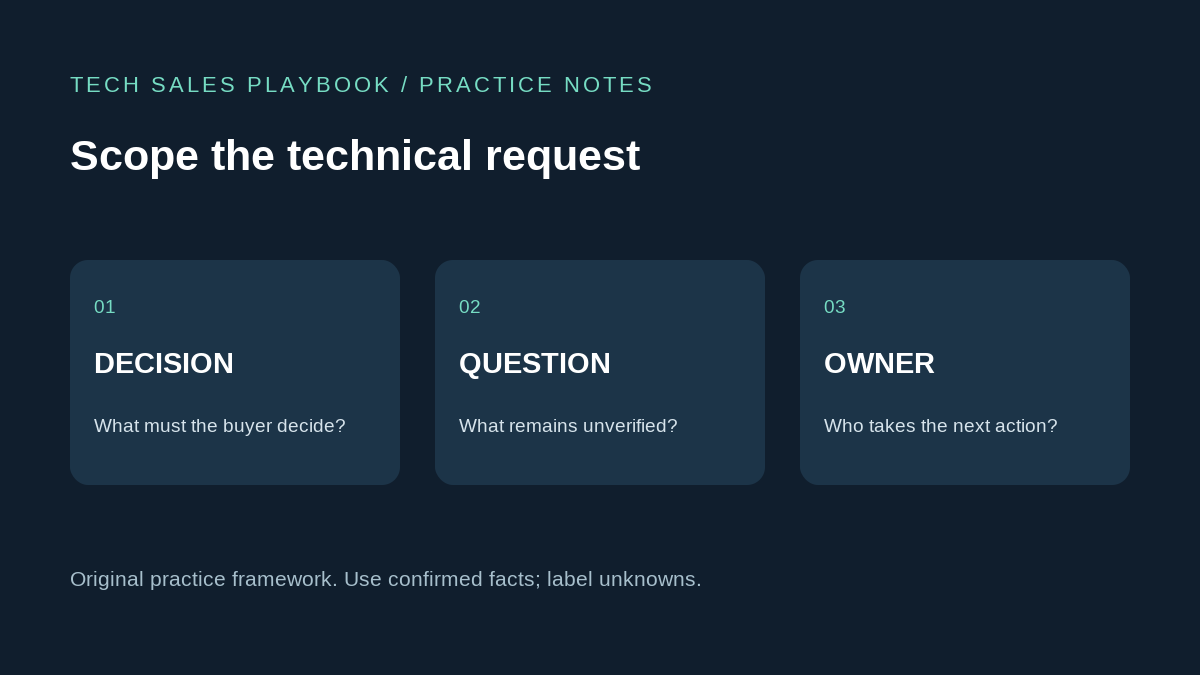
Replace a vague demo request with a buyer decision, known workflow, unresolved technical question, meeting roles and a clear acceptance check.
Original practice diagram by Tech Sales Playbook.
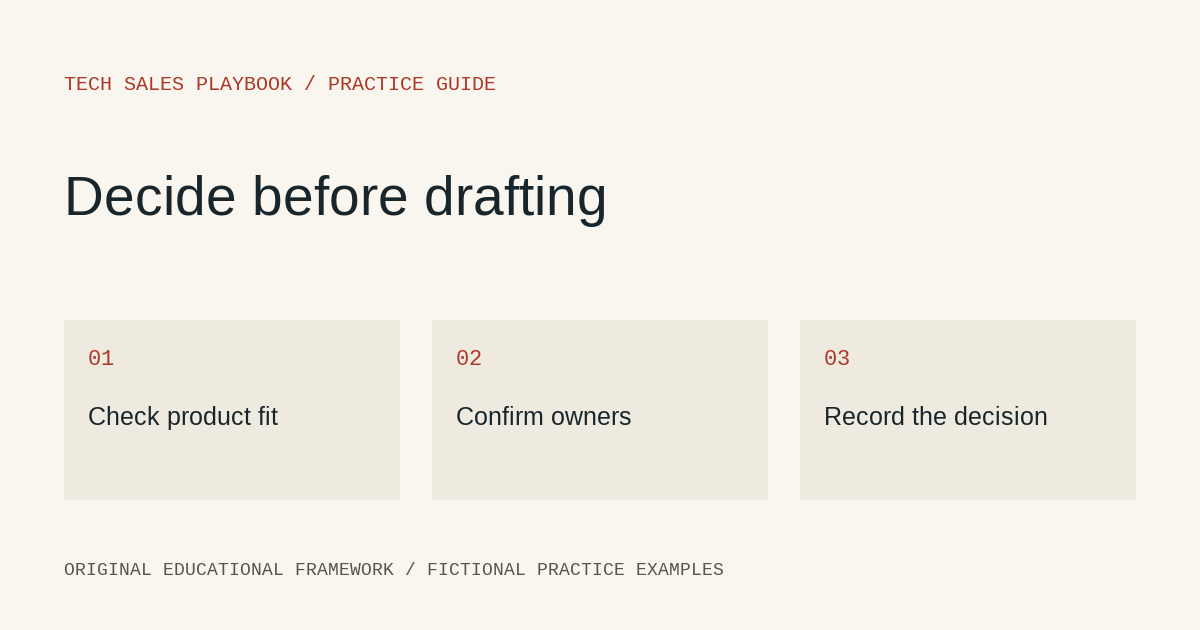
Decide whether to invest in an RFP with a requirements screen, an ownership check, and a fictional bid-decision example.
Original practice diagram by Tech Sales Playbook.
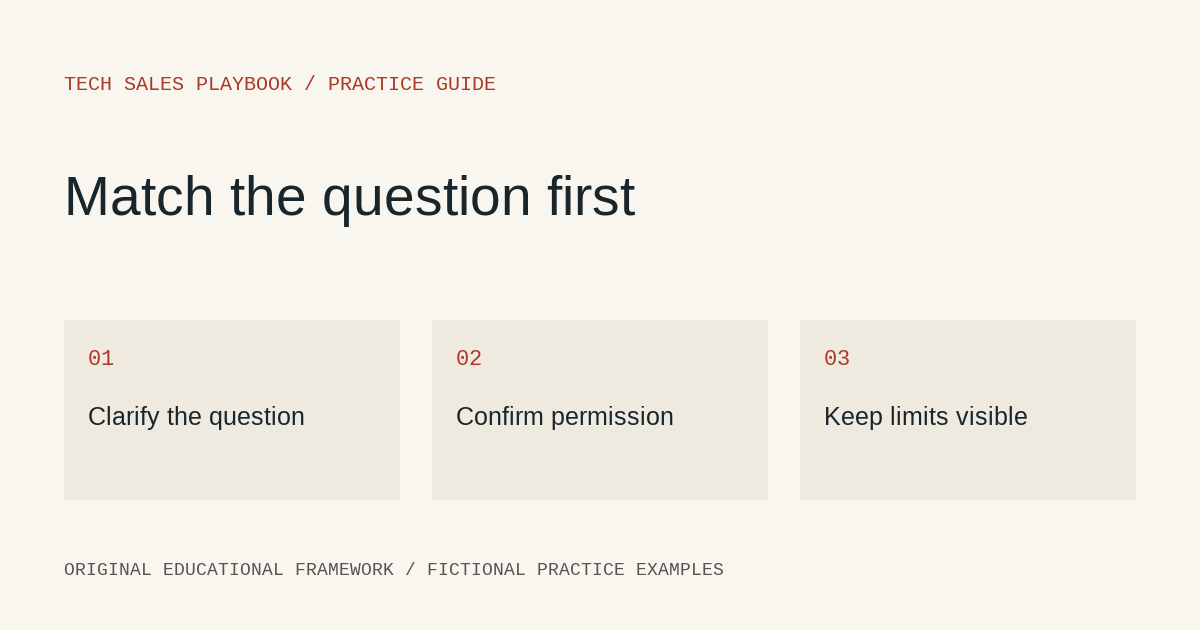
Plan a useful buyer-to-customer reference call with a question brief, permission checks, a neutral agenda, and clear limits on what one customer's experience proves.
Original practice diagram by Tech Sales Playbook.
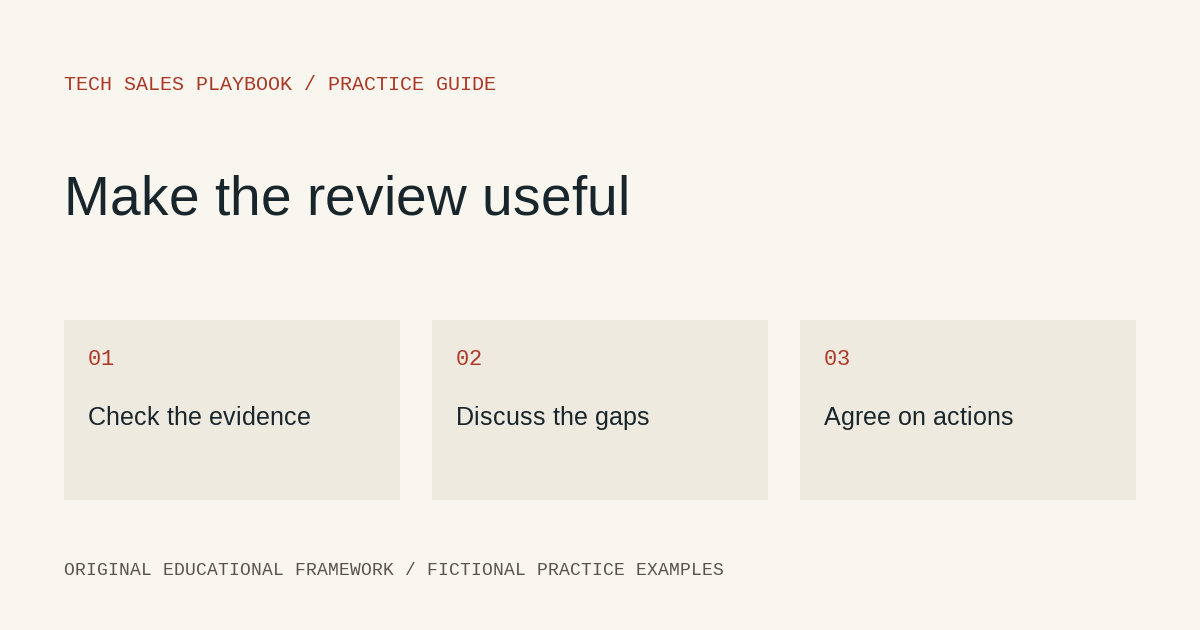
Build a post-sale executive review around customer outcomes, honest evidence, unresolved gaps and decisions with named owners.
Original practice diagram by Tech Sales Playbook.
Take over open opportunities with a six-part handoff sheet, deadline triage, a buyer introduction example, and a clear decision log.
Original practice diagram by Tech Sales Playbook.
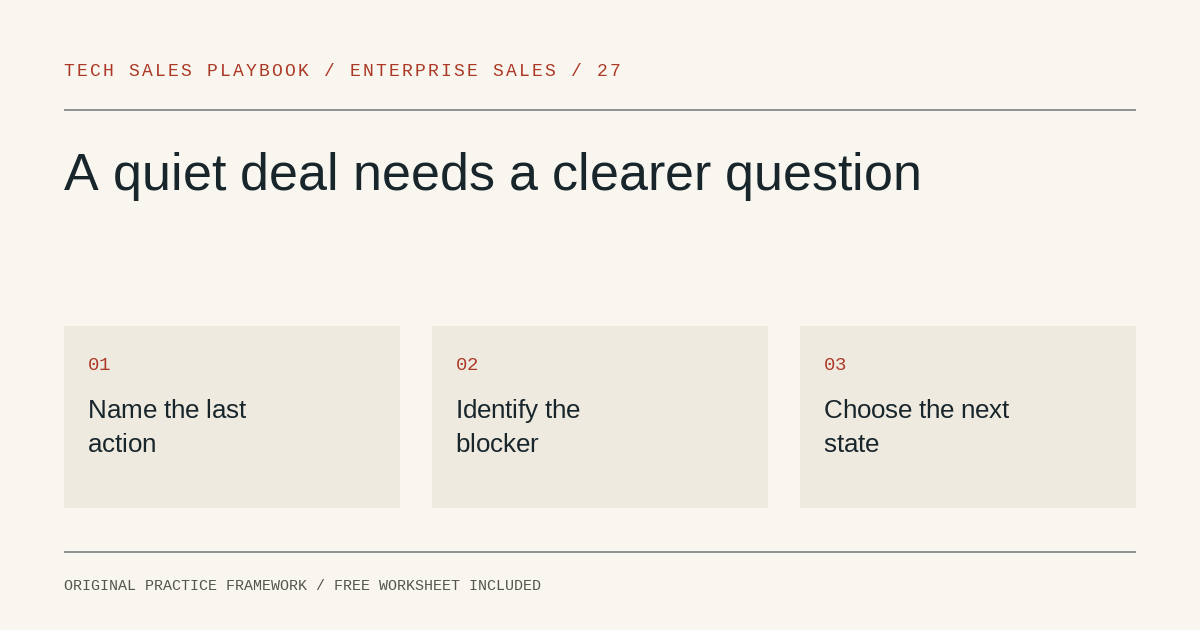
Requalify an open opportunity after a champion leaves: preserve evidence, confirm the new owner, use a respectful handover email, and update next steps.
Original practice diagram by Tech Sales Playbook.
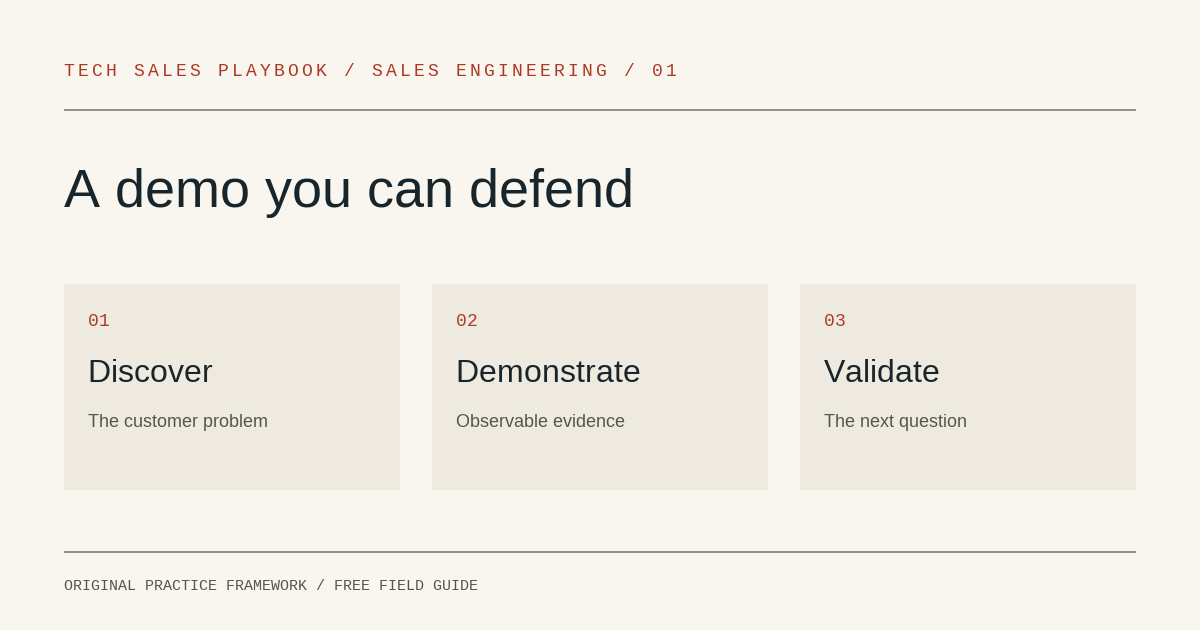
Plan a focused demo interview with a customer problem, discovery questions, observable proof and an honest technical boundary.
Original practice diagram by Tech Sales Playbook.
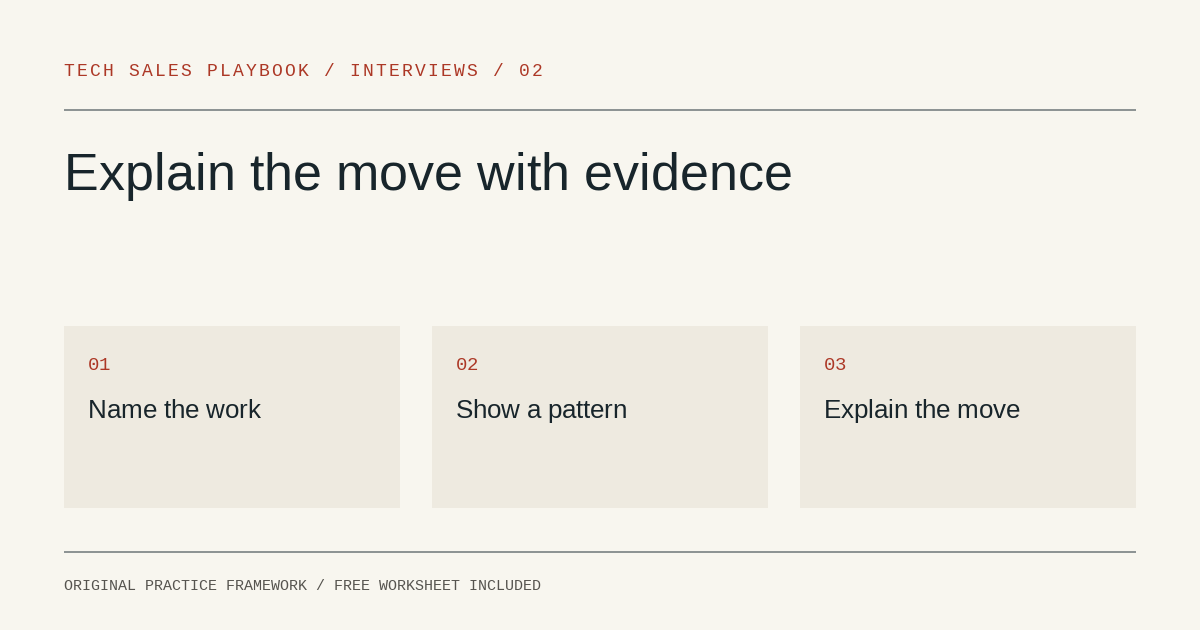
Prepare evidence stories, discovery, technical explanations, demo decisions and proof-of-concept boundaries with six original exercises.
Original practice diagram by Tech Sales Playbook.
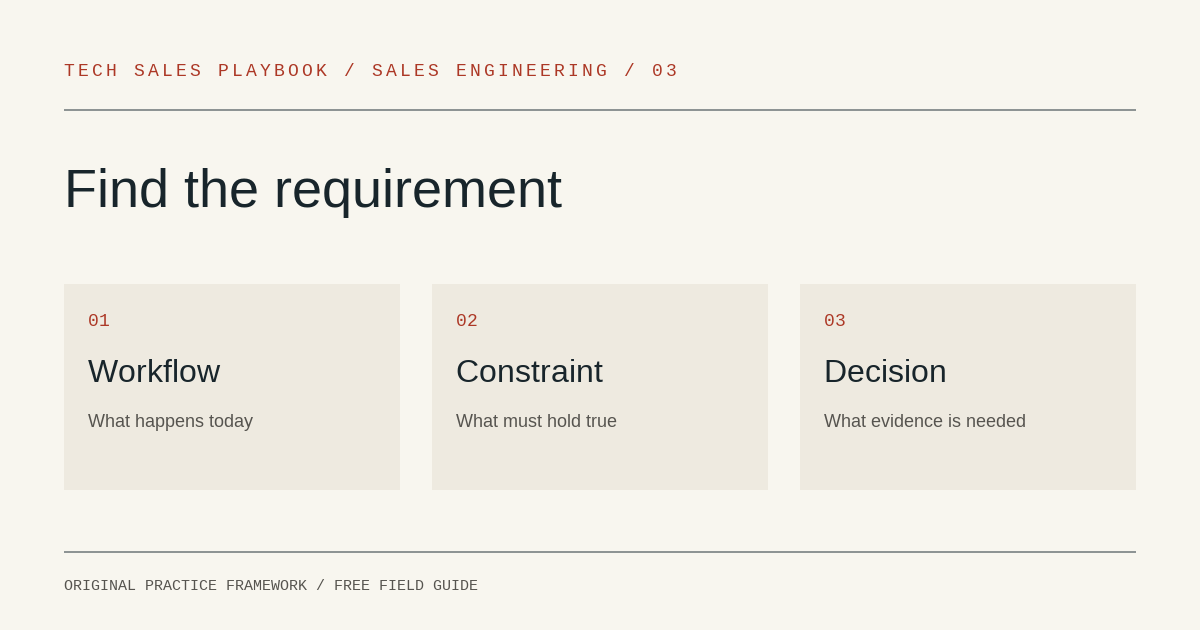
An original technical-discovery exercise covering workflows, constraints, evidence, stakeholders and the next validation decision.
Original practice diagram by Tech Sales Playbook.
Use fictional before-and-after examples to clarify demo work, technical validation and customer communication without inventing sales ownership.
Original practice diagram by Tech Sales Playbook.
Translate troubleshooting and customer communication into a credible presales application, then practice the gaps with a focused demo project.
Original practice diagram by Tech Sales Playbook.
Prepare a concise introduction, role-fit evidence, compensation questions, and a next-step checklist for a tech sales recruiter screen.
Original practice diagram by Tech Sales Playbook.
Build an honest why-sales answer with transferable evidence, realistic role expectations, and a career-change example you can adapt.
Original practice diagram by Tech Sales Playbook.
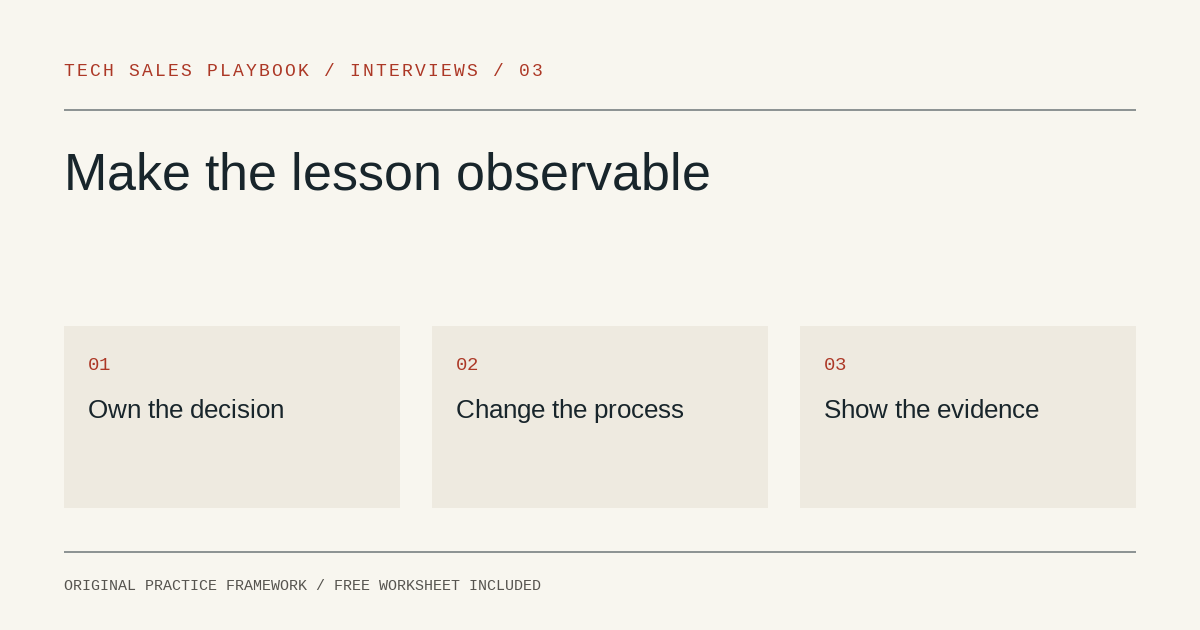
Prepare an answer about missing a goal or losing a deal with context, ownership, a specific adjustment, and evidence of what happened next.
Original practice diagram by Tech Sales Playbook.
Work through a fictional SDR writing assignment with a research brief, concise email, explanation of choices, and a submission checklist.
Original practice diagram by Tech Sales Playbook.
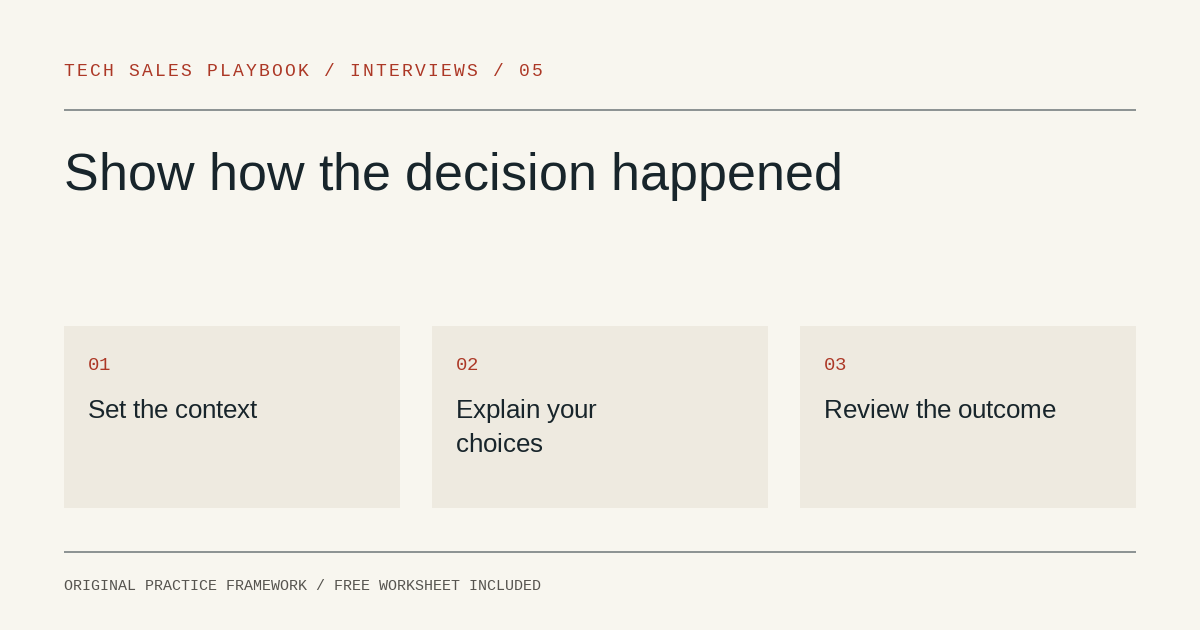
Structure an account executive deal review around the buyer's decision, stakeholders, your actions, commercial tradeoffs, and lessons learned.
Original practice diagram by Tech Sales Playbook.
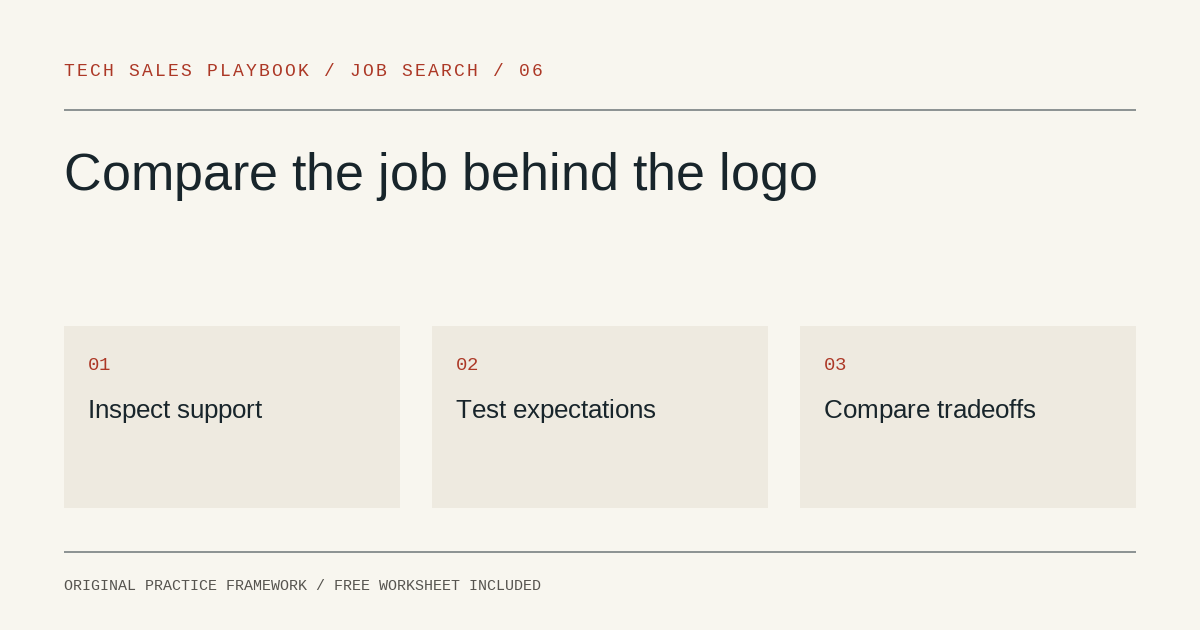
Compare SDR offers using manager support, territory, product maturity, ramp expectations, and pay-plan clarity instead of company size alone.
Original practice diagram by Tech Sales Playbook.
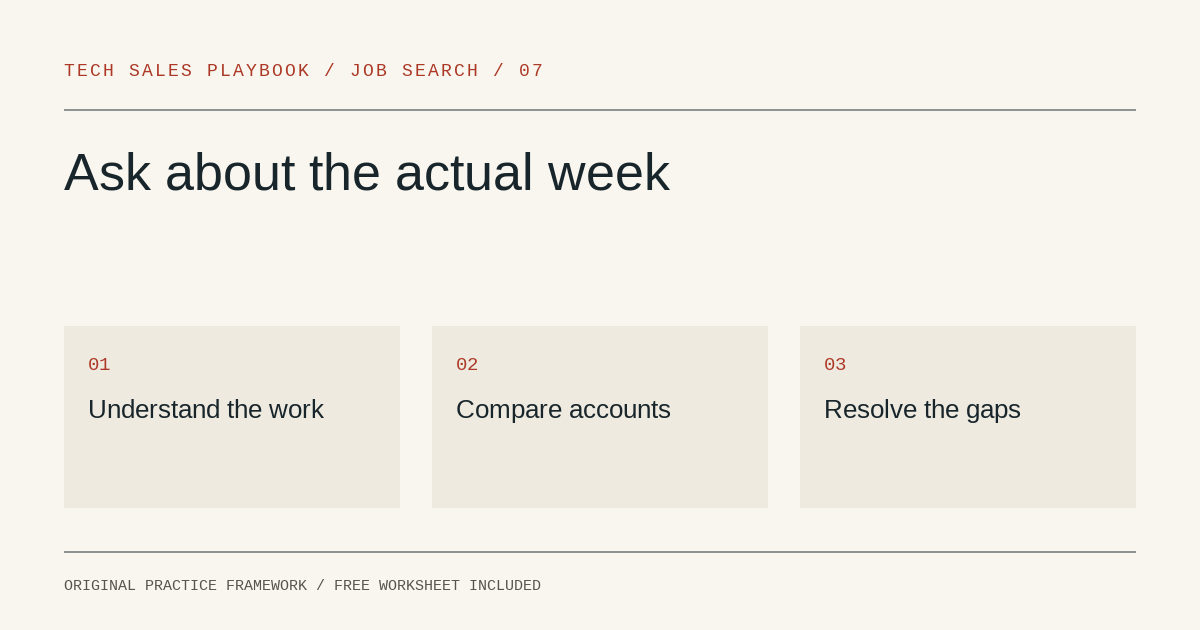
Use a prospective-colleague conversation to understand coaching, pipeline, handoffs, and day-to-day work without asking for confidential information.
Original practice diagram by Tech Sales Playbook.
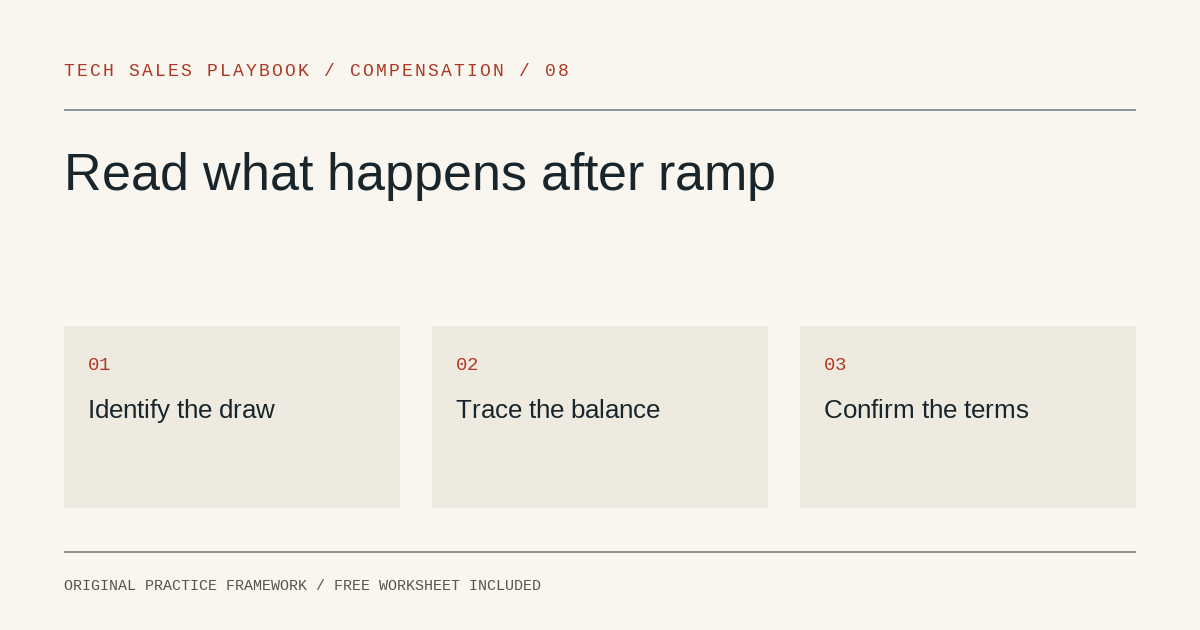
Understand the difference between a commission advance and nonrecoverable support, then inspect carryover, ramp dates, and written plan terms.
Original practice diagram by Tech Sales Playbook.
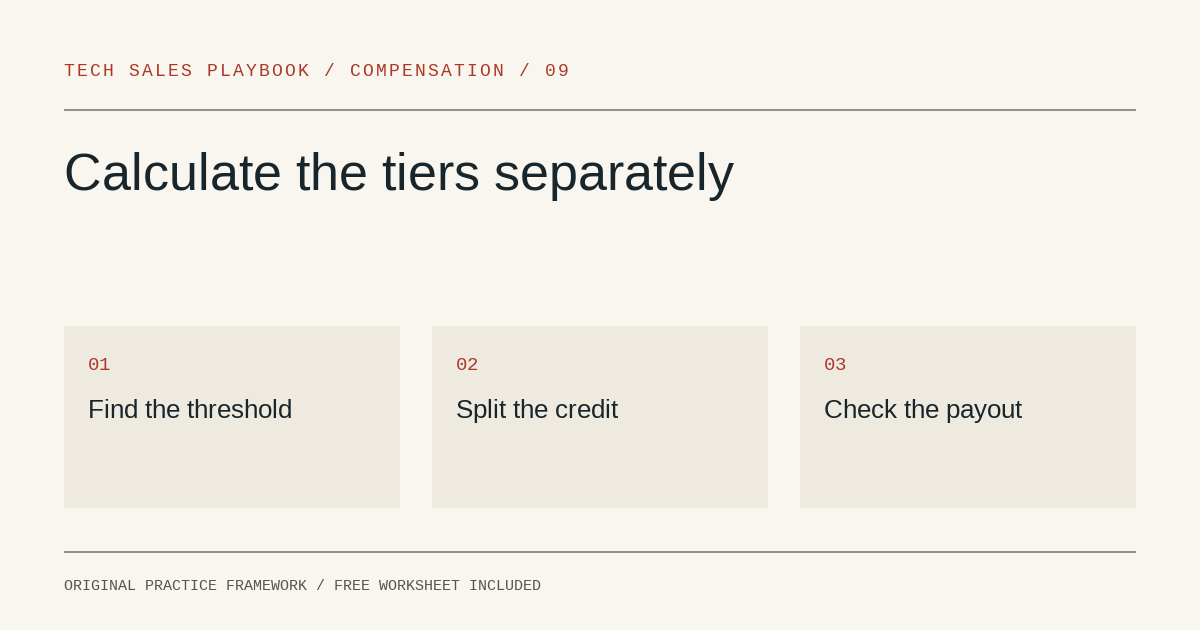
Compare marginal and retroactive accelerator assumptions with a simple worked example, then check thresholds, crediting, and caps in your plan.
Original practice diagram by Tech Sales Playbook.
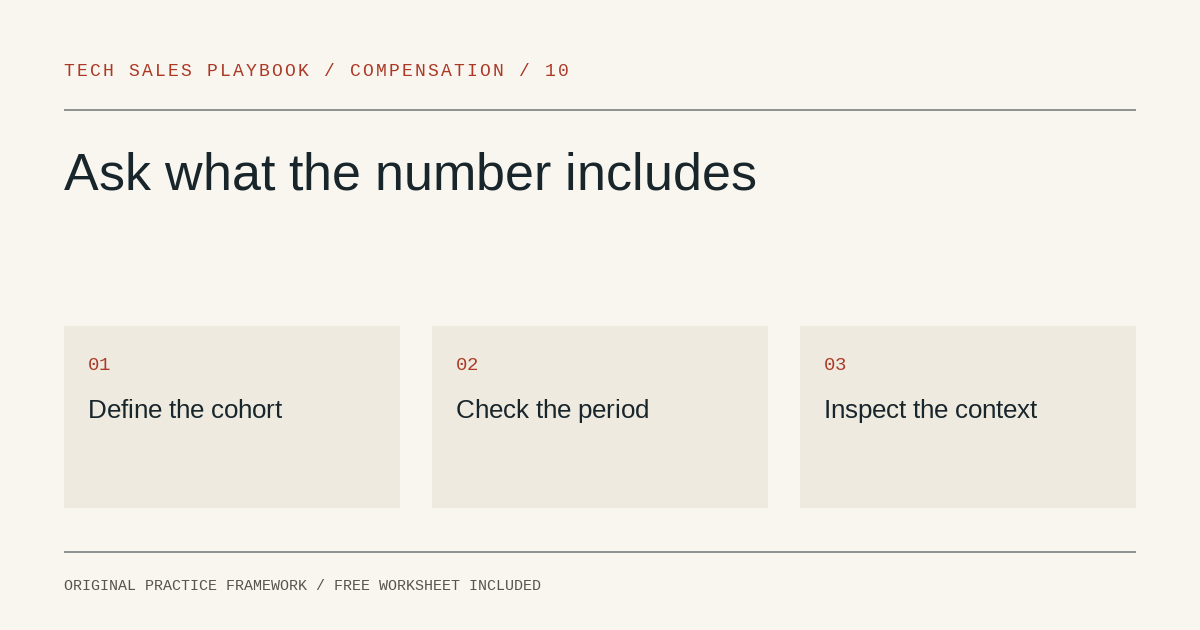
Ask about comparable rep cohorts, ramp treatment, quota changes, territory, and measurement periods before interpreting attainment claims.
Original practice diagram by Tech Sales Playbook.
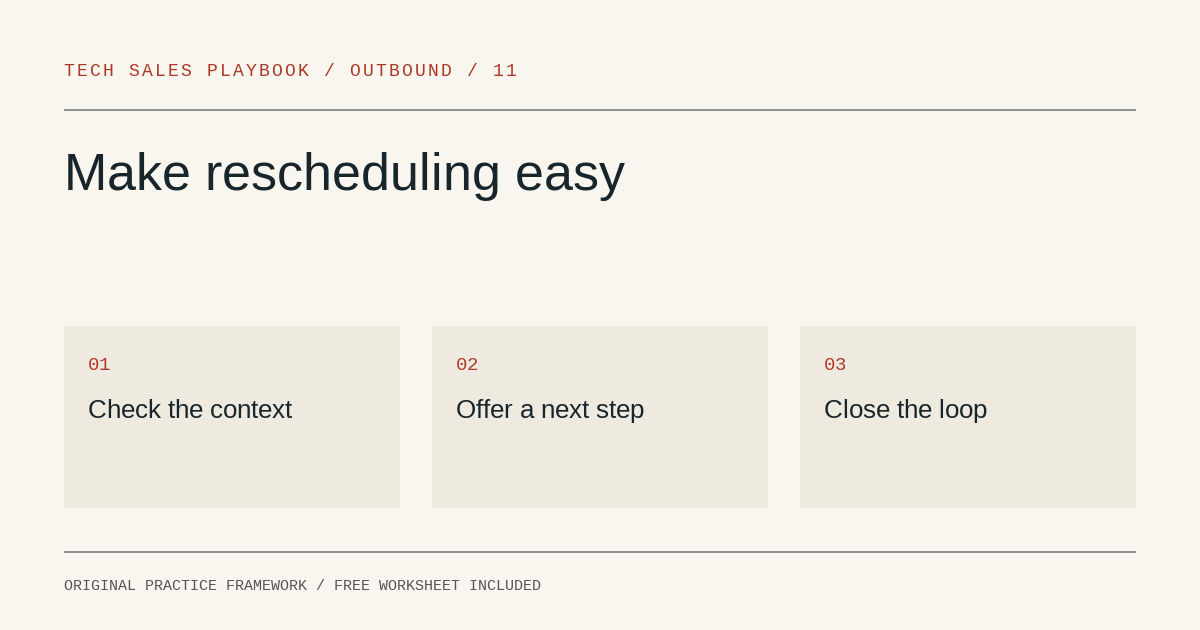
Follow up after a missed sales meeting with a neutral message, the original purpose, an easy reschedule, and a clear stopping point.
Original practice diagram by Tech Sales Playbook.
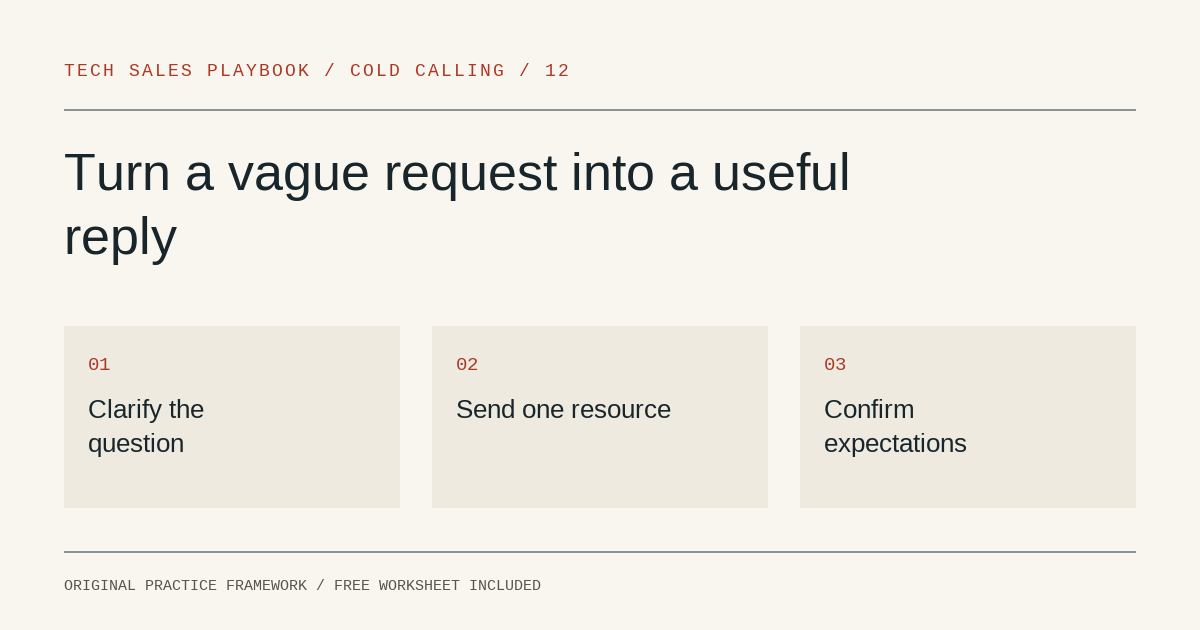
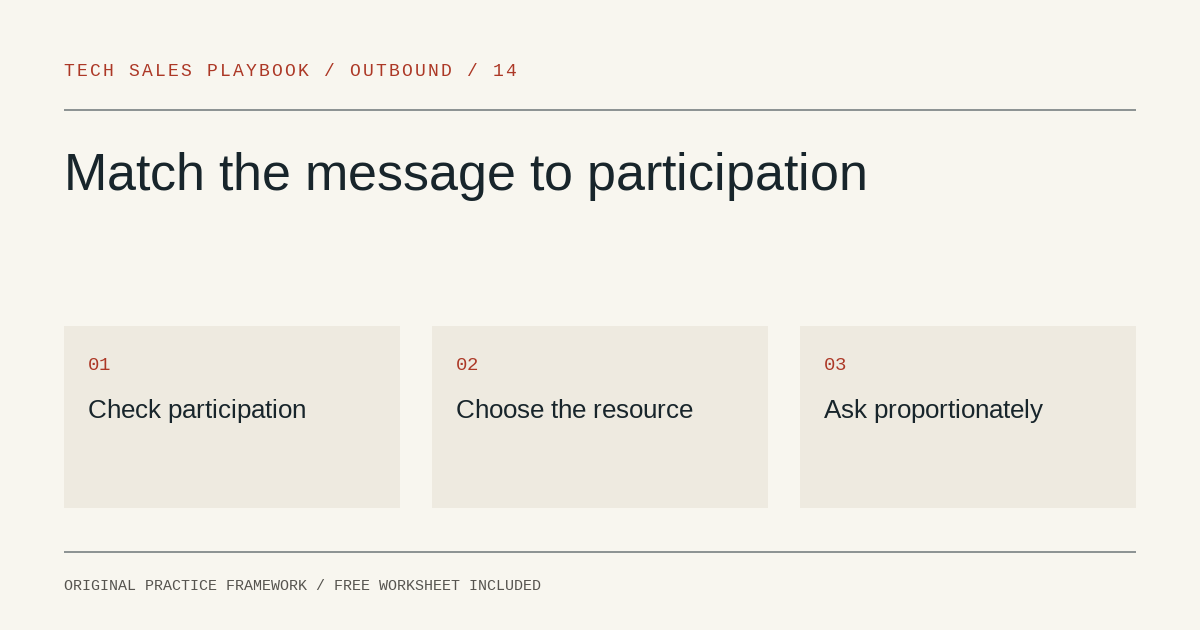
Clarify what information would help, send one relevant resource, and distinguish an information request from agreement to a meeting.
Original practice diagram by Tech Sales Playbook.
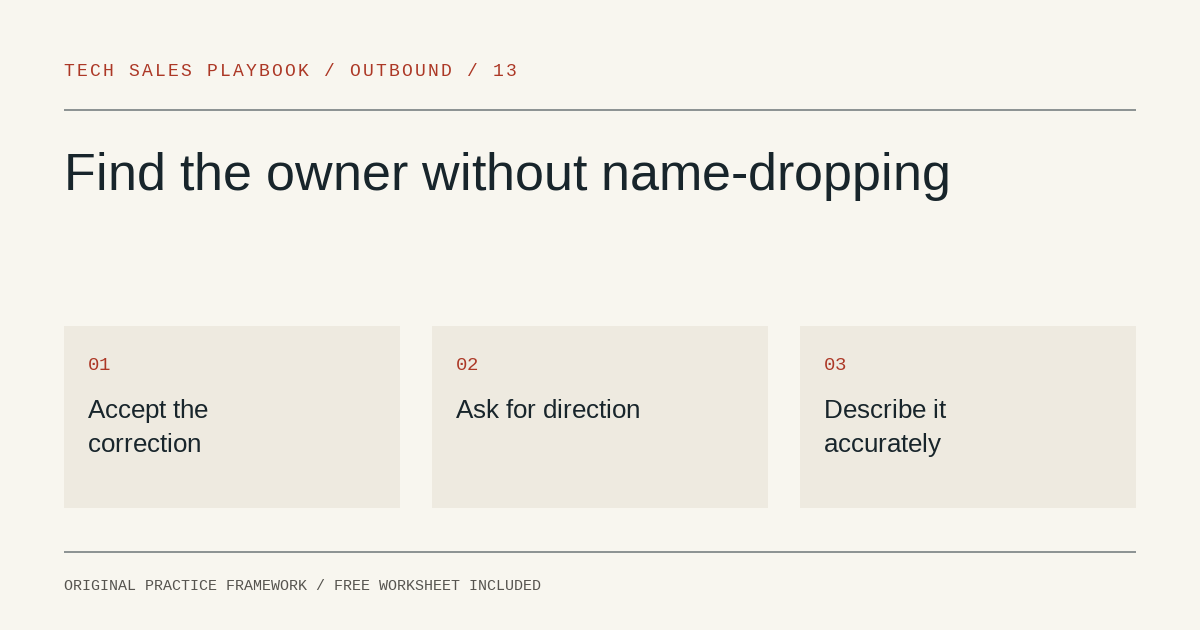
Respond to a wrong-contact reply, ask a bounded ownership question, and distinguish a suggested name from permission to claim an introduction.
Original practice diagram by Tech Sales Playbook.
Write different webinar follow-ups for attendees, registrants who missed it, and people who asked a relevant question without assuming buying intent.
Original practice diagram by Tech Sales Playbook.
Capture the conversation, fulfill the promised follow-up, and distinguish a badge scan from a real buying discussion after a trade show.
Original practice diagram by Tech Sales Playbook.
Review the original loss reason, check what has changed, and write a reengagement message that does not pretend an old opportunity is still active.
Original practice diagram by Tech Sales Playbook.
Acknowledge an existing vendor, ask a bounded workflow question, and distinguish a relevant future comparison from an unwanted replacement pitch.
Original practice diagram by Tech Sales Playbook.
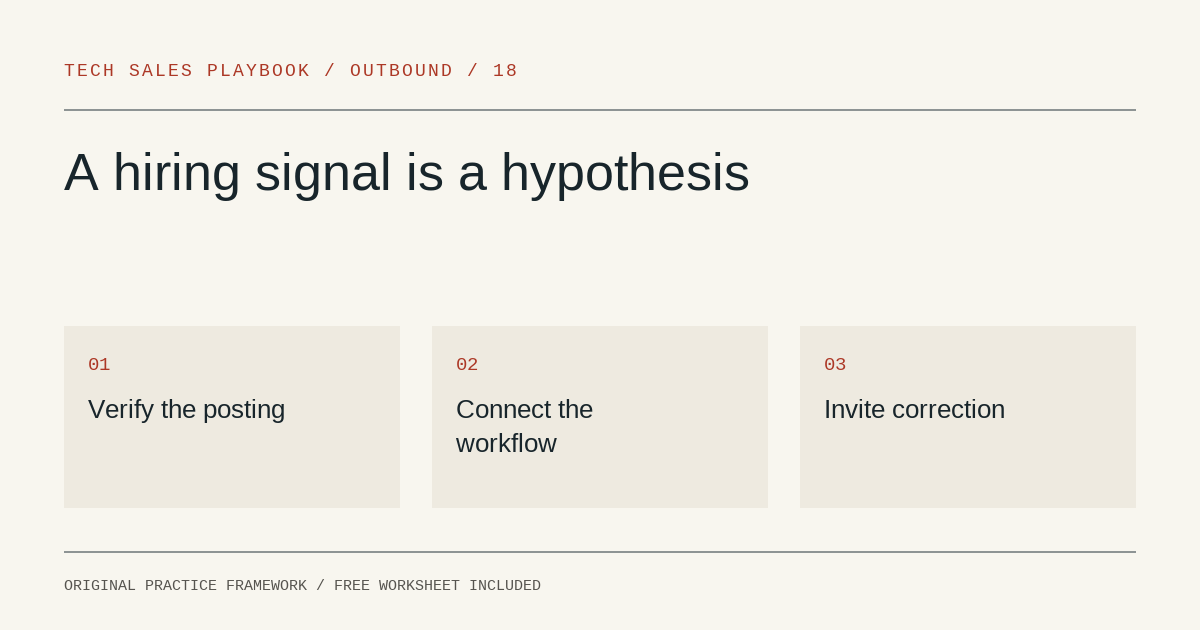
Turn a public job opening into a cautious workflow hypothesis, verify the evidence, and write outreach that invites correction.
Original practice diagram by Tech Sales Playbook.
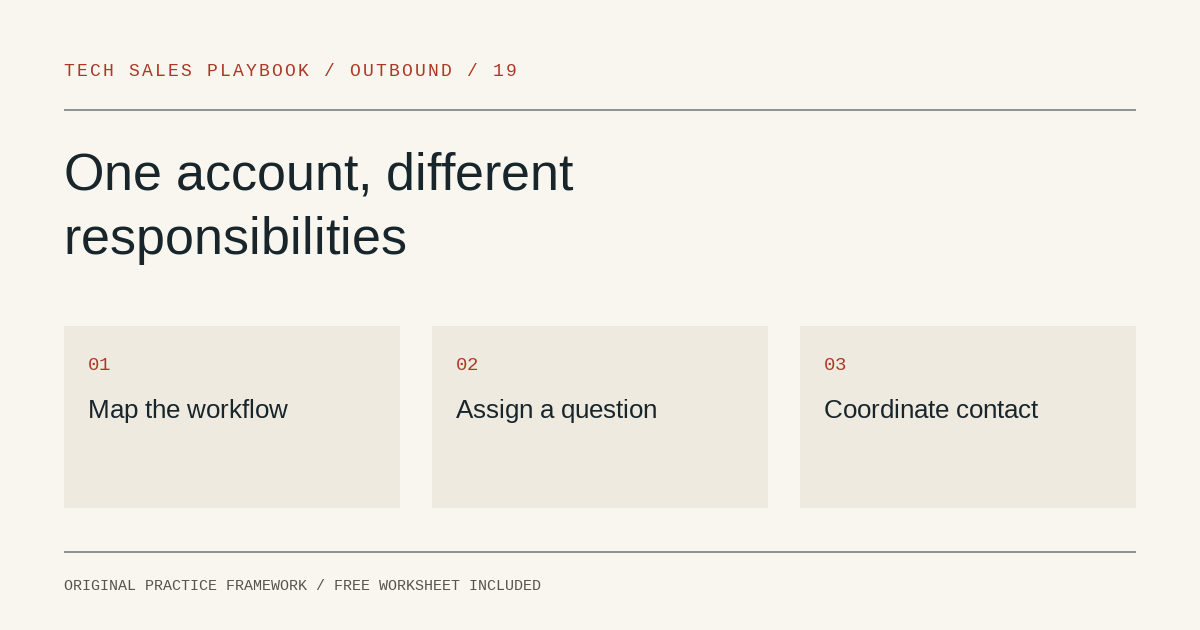
Coordinate outreach across an account by giving each stakeholder a relevant question while avoiding duplicate messages and unsupported relationship claims.
Original practice diagram by Tech Sales Playbook.
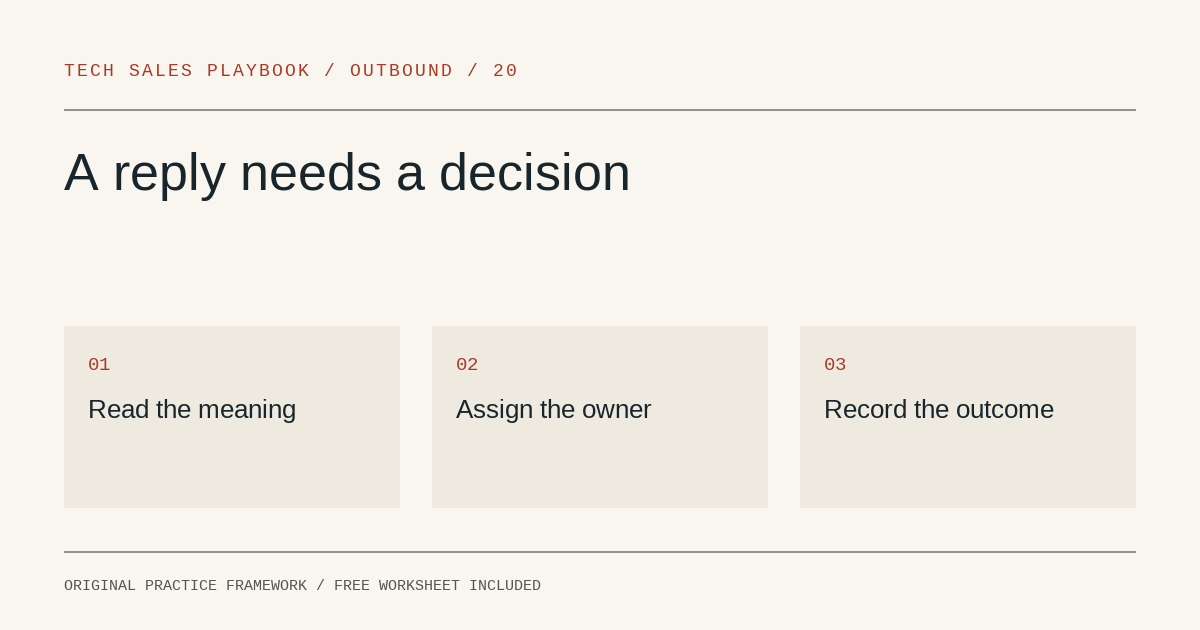
Classify outbound replies by meaning, assign a next action, and keep positive interest separate from referrals, automated replies, and stop requests.
Original practice diagram by Tech Sales Playbook.
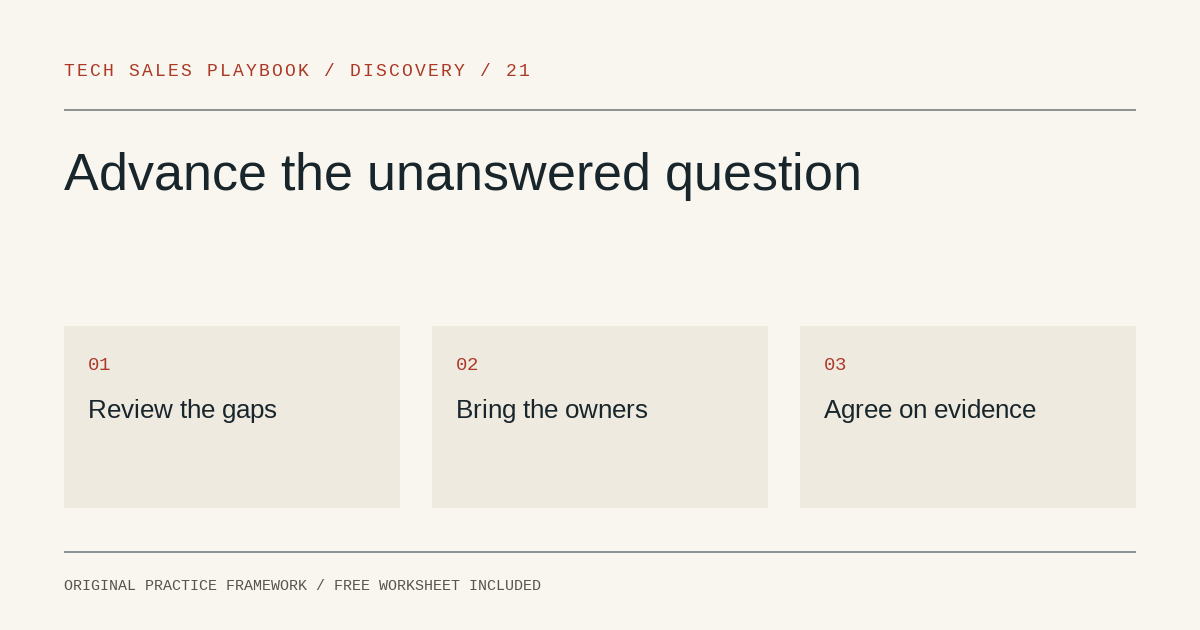
Plan a second discovery call around unresolved questions, new stakeholders, and the evidence needed for the buyer's next decision.
Original practice diagram by Tech Sales Playbook.
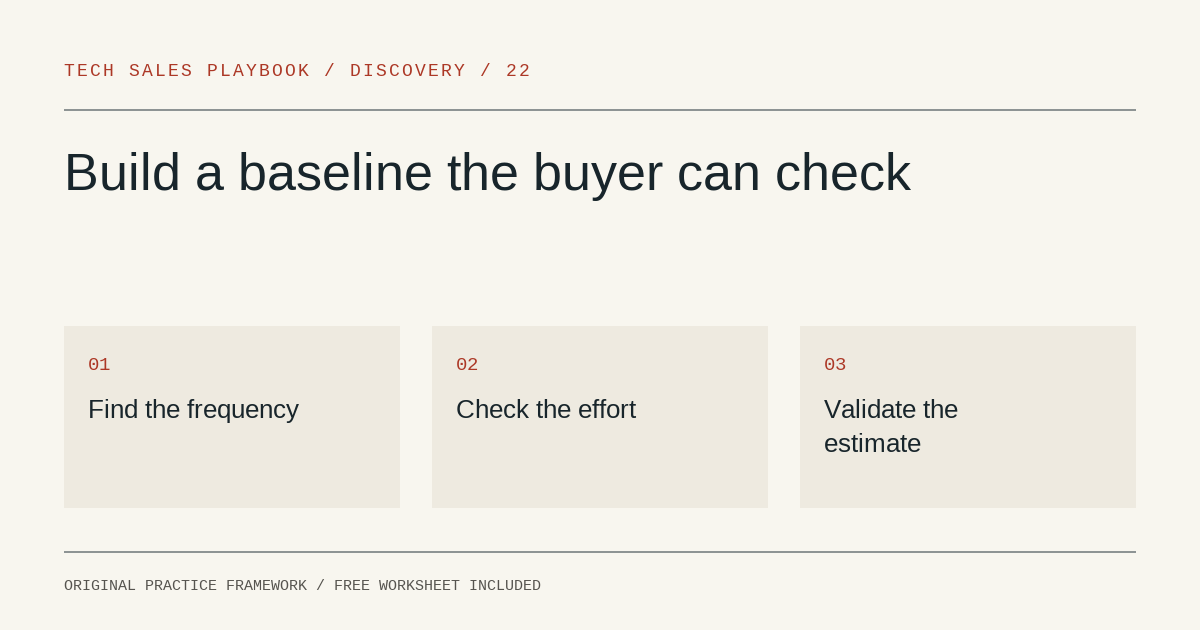
Build a baseline from frequency, time, and evidence ownership while keeping operational estimates separate from promised financial savings.
Original practice diagram by Tech Sales Playbook.
Prepare an executive buying discussion around the decision, evidence, alternatives, unresolved risks, and the specific approval being considered.
Original practice diagram by Tech Sales Playbook.
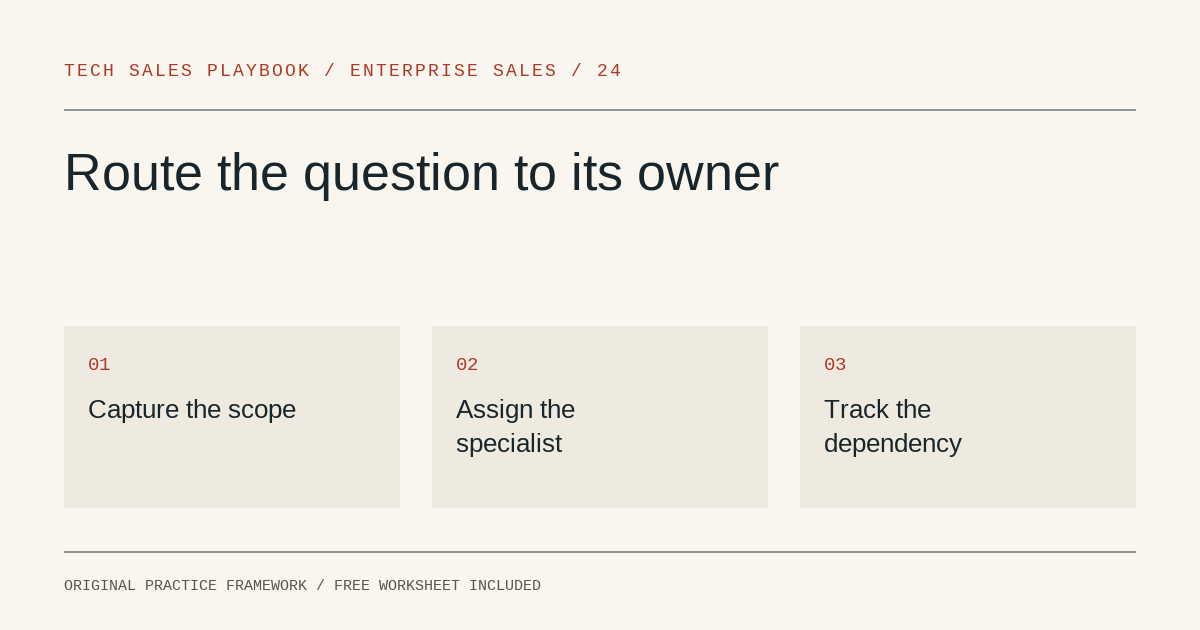
Route security-review requests with scope, deadlines, approved evidence, and accountable specialists without inventing technical answers.
Original practice diagram by Tech Sales Playbook.
Clarify scope, budget context, and the buyer's comparison before discussing concessions, while keeping pricing authority and approval rules clear.
Original practice diagram by Tech Sales Playbook.
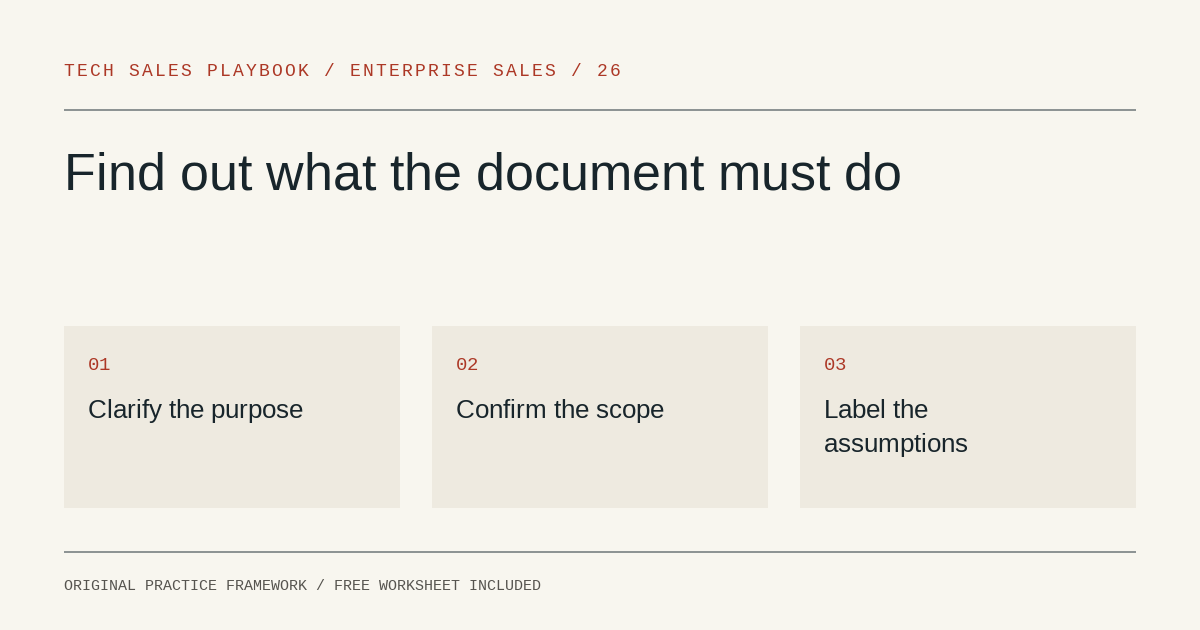
Clarify what the buyer needs from a proposal, distinguish an estimate from a committed offer, and identify the minimum scope required to proceed.
Original practice diagram by Tech Sales Playbook.
Distinguish a specific blocked step from a project that is no longer a priority, then agree whether to advance, pause, or close the opportunity.
Original practice diagram by Tech Sales Playbook.
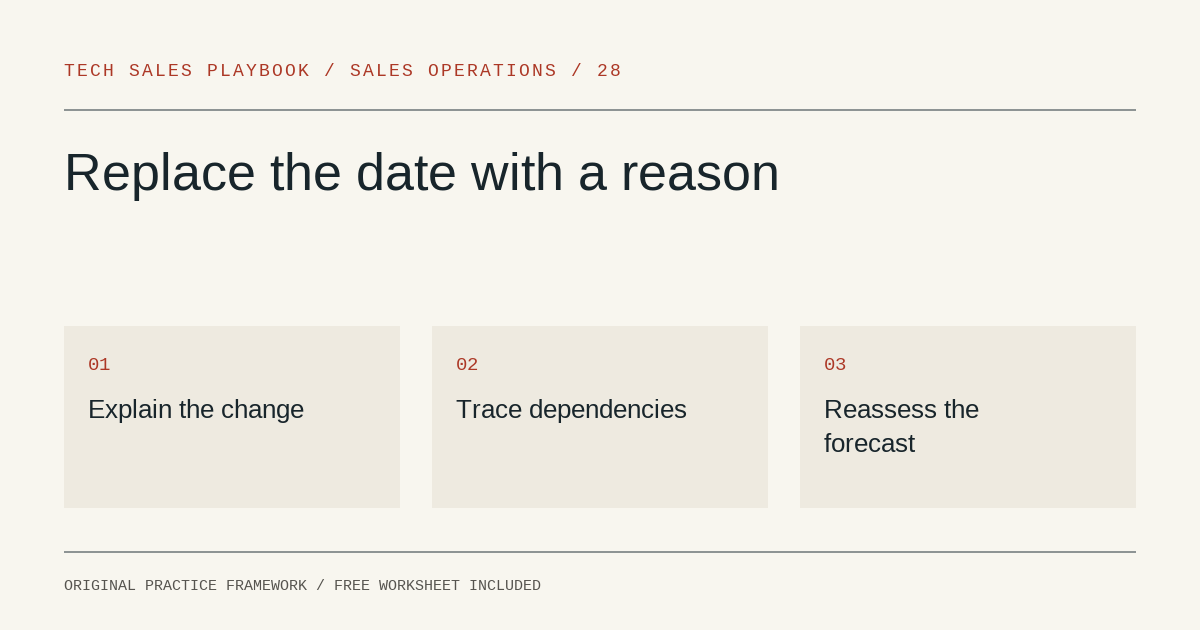
Explain what changed, which dependency controls timing, and what evidence would support a revised close date without replacing one guess with another.
Original practice diagram by Tech Sales Playbook.
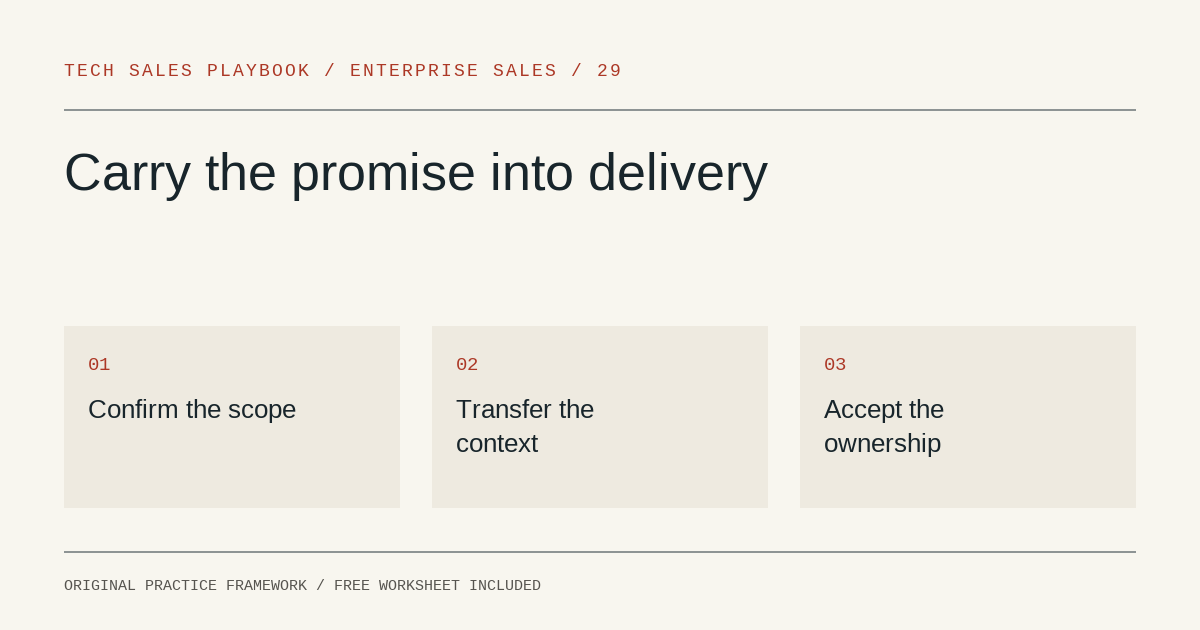
Copy a post-sale handoff template or download the free worksheet. Capture purchased scope, promises, risks, receiving owners, and kickoff decisions.
Original practice diagram by Tech Sales Playbook.
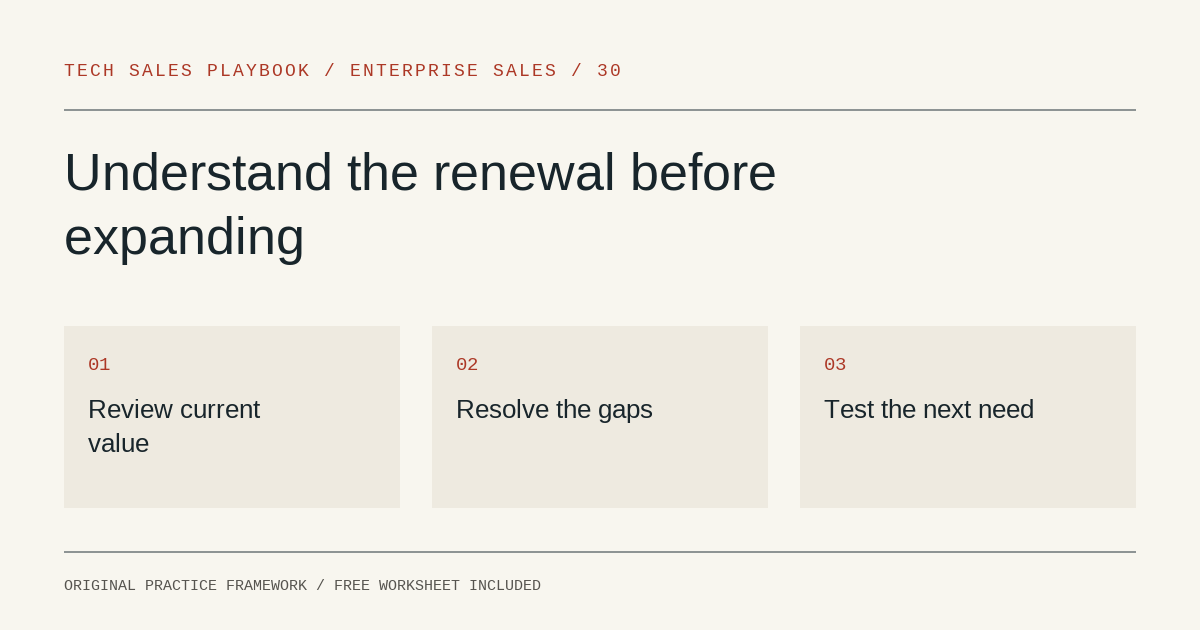
Review current value, adoption gaps, stakeholder changes, and the renewal decision before proposing more seats or a larger package.
Original practice diagram by Tech Sales Playbook.
Write a useful SDR-to-AE handoff with confirmed buyer context, open questions, meeting purpose, and clear ownership. Includes a free worksheet.
Photo by Aaron Burden on Unsplash
Write a discovery follow-up that separates confirmed needs, open questions, and agreed actions. Includes an original example and a pre-send checklist.
Photo by Kaitlyn Baker on Unsplash
Define a SaaS evaluation with a business question, measurable criteria, owners, constraints, and an exit decision. Includes a free POC worksheet.
Photo by Compagnons on Unsplash
Help a customer explain an evaluation internally with a concise problem, evidence, options, risks, and decision request. Avoid mistaking friendliness for influence.
Photo by ThisisEngineering on Unsplash
Prepare a focused SaaS demonstration with buyer questions, relevant workflows, proof points, technical unknowns, and a clear next decision.
Photo by LinkedIn Sales Solutions on Unsplash
Audit account ownership, existing relationships, fit, and capacity before building a territory work plan. Includes a practical worksheet and review questions.
Photo by Volodymyr Hryshchenko on Unsplash
Write a clear voicemail and matching email with truthful context, one relevant question, and a sensible stopping rule. Includes an original practice pair.
Photo by Julian Hochgesang on Unsplash
Respond to inbound interest with useful context checks, fit questions, routing decisions, and a relevant next step instead of repeating the form.
Photo by Redd Francisco on Unsplash
Assess your target role, evidence, structure, and editing capacity before paying for resume help. Learn when free resources, feedback, or reconstruction fit.
Photo by KOBU Agency on Unsplash
Compare a self-study playbook, free resources, and a structured training program by feedback, schedule, cost, curriculum, and evidence behind outcome claims.
Photo by Volodymyr Hryshchenko on Unsplash
Download a free SDR job-search tracker and learn how to record roles, follow-ups, interview stages, and weekly results without double-counting applications.
Photo by Volodymyr Hryshchenko on Unsplash
Practice cold-call openings, relevance, questions, objections, and next steps with a five-day plan and a downloadable self-review scorecard.
Photo by Berkeley Communications on Unsplash
Build a buyer-reviewed mutual action plan with a free CSV template, a worked example, decision criteria, owners, dependencies, and realistic dates.
Turn teaching, retail, hospitality, or recruiting experience into credible SDR resume bullets with an evidence worksheet and worked examples.
Photo by Mike Tinnion on Unsplash
Build an AE application that separates sourced pipeline, assisted deal work, and practice. Includes a fictional deal contribution example and evidence checklist.
Photo by Daniel Fazio on Unsplash
Distinguish an unfunded problem from low priority or the wrong stakeholder. Use a sample conversation and clear next-step criteria without pushing a premature demo.
Separate procurement, security, legal, and funding blockers. Build an owner-based next-step plan and avoid discounting a problem that price will not solve.
Photo by Fatemeh Rezvani on Unsplash
Build a concise account brief using public evidence, a testable problem hypothesis, and a relevant first message. Includes a free CSV template and fictional example.
Photo by Tim van der Kuip on Unsplash
Compare Denver SDR offers with evidence-based math for base salary, OTE, attainment, ramp, territory, benefits, and hybrid costs.
Photo by Scott Graham on Unsplash
A Seattle SDR offer framework for normalizing base salary, OTE, ramp, attainment evidence, equity, benefits, and location costs.
Photo by Unseen Studio on Unsplash
Evaluate an Atlanta SDR offer using first-year cash scenarios, quota evidence, ramp terms, territory quality, benefits, and commute costs.
Photo by Daniel Fazio on Unsplash
Translate SDR experience into CRM governance, reporting, routing, process documentation, analysis, and stakeholder evidence for sales operations.
Photo by Mimi Thian on Unsplash
A manager ramp plan for team trust, funnel definitions, coaching, capacity, pipeline quality, hiring, and cross-functional alignment.
Photo by Eric Rothermel on Unsplash
Build an account executive resume with a copyable structure, quota and attainment context, attributable deal evidence, and stronger before-and-after bullets.
Photo by JESHOOTS.COM on Unsplash
A practical SDR workflow for lead ownership, research, status, activity, qualification, conversion, exceptions, and handoffs in Salesforce.
Photo by Štefan Štefančík on Unsplash
Design and review HubSpot lead rotation with enrollment rules, ownership eligibility, exclusions, SLA monitoring, exceptions, and rollback.
Photo by Nick Morrison on Unsplash
Practice logistics SaaS objections about incumbents, integrations, operational disruption, data quality, timing, and proof without inventing outcomes.
Photo by René Ranisch on Unsplash
Practice HR-tech objections about employee data, incumbents, integrations, adoption, procurement, timing, and proof with careful claims.
Photo by bruce mars on Unsplash
Evaluate a Chicago SDR offer by separating base salary, variable pay, ramp, quota, territory, benefits, and pay-range evidence.
Photo by Kelly Sikkema on Unsplash
A Boston SDR compensation framework for comparing base, OTE, ramp, attainment evidence, benefits, and hybrid costs.
Photo by Jakub Żerdzicki on Unsplash
Understand entry-level SDR pay through offer math, attainment evidence, ramp guarantees, benefits, and role-level checks.
Photo by Jakub Żerdzicki on Unsplash
Translate SDR strengths into account planning, adoption, renewal, expansion, and cross-functional evidence for an account manager move.
Turn customer-success experience into credible prospecting, discovery, qualification, negotiation, and pipeline evidence for an AE role.
A ramp plan for sales engineers covering product learning, discovery, demos, technical validation, security, handoffs, and inspected outcomes.
Photo by Tim van der Kuip on Unsplash
Score sales discovery with observable criteria for agenda, questioning, listening, impact, decision process, qualification, and next steps.
Photo by Aaron Burden on Unsplash
Turn MEDDPICC into an evidence-based opportunity scorecard without forcing certainty, inflating champions, or confusing labels with proof.
Photo by Fatemeh Rezvani on Unsplash
A practical HubSpot sequence workflow for audience selection, personalization, enrollment checks, task execution, replies, and iteration.
Photo by Kaitlyn Baker on Unsplash
Run a weekly AE pipeline review around evidence changes, stage integrity, next steps, risks, creation, and forecast judgment.
Photo by Israel Andrade on Unsplash
Handle common cybersecurity prospecting objections without fear tactics, unsupported breach claims, or premature product pitches.
Photo by Compagnons on Unsplash
Respond to healthcare SaaS objections while respecting clinical priorities, procurement, privacy, security, and implementation constraints.
Photo by Taylor Grote on Unsplash
Handle fintech prospecting objections around risk, compliance, incumbent providers, integration work, and business-case uncertainty.
Photo by Julian Hochgesang on Unsplash
Practice an SDR discovery role-play with a complete scenario, question map, scoring rubric, and self-review process.
Photo by LinkedIn Sales Solutions on Unsplash
Evaluate an Austin SDR offer using current job postings, base pay, OTE, quota attainment, ramp protection, territory, and benefits.
Photo by Jakub Żerdzicki on Unsplash
Compare San Francisco SDR offers using disclosed pay ranges, expected attainment, ramp, equity, benefits, territory, and hybrid costs.
Photo by Scott Graham on Unsplash
Translate SDR experience into customer-success evidence through account context, adoption thinking, stakeholder communication, and a practical transition project.
Photo by KOBU Agency on Unsplash
A practical AE ramp plan for product learning, discovery, pipeline creation, opportunity control, forecasting, and manager inspection.
Convert experience from operations, recruiting, hospitality, education, or customer service into credible tech-sales resume evidence.
Photo by Mike Tinnion on Unsplash
Manage Salesforce opportunities with accurate stages, qualification evidence, next steps, close dates, stakeholders, and forecast inspection.
Photo by Štefan Štefančík on Unsplash
Prepare for a Salesforce SDR or BDR interview with a company-specific research brief, answer frameworks, mock-call plan, and questions for the hiring manager.
Photo by Dylan Gillis on Unsplash

Prepare for a HubSpot SDR or BDR interview with a company-specific research brief, answer frameworks, mock-call plan, and questions for the hiring manager.
Photo by Charles Forerunner on Unsplash
Prepare for a Datadog SDR or BDR interview with a company-specific research brief, answer frameworks, mock-call plan, and questions for the hiring manager.
Photo by Rodeo Project Management Software on Unsplash
Prepare for a Cloudflare SDR or BDR interview with a company-specific research brief, answer frameworks, mock-call plan, and questions for the hiring manager.
Photo by Christina @ wocintechchat.com M on Unsplash
Prepare for a Snowflake SDR or BDR interview with a company-specific research brief, answer frameworks, mock-call plan, and questions for the hiring manager.
Photo by Redd Francisco on Unsplash
Prepare for a MongoDB SDR or BDR interview with a company-specific research brief, answer frameworks, mock-call plan, and questions for the hiring manager.
Photo by charlesdeluvio on Unsplash
Prepare for a Okta SDR or BDR interview with a company-specific research brief, answer frameworks, mock-call plan, and questions for the hiring manager.
Photo by Mario Gogh on Unsplash
Prepare for a ServiceNow SDR or BDR interview with a company-specific research brief, answer frameworks, mock-call plan, and questions for the hiring manager.
Prepare for a Stripe SDR or BDR interview with a company-specific research brief, answer frameworks, mock-call plan, and questions for the hiring manager.
Prepare for a Gong SDR or BDR interview with a company-specific research brief, answer frameworks, mock-call plan, and questions for the hiring manager.
Photo by Cherrydeck on Unsplash
A practical SDR ramp plan covering product fluency, account research, call practice, activity quality, pipeline creation, and manager check-ins.
Photo by Volodymyr Hryshchenko on Unsplash
A complete framework for preparing, opening, discovering, handling objections, and closing a SaaS mock cold-call interview.
Photo by Berkeley Communications on Unsplash
Score SDR calls consistently across relevance, discovery, objection handling, next-step control, listening, and execution.
Photo by JESHOOTS.COM on Unsplash
A practical Salesforce workflow for SDR research, activity capture, lead and contact management, follow-up, and clean AE handoffs.
Photo by Mimi Thian on Unsplash
Organize SDR prospecting in HubSpot with reliable records, task queues, sequences, lifecycle stages, and AE handoffs.
Photo by Nick Morrison on Unsplash
Use MEDDIC as a discovery map with practical questions for metrics, economic buyer, decision criteria, process, pain, and champion.
Compare NYC SDR base salary and OTE with a worked pay example, quota questions, local posting research, and a free compensation calculator.
Photo by Kelly Sikkema on Unsplash
Compare remote SDR offers across location bands, base pay, OTE, ramp, territory, benefits, equipment, and promotion opportunity.
Photo by Jakub Żerdzicki on Unsplash
Build an SDR resume without formal sales experience by translating customer work, goals, persistence, research, and communication into credible proof.
Photo by Unseen Studio on Unsplash
Create a credible BDR-to-AE promotion case using performance evidence, discovery practice, opportunity exposure, forecasting habits, and manager alignment.
Photo by ThisisEngineering on Unsplash
A practical map of the tech sales ladder, promotion timelines, skills, and pay bands from entry level to enterprise.
Compare HubSpot sales certification, Salesforce Trailhead badges, and paid training. Choose by the role requirement and leave with work you can show.
Photo by Jeswin Thomas on Unsplash
The SDR and BDR interview questions candidates should expect in 2026, with answer frameworks, mock-call prep, and questions to ask before accepting an offer.
Photo by Vitaly Gariev on Unsplash
How to handle not interested, send me an email, no budget, and already have a vendor without sounding robotic.
Photo by David Hahn on Unsplash
Subject line patterns that look human, avoid hype, and earn enough opens to let your message do its job.
Photo by Marek Levak on Unsplash
How to use LinkedIn for account research, warm touches, and multi-channel outbound without spamming prospects.
Photo by Evangeline Shaw on Unsplash
Questions that uncover pain, quantify impact, identify decision makers, and move a deal forward.
Photo by Vitaly Gariev on Unsplash
Learn the six MEDDIC elements with discovery questions, a worked SaaS deal example, and a free evidence checklist for your next pipeline review.
A simple account planning system for mapping stakeholders, triggers, initiatives, and next best actions.
How to evaluate base, OTE, quota, ramp, accelerators, clawbacks, and territory quality before signing.
Photo by Melanie Deziel on Unsplash
A practical keyword and proof-point guide for writing a tech sales resume that can pass ATS screens and earn recruiter callbacks.
Photo by Vitaly Gariev on Unsplash
A focused search strategy for remote SDR roles, including filters, company signals, and outreach scripts.
Photo by Christin Hume on Unsplash
A simple structure for mock discovery, demo, territory plan, or business-case presentations in AE interviews.
Photo by Campaign Creators on Unsplash
Compare SDR and BDR responsibilities, inbound versus outbound work, compensation questions, and first-job fit. Includes a practical comparison table.
Photo by Annie Spratt on Unsplash
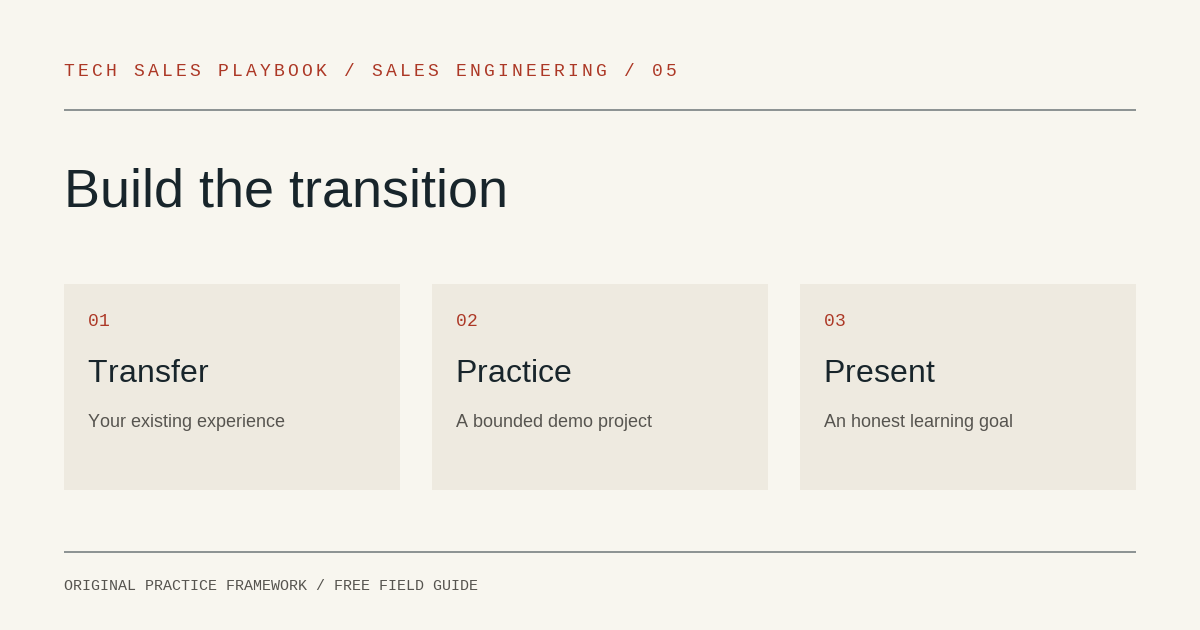
The exact playbook for career changers to land their first SDR role without a sales background.
Photo by Christin Hume on Unsplash
The essential metrics that drive tech sales—and how to speak fluently about them in interviews.
Photo by Julian Hochgesang on Unsplash
A repeatable cold call structure for opening strong, handling early resistance, and turning more live conversations into booked meetings.
Connection request and LinkedIn message templates for starting better conversations with sales managers, recruiters, and prospects.
Photo by jimylloyd laumain on Unsplash
A complete prep guide for SDR mock cold call interviews, including the call structure, script examples, objection handling, scoring criteria, and follow-up moves.
Photo by Vitaly Gariev on Unsplash
Understand OTE, model quota-attainment scenarios, check commission-plan rules, and prepare a negotiation request. Includes a free calculator.
Photo by Vitaly Gariev on Unsplash
How to identify companies with strong SDR training programs and promotion paths.
Photo by Product School on Unsplash