Best For
- Enterprise account executives
- Sellers managing complex evaluations
Loading...
A 37-page field manual for complex accounts. Covers account planning, stakeholder decisions, executive engagement, evaluations, security, procurement, multi-year terms, competitive displacement, rollout, and three worksheets.
Plan complex accounts, align stakeholders, and guide evaluation through rollout.
37 pages
Finished PDF playbook
20-page preview
Review the sample first
30-day guarantee
Instant access after checkout
Look inside
The full playbook runs 37 pages.
These 20 are the real thing, not a summary.
Page 1 / 20
Text from the same public sample shown above. Use the page images or PDF for diagrams, tables and original layout.
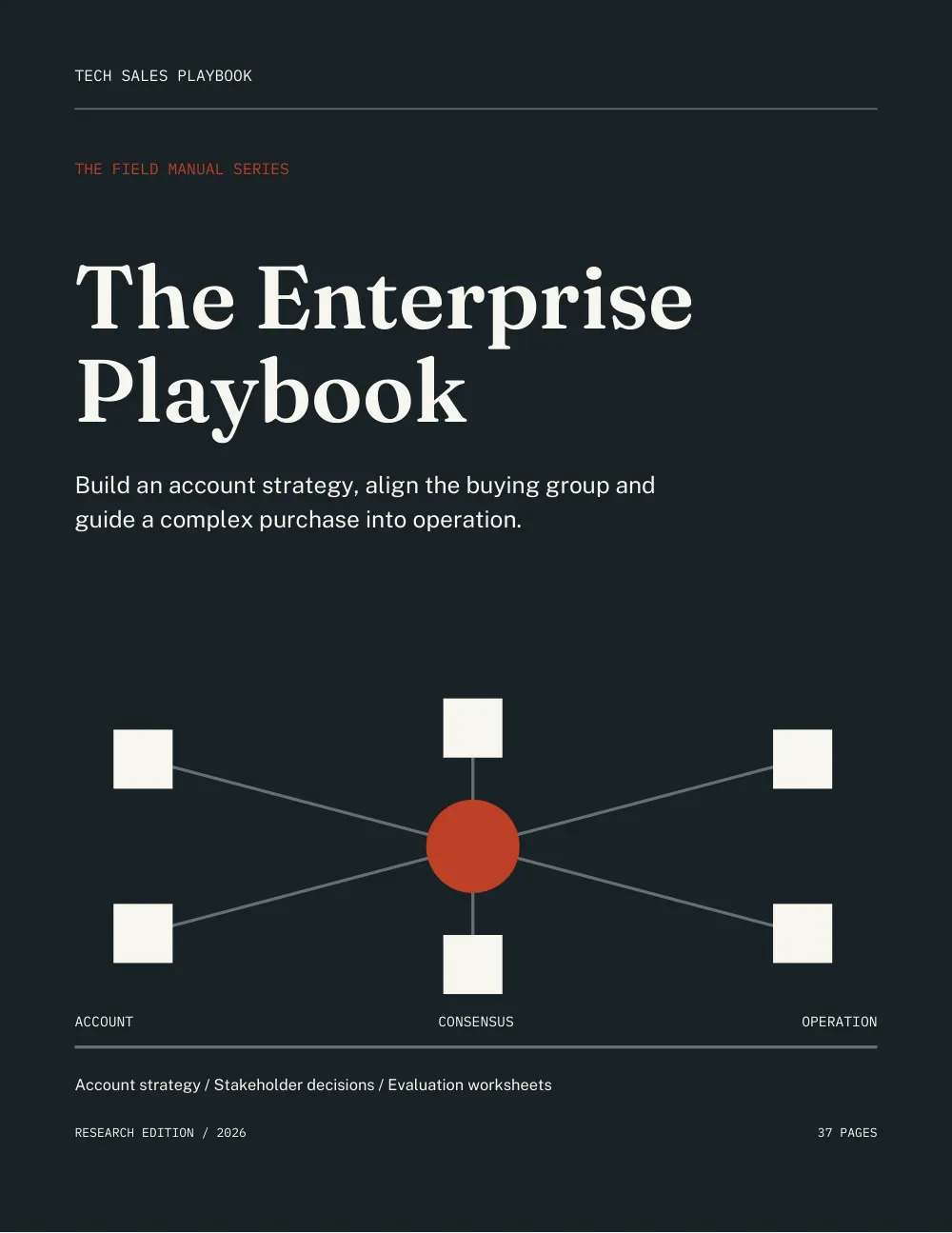
TECH SALES PLAYBOOK THE FIELD MANUAL SERIES The Enterprise Playbook Build an account strategy, align the buying group and guide a complex purchase into operation. ACCOUNT CONSENSUS OPERATION Account strategy / Stakeholder decisions / Evaluation worksheets RESEARCH EDITION / 2026 37 PAGES
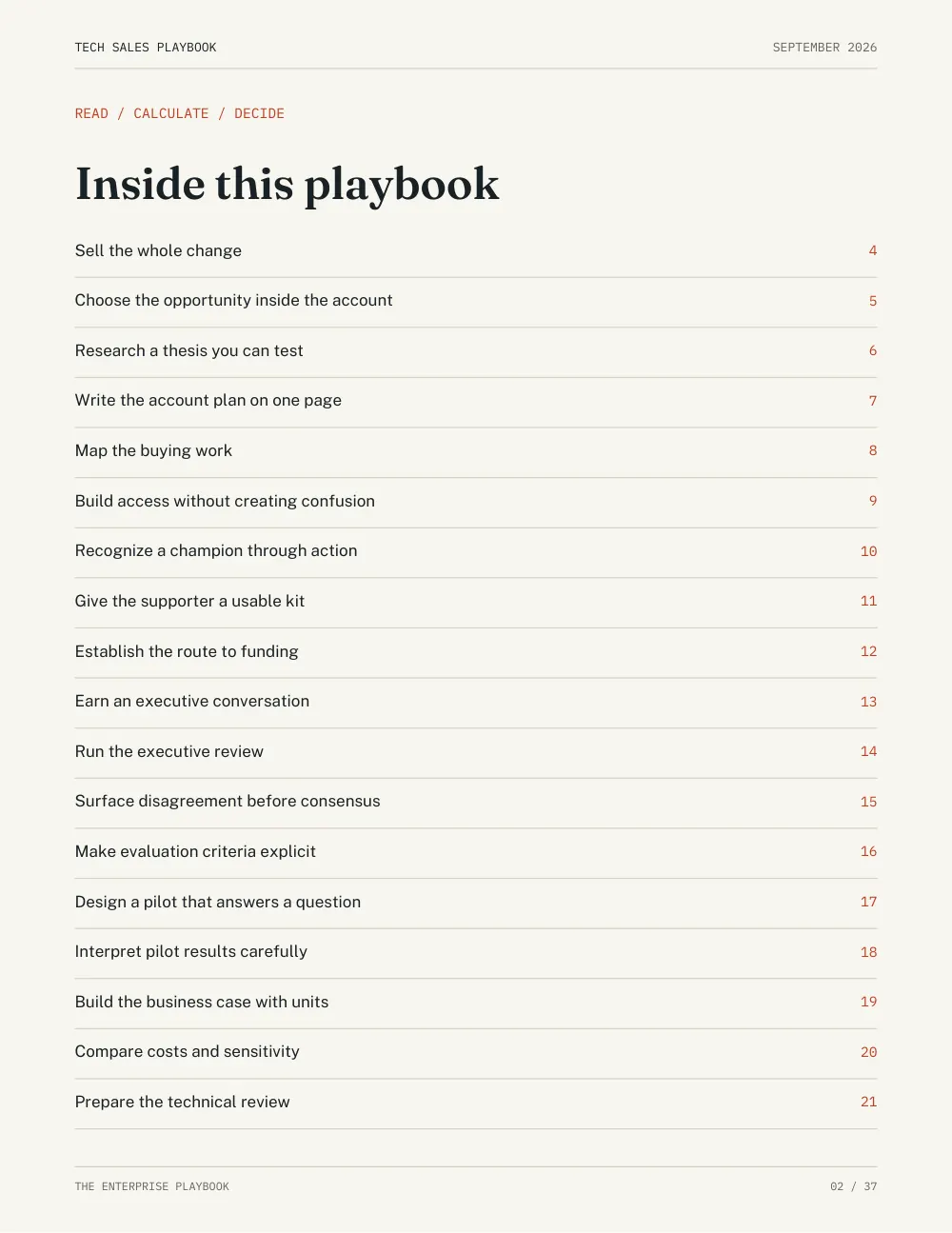
TECH SALES PLAYBOOK SEPTEMBER 2026 THE ENTERPRISE PLAYBOOK 02 / 37 READ / CALCULATE / DECIDE Inside this playbook Sell the whole change 4 Choose the opportunity inside the account 5 Research a thesis you can test 6 Write the account plan on one page 7 Map the buying work 8 Build access without creating confusion 9 Recognize a champion through action 10 Give the supporter a usable kit 11 Establish the route to funding 12 Earn an executive conversation 13 Run the executive review 14 Surface disagreement before consensus 15 Make evaluation criteria explicit 16 Design a pilot that answers a question 17 Interpret pilot results carefully 18 Build the business case with units 19 Compare costs and sensitivity 20 Prepare the technical review 21
TECH SALES PLAYBOOK SEPTEMBER 2026 THE ENTERPRISE PLAYBOOK 03 / 37 READ / CALCULATE / DECIDE Tools for the decision Coordinate security evidence 22 Navigate procurement and legal 23 Plan the dependencies together 24 Structure a multi-year proposal 25 Understand the incumbent's position 26 Make switching costs visible 27 Coordinate the seller's team 28 Manage risk and the forecast 29 Respond when the account changes 30 Plan adoption before signature 31 Earn regional expansion 32 Atlas: the decision changes 33 Worksheet: account strategy 34 Worksheet: stakeholder decisions 35 Worksheet: evaluation to rollout 36 Sources and edition notes 37
TECH SALES PLAYBOOK SEPTEMBER 2026 THE ENTERPRISE PLAYBOOK 04 / 37 01 / THE ENTERPRISE ASSIGNMENT Sell the whole change Enterprise selling asks you to help an organization make and implement a decision across several kinds of responsibility. A useful product demonstration may settle one question while leaving funding, integration, security and regional adoption unresolved. Your account strategy must connect those decisions without pretending one enthusiastic person can make them all. This book is for AEs taking responsibility for larger or more complex accounts. It covers selecting an opportunity within an account, researching a relevant hypothesis, building stakeholder access, supporting internal agreement and coordinating evaluation through implementation. Company size and contract value alone do not tell you which process to use. Let the buyer's actual complexity guide the work. Use it in three passes Before investing: complete the account thesis, opportunity selection and evidence map. Identify why this account deserves scarce specialist time. During evaluation: use stakeholder, champion, executive and pilot tools to resolve the decisions that could change the purchase. Before agreement: reconcile the business case, procurement route, commercial obligations and adoption plan. Transfer the decision record to delivery. Atlas Distribution is the original fictional case throughout this edition. Its prices, workflow volumes, people and results are teaching assumptions, not a customer story. Scripts, rubrics and worksheets are original applications. Linked sources support specific framework definitions and security-document distinctions; no source establishes a universal enterprise sales cycle or win rate. Start with a decision, not a logo: which team could make which purchase for which operational reason? If you cannot answer yet, your next task is focused discovery.
TECH SALES PLAYBOOK SEPTEMBER 2026 THE ENTERPRISE PLAYBOOK 05 / 37 02 / AN ACCOUNT IS NOT ONE DEAL Choose the opportunity inside the account A large company can contain several unrelated buying groups. A corporate strategy statement does not prove that a particular division has a funded project. Write down the smallest coherent opportunity you can investigate: a business unit, a workflow, a responsible owner and an outcome worth considering. At Atlas, the broad account thesis is that inconsistent exception handling across three regions creates rework. The first opportunity is narrower: the central operations team wants to evaluate a shared escalation workflow. Regional participation, IT capacity and spending authority remain unknown. Keep the account hypothesis separate from the opportunity evidence. A useful first filter Ask whether your product can support the intended use, whether the problem is material to an identifiable owner and whether there is a credible route to evaluation. Then consider timing, access and the resources your team would need to invest. A high potential contract value does not compensate for a known product mismatch. Signal What it establishes Relevant public initiative A reason to investigate, not proof of project funding. Buyer confirms workflow problem Evidence of a problem in that team's context. Owner accepts an evaluation question A defined next step, not a purchase commitment. Delivery confirms feasibility Support for the assessed scope, subject to stated limits. Review account potential and current opportunity quality separately. You can maintain a long-term relationship with a valuable account while declining to forecast an unqualified project. That distinction protects specialist time and keeps your next action grounded in something the buyer can actually decide.
TECH SALES PLAYBOOK SEPTEMBER 2026 THE ENTERPRISE PLAYBOOK 06 / 37 03 / FROM PUBLIC FACT TO BUYER QUESTION Research a thesis you can test Use public information to form a relevant question, not to narrate the buyer's business back to them. Start with the company's own reports, announcements, product information and job descriptions. Record the source, date and exact observation. Then write your interpretation in a separate field. The three-line research note Fact: Atlas has announced a fictional regional consolidation initiative. Hypothesis: operations may need a more consistent exception workflow. Question: Which processes are being standardized, and where does regional variation remain intentional? The hypothesis can be wrong. The company may already have solved the issue, or the initiative may concern another function. A good first conversation lets the buyer correct your premise quickly. Look for changes that could make your category relevant: a new operating model, acquisition, platform transition or service commitment. Do not infer personal motives or private financial distress from a title change or an isolated hiring signal. Keep research proportionate to the intended conversation. Your announcement describes a shared operating model across regions. I wondered whether exception routing is part of that work, or whether the regions will continue to manage it independently. Before using a claim, open its original source and check whether it refers to the current organization, period and geography. An old subsidiary announcement may not apply to today's buying group. If the source is ambiguous, ask a question rather than asserting a conclusion. Finish the research session with one account thesis, two uncertainties and a next action. A long dossier that does not improve the next conversation consumes time without improving the opportunity. Save useful source notes so colleagues can verify them without repeating the search.
TECH SALES PLAYBOOK SEPTEMBER 2026 THE ENTERPRISE PLAYBOOK 07 / 37 04 / A STRATEGY THAT CHANGES YOUR WEEK Write the account plan on one page An account plan should tell your team where to focus and what evidence would justify more investment. Start short enough to review in a working meeting. Link detailed research and relationship notes rather than pasting everything into the plan. Field Atlas example - fictional Account thesis Shared exception handling may support the regional operating-model initiative. Initial opportunity Central operations evaluates escalation workflow for three regions. Buyer outcome Reduce avoidable rework while preserving necessary regional controls. Evidence Operations confirms inconsistent routing; baseline and regional views remain open. Access plan Ask the operations lead to include regional and IT owners in scoping. Seller investment Discovery plus a bounded technical review before proposing a pilot. Stop or reconsider No responsible owner, unsupported requirements or no capacity to evaluate. Add the current opportunity stage under your company's definitions, the next buyer decision and the seller owner for each action. A strategy needs a choice: which entry point are you pursuing, and which attractive-looking distractions are you deferring? Review the plan when evidence changes. If one region has a materially different process, you may need a narrower initial scope. If central operations lacks authority, the route to funding may change. Updating the plan is part of strategy, not an admission that the first draft failed. Keep account-wide ambitions distinct from the current proposal. Do not multiply a small team's possible spend across every employee and present the result as qualified pipeline. Expansion is a hypothesis until the relevant teams confirm need, fit and a decision route.
TECH SALES PLAYBOOK SEPTEMBER 2026 THE ENTERPRISE PLAYBOOK 08 / 37 05 / ROLES BEFORE TITLES Map the buying work Map the work required for a decision before attaching names. Who owns the problem? Who will use the system? Who evaluates technical fit? Who approves spending? Who reviews risk and contracts? Who must implement the change? One person may own several roles, and some roles may be shared. At Atlas, central operations sponsors the workflow question. Regional managers own local execution. IT owns integration capacity. Security reviews data access. Finance evaluates the spending request. Procurement coordinates the purchase route. These are fictional assignments to be confirmed, not a universal enterprise organization chart. Record each stakeholder carefully For every person, capture their responsibility, stated concern, influence on this decision, current position and the evidence behind your assessment. Use neutral descriptions such as needs a regional exception path. Avoid labels such as blocker when the person is identifying a legitimate requirement. Who would need to live with the workflow after launch, and who could reject the proposed approach even if the operations team prefers it? An organization chart shows reporting relationships. A decision map shows who must do what for this purchase. Keep both only when both help. A senior executive can support a project without controlling a security review or regional implementation capacity. Leave unknown positions unknown. Silence is not support, a calendar acceptance is not approval and a copied email does not prove engagement. Your next action should reduce a specific uncertainty: confirm a role, hear a concern or obtain a decision. Add names through relevant introductions rather than collecting contacts without a reason to speak to them.
TECH SALES PLAYBOOK SEPTEMBER 2026 THE ENTERPRISE PLAYBOOK 09 / 37 06 / MULTIPLE RELATIONSHIPS, ONE ACCOUNT RECORD Build access without creating confusion Having more than one relationship can make an opportunity less dependent on a single person's availability. The relationships need a purpose. Ask the current contact which colleagues should participate and explain what each conversation will resolve. You own the operating outcome, and IT owns the integration work. Could we include the integration owner in a short scoping session so we do not build a proposal around an assumption they cannot support? Share the intended agenda and let the contact help shape it. If the organization has a formal vendor communication route, follow it. Uncoordinated outreach can create conflicting versions of the project or make the seller appear unaware of the buyer's process. A practical access record Name the person, the question to resolve, the introduction route, the seller owner and the result. At Atlas, the AE handles business discovery while a solution engineer joins the technical review. Both write into the same opportunity record. The buyer should not receive separate promises from separate members of your team. If a contact resists an introduction, ask why. The colleague may be unavailable, the scope may be premature or the buyer may not consider the project important enough. Do not assume the contact is protecting their status. Use the answer to adjust the next step. If the contact leaves, a clear account record and other relevant relationships help the next conversation begin from facts. Still ask the new owner to reassess the need. They do not inherit a purchase commitment merely because a predecessor liked the product. Reconfirm scope, priorities and authority before resuming the old forecast.
TECH SALES PLAYBOOK SEPTEMBER 2026 THE ENTERPRISE PLAYBOOK 10 / 37 07 / ADVOCACY YOU CAN OBSERVE Recognize a champion through action MEDDICC's champion guidance describes influence, internal advocacy and a vested interest in success. A helpful contact may offer insight without having all of those characteristics. Use the distinction to understand support; do not turn it into a label you impose on the customer. Look for relevant actions. Does the person correct your business case? Bring necessary colleagues into the evaluation? Explain the decision process accurately? Advocate for a useful next step when you are absent? These original evidence questions are practical checks, not proof that the deal will close. At Atlas, the operations lead shares requirements and likes the demonstration. That establishes engagement. When the lead convenes regional managers, incorporates their concerns and obtains a finance review, there is stronger evidence of internal influence and advocacy. What would your colleagues challenge in this proposal? I can help make the evidence clearer before you decide whether to recommend it. Support the person's actual objective. Give them accurate, editable material they can defend. Do not ask them to conceal limitations, invent executive approval or promise a decision outside their authority. A relationship becomes more useful when difficult information can be shared plainly. Reassess as the project changes. Someone influential in operations may have little authority over a new security requirement or a different business unit. Build the additional relationships the work requires. If a contact is willing to help but lacks influence, appreciate the help and ask how the real decision owners engage. Calling someone a champion in your CRM does not create the access, evidence or authority the opportunity still needs.
TECH SALES PLAYBOOK SEPTEMBER 2026 THE ENTERPRISE PLAYBOOK 11 / 37 08 / INTERNAL ADVOCACY MATERIAL Give the supporter a usable kit An internal supporter needs material that survives questions without the seller in the room. Build a small kit around the decision their colleagues need to make. Ask the supporter to edit it before sharing and remove anything they cannot substantiate. Four useful pieces Decision brief: the requested scope, problem, evidence, costs, alternatives and open conditions on one page. Evidence appendix: the relevant evaluation results, source assumptions and product limitations, linked to the brief. Objection notes: likely questions from finance, IT and regional owners, with honest answers or named follow-up owners. Next-action plan: the work, owners and dependencies needed for a decision and a workable launch. At Atlas, the brief states that a shared workflow could reduce rework. It does not claim the annual savings are proven. The appendix shows baseline assumptions and the pilot plan. Regional concerns are visible rather than removed to make the proposal look unanimous. If finance asked which number is least certain, which one would you point to? Let's make that assumption visible and decide whether it needs more evidence. Keep the material concise enough to use. A forty-slide seller deck may force the supporter to build their own summary under time pressure. An accurate one-page brief plus a traceable appendix gives them a clearer starting point. Update the version after scope or price changes. Do not let an old high-benefit, low-cost version keep circulating after the proposal changes. Never include your internal discount floor or private forecast discussion in the buyer's kit. The buyer needs a fair decision record, not your negotiation preparation.
TECH SALES PLAYBOOK SEPTEMBER 2026 THE ENTERPRISE PLAYBOOK 12 / 37 09 / ECONOMIC AUTHORITY Establish the route to funding MEDDICC defines the economic buyer as the person with overall authority in the buying decision. Apply that as a question to investigate. Do not infer authority solely from title, enthusiasm or attendance at an executive meeting. Ask how a purchase of this scope is funded and approved. Is spending already allocated, requested from a shared budget or dependent on another project's decision? Who can authorize the amount and obligations being proposed? Which approvals remain mandatory even after that person supports the purchase? For this scope, who decides whether the organization should make the investment, and what evidence do they need from the evaluation? At Atlas, the operations VP sponsors the project but finance requires an investment review. The AE should learn the review criteria and route. Meeting the VP does not establish that funding is approved or that security and procurement can be skipped. Prepare for the funding conversation with the business problem, alternatives, full cost and uncertainty. Ask what result would justify the investment and what competing priorities could displace it. Avoid a feature tour unless it addresses a criterion the decision owner actually cares about. If direct access is unavailable, ask the authorized contact how questions can reach the decision owner and how answers will be recorded. Mark the limitations of indirect information in your internal notes. You may continue useful work, but do not claim first-hand approval you have not received. Funding, contract signature authority and operational ownership can differ. Map each one explicitly so a late discovery about the approval route does not overturn your schedule.
TECH SALES PLAYBOOK SEPTEMBER 2026 THE ENTERPRISE PLAYBOOK 13 / 37 10 / A RELEVANT REASON TO MEET Earn an executive conversation An executive invitation should name a decision or uncertainty worth the executive's attention. Use the existing relationship and the buyer's preferred communication route when possible. Keep the request focused on their responsibility rather than your desire to meet someone senior. Original introduction request We have a draft scope and two open investment questions: whether regional consistency is a priority for this period, and what evidence would justify the change effort. Would a short review with the operations VP help us decide whether to continue the evaluation? Original executive opening Your team has identified avoidable rework in exception handling. We are testing whether a shared workflow can reduce it without removing regional controls. I would like to confirm the business priority and the evidence you would need before supporting an investment. These are live-conversation or introduction prompts, not a complete unsolicited email campaign. If you adapt them into outbound email, use the accurate identification, disclosure, address and opt-out workflow in the Outbound Playbook and your approved sending process. Prepare a brief that can be read quickly: decision, evidence, alternatives, costs and open questions. Ask the executive's assistant or contact about the available time and expected format. Arrive ready to shorten the agenda without losing the decision. Do not claim you are acting at another executive's request unless that request exists. Do not use a senior sponsor to pressure a reviewer to waive a substantive requirement. Executive involvement is useful when it clarifies priorities, allocates resources or resolves a decision within that person's authority.
TECH SALES PLAYBOOK SEPTEMBER 2026 THE ENTERPRISE PLAYBOOK 14 / 37 11 / DECISION, EVIDENCE, IMPLICATION Run the executive review Open with the outcome you want from the meeting, then confirm whether it is the right use of the time. State what is known, what remains uncertain and the choice the organization faces. Let the executive change the priority if your understanding is incomplete. An original fifteen-minute structure Use the first two minutes to confirm the decision and context. Spend the next five on evidence, alternatives and material uncertainty. Use five for the executive's questions and priorities. Reserve three to agree on the decision or next work. This is a planning aid; adapt to the actual conversation rather than enforcing a timer. At Atlas, the AE presents the rework baseline as an assumption to validate. The VP asks whether regional exception rules will survive standardization. That question changes the evaluation: regional control becomes an explicit acceptance criterion. The right response is to update the pilot, not to continue a prepared financial pitch as though nothing changed. That changes what we need to prove. I will add preservation of regional exception rules to the evaluation and confirm the acceptance test with the regional owners. Is that enough to justify continuing the assessment? After the meeting, send a short recap through the agreed channel. Separate the executive's decision from the seller's interpretation. Record conditions and owners. If the executive supported further evaluation, do not describe it as purchase approval. Brief the rest of the account team so later conversations use the corrected priorities. Executive meetings create value when they improve the work that follows, not simply when they add a senior name to a slide.
TECH SALES PLAYBOOK SEPTEMBER 2026 THE ENTERPRISE PLAYBOOK 15 / 37 12 / THE BUYING GROUP'S DIFFERENT NEEDS Surface disagreement before consensus Consensus does not require everyone to rank every issue identically. It requires a workable decision process in which relevant concerns are heard and the authorized owners decide how to proceed. Ask each group what it needs to support the proposed change and what it considers unacceptable. Atlas group Concern to resolve Central operations Consistent routing and visibility across regions. Regional managers Preserve necessary local exceptions and avoid extra administrative work. IT Integration scope, capacity and ownership. Security Data access and acceptable controls for the intended use. Finance Full cost and credible benefit assumptions. Write disagreements as decisions, not personality conflicts. Central wants one global routing rule while Region West needs a local exception is actionable. Region West is difficult is not. Bring the relevant owners together when a tradeoff crosses their responsibilities. Show the options, consequences and evidence needed. Ask who has authority to decide if preferences remain different. Do not announce consensus because the loudest participant agreed while others stayed silent. We have agreement on shared visibility and a difference on local routing. Can we define which exceptions must remain regional, then test whether the proposed design supports both needs? Record the disposition: accepted, rejected, conditioned or unresolved, with the responsible owner. A meeting that reveals a real incompatibility can be useful even if the deal narrows or stops. Your objective is a purchase the organization can implement, not an artificially unanimous meeting summary.
TECH SALES PLAYBOOK SEPTEMBER 2026 THE ENTERPRISE PLAYBOOK 16 / 37 13 / DEFINE WHAT WOULD COUNT AS FIT Make evaluation criteria explicit Agree on the requirements before designing the demonstration or pilot. Distinguish required capabilities, preferences and implementation constraints. Ask the buyer how each criterion will be judged and who can accept the result. Original Atlas acceptance record Criterion Evidence and decision owner Routing accuracy Agreed representative cases follow the intended path; operations accepts the result. Regional exceptions Named local rules remain available; each affected regional owner reviews. Integration Authorized technical assessment confirms supported access and dependencies. Usability Designated users complete agreed tasks and document friction. Operational impact Baseline and pilot measures are compared with limitations visible. Do not invent a scoring system that weights your strongest feature most heavily. If the buyer uses weights, let the responsible owners establish them and record why. A required criterion may be a gate rather than something that can be offset by points elsewhere. Ask what would cause the buyer to reject the product even if the demo is impressive. That question can expose a missing integration, unsupported deployment model or unacceptable change burden before either side invests in a long evaluation. If requirements change, version the record and assess the impact on work, timing and price. Avoid silently adding a new test while keeping an old success claim. A passed evaluation means the agreed scope passed the agreed criteria; it does not prove every future use case is supported. Conclude with a shared decision: is there enough fit to justify a bounded evaluation, or is the gap already decisive? Continuing by default can consume both teams' time without changing the answer.
TECH SALES PLAYBOOK SEPTEMBER 2026 THE ENTERPRISE PLAYBOOK 17 / 37 14 / BOUNDED WORK, CLEAR EXIT Design a pilot that answers a question A pilot should resolve a decision that cannot be settled adequately with existing evidence. Define scope, participants, data, access, success criteria, ownership, costs and the decision that follows. Agree on the end condition before starting. At Atlas, the proposed pilot tests a subset of exception cases in one region while including representative local rules. It cannot prove the behavior of every region automatically. The plan names what will be tested elsewhere before a broader rollout. Original pilot charter Question: can the proposed workflow reduce handling effort while preserving required routing and regional controls? Scope: agreed case types and authorized data in the assessed environment. Owners: buyer operations for cases, IT/security for access, seller specialist for configuration and issue tracking. Evidence: task outcomes, handling-time observations, errors and user feedback under a documented method. Exit: review results and limitations, then approve a next scope, extend for a specific unresolved question or stop. Do not describe a free pilot as costless. The buyer and seller still invest staff time, setup work and possibly other resources. Make the investment proportionate to the decision. If the pilot answers these questions, what decision will the team be able to make? If the answer is another unspecified pilot, let's clarify what is missing before we start. Use approved agreements and data-handling processes. Never introduce customer data or unsupported integrations simply to speed up a demo. If access is delayed, revise the schedule and evidence plan rather than substituting a different test while retaining the original success claim.
TECH SALES PLAYBOOK SEPTEMBER 2026 THE ENTERPRISE PLAYBOOK 18 / 37 15 / OBSERVED RESULT VERSUS ROLLOUT ASSUMPTION Interpret pilot results carefully Atlas's fictional pilot observes 500 comparable cases. Average handling time is 6 minutes in the baseline and 4.2 minutes in the pilot. The difference is 1.8 minutes per case, or 30% of the baseline. Across those 500 cases, the observed difference is 900 minutes, equivalent to 15 hours. Those calculations describe the example. They do not establish causation or guarantee the same improvement across every region. Ask whether case mix, staffing, measurement method, training, seasonality or other changes could explain part of the difference. The result note should include What was measured, over which cases and period, with what exclusions. The baseline and pilot methods, including whether they are comparable. Errors, rework or downstream effort that could offset apparent time savings. Which requirements passed and which remain untested or failed. The buyer owner's interpretation and the next decision supported by the evidence. At Atlas, one region's cases may be simpler than another's. A 30% improvement can be a scenario input for planning, clearly labeled, while broader validation remains open. Do not describe it as a company-wide measured result. We observed a fifteen-hour handling-time difference in the pilot sample. Before using the same rate across all regions, which differences in case mix or workflow should we test? Report unfavorable findings too. If faster handling produces routing errors, the result may not meet the actual objective. A pilot that disproves fit has still answered a decision question. Hiding the failure simply transfers the problem into implementation.
TECH SALES PLAYBOOK SEPTEMBER 2026 THE ENTERPRISE PLAYBOOK 19 / 37 16 / VALUE THAT FINANCE CAN EXAMINE Build the business case with units Use a model the buyer can inspect and change. Separate measured inputs from assumptions, capacity value from cash savings and recurring costs from one-time work. Identify the person who owns each input and the decision the model is meant to inform. Atlas's fictional planning baseline is 5,000 cases per month at 6 minutes of handling effort each. That is 30,000 minutes, or 500 hours per month. Across twelve comparable months, it becomes 6,000 hours. At an assumed loaded labor value of $55 per hour, the annual capacity value is $330,000. If a 30% handling-time reduction were sustained across that volume, the released capacity would be 1,800 hours, valued at $99,000 per year. This is a scenario extrapolated from a bounded pilot, not a measured annual outcome. It is not automatically payroll savings: people may use the released time for other work. Keep the model honest Ask whether volume varies, whether the time includes work the product can change and whether the hourly value is appropriate. Ask what happens to the released capacity. Avoid adding revenue benefits from the same hours unless a separate, defensible causal path prevents double counting. Which inputs would finance accept today, and which should remain a sensitivity range? If the organization gains capacity but does not reduce spending, how should that benefit be evaluated? Show the unrounded calculations in your working file and round only the presentation as appropriate. A precise-looking answer from uncertain inputs is still uncertain. The purpose is to expose the investment decision, not to manufacture a large ROI label.
TECH SALES PLAYBOOK SEPTEMBER 2026 THE ENTERPRISE PLAYBOOK 20 / 37 17 / LET THE MODEL SAY NO Compare costs and sensitivity Assume Atlas's proposal costs $90,000 per year plus $20,000 implementation. First-year seller charges total $110,000, before any taxes, internal labor, migration, overlap or other applicable costs. Against the $99,000 annual capacity-value scenario, the simple first-year difference is negative $11,000. Reduction scenario Annual capacity value Less $110,000 first-year charges 20% of baseline $66,000 -$44,000 30% of baseline $99,000 -$11,000 40% of baseline $132,000 $22,000 The break-even reduction on this limited comparison is $110,000 / $330,000, approximately 33.3%. That assumes a full year of benefit and ignores additional costs. A delayed rollout or extra work would worsen the comparison. These are capacity-value comparisons, not cash ROI or a guarantee of economic return. A negative result is a reason to reconsider scope, price, evidence or whether the purchase is justified. Do not add an unsupported revenue benefit merely to make the total positive. If the buyer has a separate risk or service objective, describe it with its evidence and uncertainty rather than assigning a convenient invented dollar value. At Atlas, finance might prefer a narrower initial deployment or ask for more evidence of operational value. The seller should support that decision honestly. A smaller, useful project can be better than a broad agreement the customer cannot justify. At the current assumptions, the first-year comparison is negative. Let's identify whether a different scope is useful or whether the investment should wait.
This is meant to be opened while you work. The sections are concrete enough to copy, practice, adapt, and reuse during applications, interviews, calls, and weekly execution.
Account planning methodology
Stakeholder mapping and analysis
Executive outreach and engagement
Building internal champions
Procurement and legal navigation
Multi-year deal structuring
Competitive displacement strategies
Map account priorities and decision responsibilities.
Design an evaluation with measurable criteria.
Coordinate commercial, security and rollout work.
The sample exists so buyers can inspect the writing style, structure, and depth before purchase. If the sample feels useful, the full PDF continues with the same practical format.
What you are buying
Before you decide
Start with the question that matters to you. You can use the free material without making a purchase.
Try one relevant task first. If that resolves your immediate question, keep using the free resources. Inspect the book’s sample when you need more structured practice.
Try the related free resourcePlan complex accounts, align stakeholders, and guide evaluation through rollout.
Use this as a self-study routine, adjusting it to the material. Completing a session is not a certification or an assessment of hiring readiness.
Choose one book for a focused gap. Consider a bundle only if you will use its listed books; compare the exact contents and avoid paying twice for material you already own.
A PDF is self-directed preparation. Individual feedback on your own resume is a separate service with its own scope and availability.
Compare the resume serviceCheck the current price, included files, delivery instructions and refund terms before opening checkout.
Read the actual sample and file details on this page. If you need help with an order or access, contact support with your question rather than placing a second order.
Read purchase and refund termsAsk a product or access question$29 PDF download
$29 PDF download
$39 PDF download
$29 PDF download
$19 PDF download
$19 PDF download
$19 PDF download
$19 PDF download
$19 PDF download