Best For
- Career changers
- Recent graduates
- Candidates without formal sales experience
- New SDRs planning the next step
Loading...
A 104-page, eighteen-chapter playbook for career changers and new grads. Covers roles, training, company research, resumes, LinkedIn, applications, portfolios, interviews, mock calls, offers, ramp, SDR-to-AE development, and AI-assisted preparation. Includes forty-four scripts, worked examples, and three reusable worksheets.
Start here when you want one complete path from zero experience to a first SDR offer and a credible ramp plan.
104 pages
Finished PDF playbook
20-page preview
Review the sample first
30-day guarantee
Instant access after checkout
Look inside
The full playbook runs 104 pages.
These 20 are the real thing, not a summary.
Page 1 / 20
Text from the same public sample shown above. Use the page images or PDF for diagrams, tables and original layout.
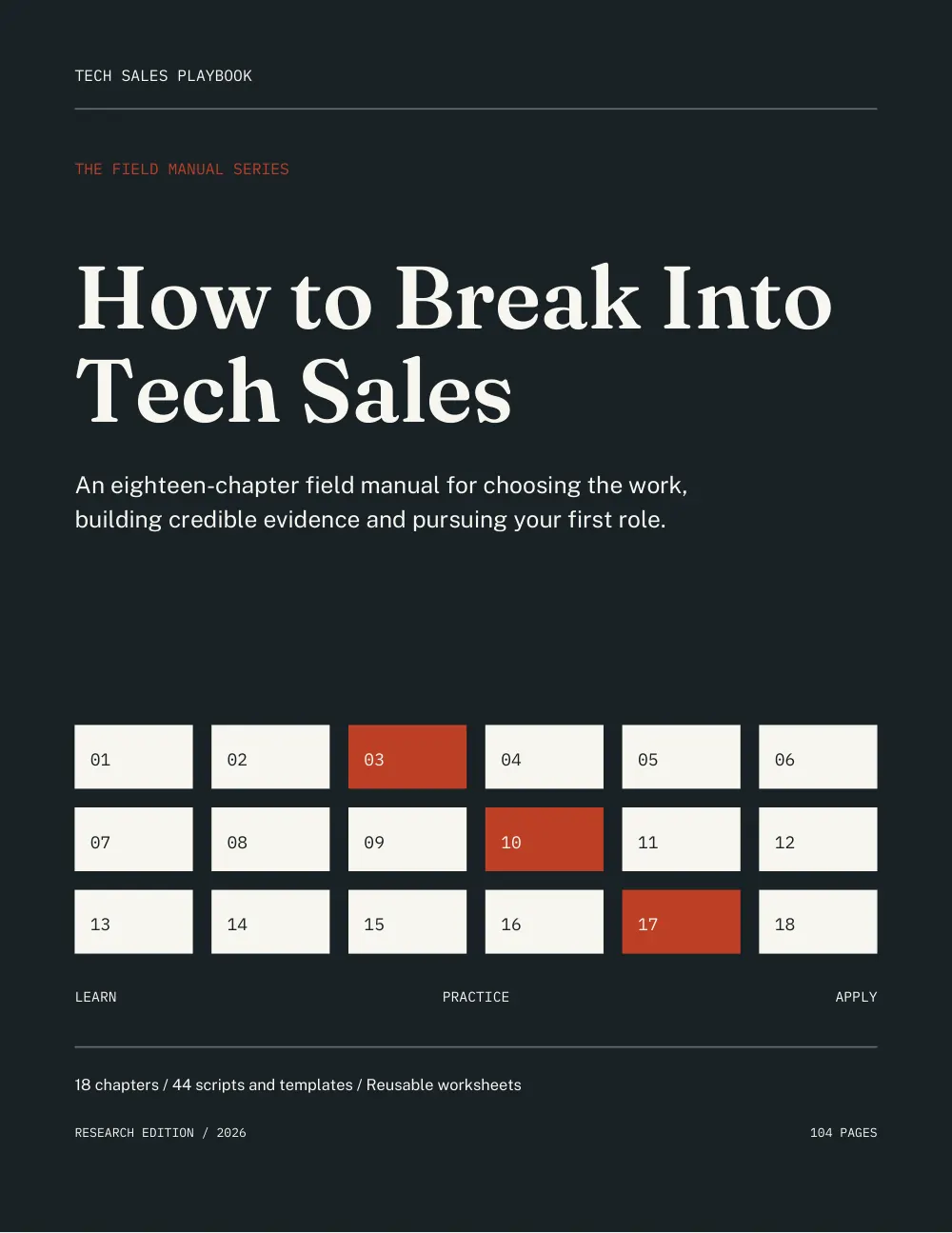
TECH SALES PLAYBOOK THE FIELD MANUAL SERIES How to Break Into Tech Sales An eighteen-chapter field manual for choosing the work, building credible evidence and pursuing your first role. 01 02 03 04 05 06 07 08 09 10 11 12 13 14 15 16 17 18 LEARN PRACTICE APPLY 18 chapters / 44 scripts and templates / Reusable worksheets RESEARCH EDITION / 2026 104 PAGES
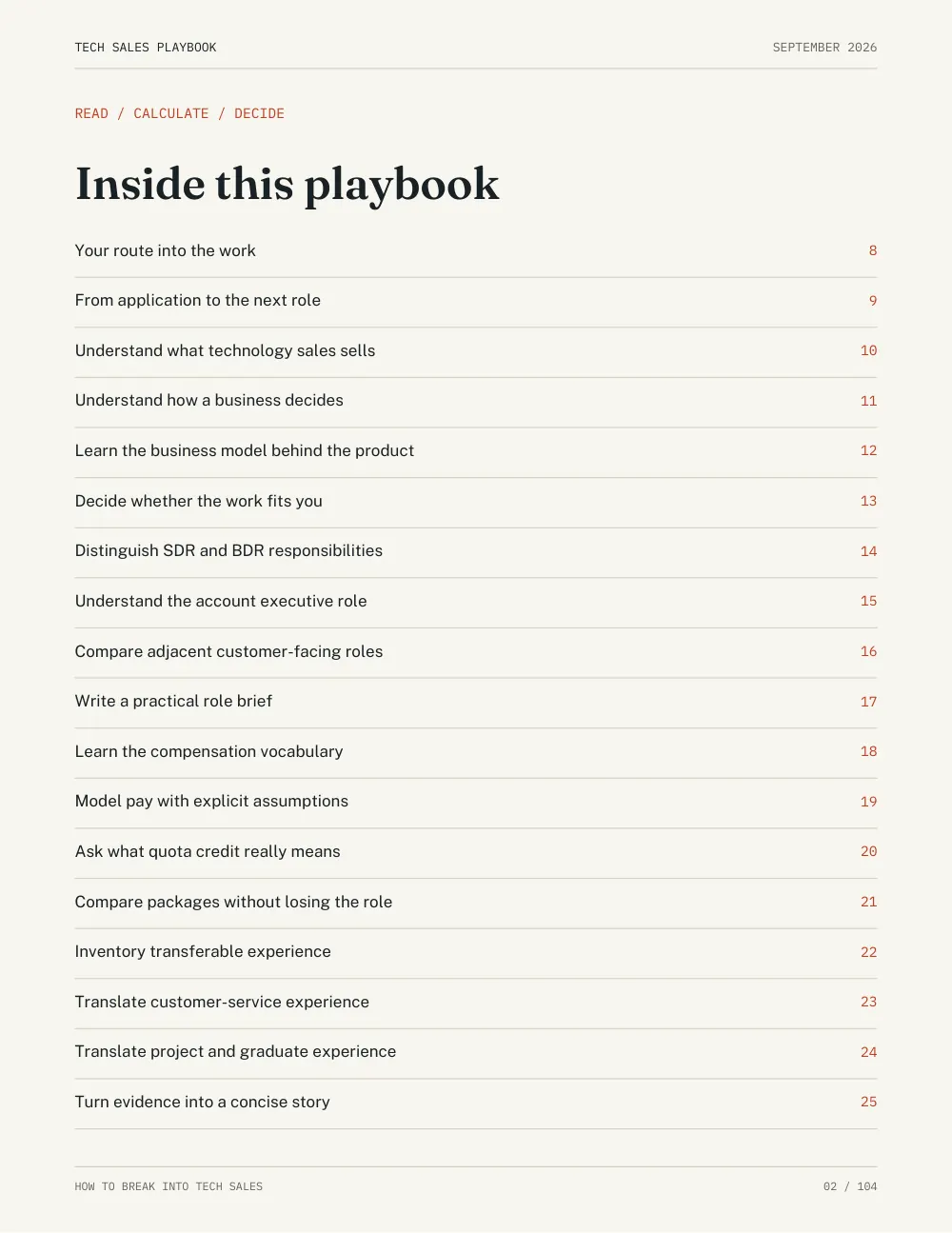
TECH SALES PLAYBOOK SEPTEMBER 2026 HOW TO BREAK INTO TECH SALES 02 / 104 READ / CALCULATE / DECIDE Inside this playbook Your route into the work 8 From application to the next role 9 Understand what technology sales sells 10 Understand how a business decides 11 Learn the business model behind the product 12 Decide whether the work fits you 13 Distinguish SDR and BDR responsibilities 14 Understand the account executive role 15 Compare adjacent customer-facing roles 16 Write a practical role brief 17 Learn the compensation vocabulary 18 Model pay with explicit assumptions 19 Ask what quota credit really means 20 Compare packages without losing the role 21 Inventory transferable experience 22 Translate customer-service experience 23 Translate project and graduate experience 24 Turn evidence into a concise story 25
TECH SALES PLAYBOOK SEPTEMBER 2026 HOW TO BREAK INTO TECH SALES 03 / 104 READ / CALCULATE / DECIDE Tools for the decision Choose a skill gap before choosing a course 26 Use free learning with an application task 27 Evaluate a paid program before enrolling 28 Run a two-week learning experiment 29 Research a relevant account question 30 Ask questions that follow the answer 31 Qualify a next step without assuming a sale 32 Write a handoff another person can use 33 Compare companies with a short rubric 34 Build a company brief for an application 35 Verify openings and recruiting contacts 36 Create a shortlist you can actually work 37 Build a resume around relevant evidence 38 Write bullets that withstand a follow-up 39 Read a complete positioning example 40 Tailor and check the exported file 41 Write a profile headline that orients the reader 42 Build an About section and choose visibility 43
TECH SALES PLAYBOOK SEPTEMBER 2026 HOW TO BREAK INTO TECH SALES 04 / 104 READ / CALCULATE / DECIDE Tools for the decision Map real relationships and useful requests 44 Learn from an informational conversation 45 Complete the application as a quality check 46 Use career outreach to make one clear request 47 Follow up around an actual next action 48 Measure the search without inventing causation 49 Choose a portfolio task that answers a question 50 Build a sample with a visible decision 51 Include a mock-call reflection 52 Review and share the portfolio carefully 53 Prepare for the actual interview stage 54 Answer introduction and motivation questions 55 Prepare behavioral evidence and a gap answer 56 Handle assignments and presentations 57 Establish the mock-call scenario 58 Practice a clear first conversation 59 Respond to objections and feedback 60 Review practice with observable criteria 61
TECH SALES PLAYBOOK SEPTEMBER 2026 HOW TO BREAK INTO TECH SALES 05 / 104 READ / CALCULATE / DECIDE Tools for the decision Review the written offer and role conditions 62 Test an offer under different scenarios 63 Negotiate a specific term honestly 64 Make the decision and close the loop 65 Use the first month to learn the standards 66 Apply feedback during the second month 67 Review progress during the third month 68 Keep a weekly operating review 69 Understand the gap between SDR and AE 70 Align development with your manager 71 Build a readiness portfolio with honest labels 72 Evaluate internal and external next steps 73 Use AI for bounded preparation tasks 74 Verify facts and protect sensitive inputs 75 Practice with prompts that preserve ownership 76 Build a reviewed workflow you can repeat 77 Clarify the work before investing more time 78 Start a relevant learning conversation 79
TECH SALES PLAYBOOK SEPTEMBER 2026 HOW TO BREAK INTO TECH SALES 06 / 104 READ / CALCULATE / DECIDE Tools for the decision Confirm and follow through on advice 80 Ask for a referral with an easy choice 81 Introduce an application with relevant evidence 82 Follow up on an open action 83 Coordinate interview scheduling clearly 84 Introduce your background honestly 85 Explain motivation and company interest 86 Discuss feedback and experience gaps 87 Clarify and deliver an assignment 88 Thank the interviewer and correct facts 89 Communicate timing or withdrawal 90 Respond to rejection and future contact 91 Clarify the offer and ramp terms 92 Negotiate and ask for review time 93 Accept or decline clearly 94 Prepare for the first day and manager meeting 95 Route unknowns and changing priorities 96 Ask for feedback and report a useful review 97
TECH SALES PLAYBOOK SEPTEMBER 2026 HOW TO BREAK INTO TECH SALES 07 / 104 READ / CALCULATE / DECIDE Tools for the decision Open a next-role development conversation 98 Review promotion timing or an external role 99 Worksheet: your role and company decision 100 Worksheet: your evidence and practice record 101 Worksheet: your weekly search review 102 Sources and edition notes 103 Source notes for the search and interviews 104
TECH SALES PLAYBOOK SEPTEMBER 2026 HOW TO BREAK INTO TECH SALES 08 / 104 START HERE / CHAPTERS 01-09 Your route into the work This book is for career changers, graduates and people exploring their first technology-sales role. It connects the decisions that often get treated separately: which job to pursue, what to learn, how to show relevant experience and how to assess an offer. The aim is a credible route toward suitable work. No book can control an employer's headcount, timing or hiring decision. The examples are fictional, the tools are original and the schedules are planning aids. Replace every example accomplishment with your own evidence. Chapter What you will produce 01. The landscape A realistic understanding of the work 02. Roles and fit A role brief with practical constraints 03. Compensation Defined pay terms and scenario calculations 04. Transferable evidence A bank of experience you can explain 05. Training choices A learning plan tied to an actual gap 06. Selling fundamentals Research, questions and useful handoff notes 07. Company selection A prioritized, verified target list 08. Resume Clear, accurate application evidence 09. Profile and network Positioning and useful career conversations Read in order if the field is new to you. If an interview is already scheduled, use the contents to reach the relevant preparation chapter, then return to any foundational gap it exposes. Complete the work products as you go. A short role brief or reviewed practice call is more useful than highlighting every page while postponing the next decision. The focused books in this collection provide deeper treatment of individual skills; this manual connects them into a complete entry path.
TECH SALES PLAYBOOK SEPTEMBER 2026 HOW TO BREAK INTO TECH SALES 09 / 104 START HERE / CHAPTERS 10-18 From application to the next role The second half turns preparation into applications, interviews and informed employment decisions. It then follows the transition into work and the longer development path. Those are related stages, not a guaranteed timetable. Chapter What you will produce 10. Application and outreach A tracker and purposeful follow-up plan 11. Practice portfolio A labeled sample with visible reasoning 12. Interviews True answers and a stage-specific brief 13. Mock calls Reviewed practice and a specific redo 14. Offers A comparison of terms and unresolved questions 15. First ninety days A ramp plan aligned with the manager 16. SDR to AE A development map with evidence and gaps 17. AI-assisted work A reviewed workflow that preserves accuracy 18. Script library Forty-four adaptable scripts and templates Use the library deliberately The scripts support role research, networking, applications, interviews, offers and development conversations. They are not a sequence to send to one person. Each has a purpose and conditions for use. Keep the underlying facts accurate and the request appropriate to the relationship. Keep a working folder Save the role brief, resume versions, source notes, practice artifacts and application tracker. Keep private information secure. Preserve what you submitted so later conversations do not drift into a different account of your background. The three worksheets at the end help you record role fit, evidence and weekly decisions. Source notes explain the bounded external guidance used. When a platform or employer process changes, follow its current instructions and update your plan.
TECH SALES PLAYBOOK SEPTEMBER 2026 HOW TO BREAK INTO TECH SALES 10 / 104 CHAPTER 01 / THE LANDSCAPE Understand what technology sales sells Technology sales connects a product or service to a customer's decision. The product might be software, infrastructure, a technical service or a combination. The work includes understanding the customer's situation, evaluating fit and coordinating a credible next step. A seller does not need to be the engineer who built the product. They do need enough understanding to explain supported capabilities, ask useful questions and involve the right specialist when a requirement exceeds their knowledge. A fictional example Cedar Systems provides software that assigns incoming requests and shows whether a receiving team has accepted a handoff. A possible customer is an operations team that currently checks acceptance manually. The seller's task is to learn whether that workflow creates a meaningful problem and whether the product fits. The capability alone does not establish value. The customer may already have a satisfactory process, lack a relevant need or require an integration that is not supported. Good selling makes those facts clearer rather than pretending every company should buy. What to learn first Who uses the product? Who decides whether to buy? Which problem does it address? What is supported, what requires configuration and what remains unknown? How does the team deliver the product after a sale? Salesforce's role overview describes understanding customer challenges and connecting them with solutions as part of sales work. It is a provider's role description, not a universal hiring standard. Sales role overview Write a plain-language product explanation before collecting acronyms. If you cannot explain what the customer would do differently, return to the workflow and the supported capability.
TECH SALES PLAYBOOK SEPTEMBER 2026 HOW TO BREAK INTO TECH SALES 11 / 104 CHAPTER 01 / THE BUYING WORK Understand how a business decides Business purchases can involve several people with different responsibilities. A user may care about daily workflow, a manager about outcomes, a technical owner about compatibility and an authorized approver about cost and risk. The actual arrangement varies by customer. A simple decision map Question What the seller needs to understand Is there a relevant problem? Current workflow and consequence Is change worthwhile? Priority, alternatives and expected value Does the product fit? Requirements and evidence from evaluation Can the organization proceed? Decision owners, approvals and execution steps What happens afterward? Implementation ownership and intended use The map is an original teaching framework. It is not a claim that every buyer follows a fixed sequence. A technical review may begin early, and priorities can change after evaluation. Cedar example An operations manager sees requests waiting between teams. A systems lead needs to evaluate how Cedar would connect to existing tools. Another person may authorize spending. Interest from the operations manager is useful, but it does not establish technical approval or a signed purchase. As a new SDR, you may own only the first conversation and handoff. Understanding the broader decision helps you collect useful information without pretending to own the entire sale. Ask what is confirmed and what remains a hypothesis. A meeting is a commitment to meet, not necessarily a commitment to buy. Learning to preserve that distinction will improve both your interview answers and your later work records.
TECH SALES PLAYBOOK SEPTEMBER 2026 HOW TO BREAK INTO TECH SALES 12 / 104 CHAPTER 01 / RECURRING AND ONE-TIME WORK Learn the business model behind the product Read how the actual company sells and delivers its offering. A subscription, usage-based service, license and implementation project can create different customer questions. Do not assume every technology business uses the same pricing or sales motion. Terms to clarify A subscription may charge for ongoing access. Usage pricing may depend on a measured unit. Implementation can involve a separate fee and delivery work. Renewals, expansion and support may be owned by different teams. Ask how those responsibilities are divided. Fictional package Suppose a product has a $24,000 annual subscription and a $3,000 one-time implementation fee. First-year charges are $27,000 if both apply in that year. The recurring subscription amount is still $24,000. Do not call the entire $27,000 recurring revenue or assume the same charge repeats every year. This is simple contract-value arithmetic, not an accounting determination. Recognized revenue, cash collection and sales credit may follow different rules. Use the company's actual definitions in work and interviews. Why this matters to a candidate The model affects what customers evaluate and what a seller needs to explain. A usage product may raise questions about consumption and forecasting. A large implementation may require delivery coordination. A renewal role may focus on adoption and ongoing value. During company research, write down the known model and unresolved questions. Avoid inventing prices or contract terms when they are not public. You can show commercial curiosity by identifying what you need to learn rather than pretending to know the company's internal economics.
TECH SALES PLAYBOOK SEPTEMBER 2026 HOW TO BREAK INTO TECH SALES 13 / 104 CHAPTER 01 / EXPECTATIONS WITHOUT THE HYPE Decide whether the work fits you Consider the ordinary work, not only the success stories. Sales can involve research, repeated outreach, uncertain responses, careful notes, feedback, performance targets and coordination with colleagues. The balance differs by role and employer. Questions for yourself Am I willing to practice conversations and receive specific feedback? Can I follow through on small commitments and keep records accurate? Do I want to understand a customer problem before recommending something? How do I respond when effort does not produce an immediate result? Which schedule, location and compensation conditions do I need? You do not need a particular personality stereotype to explore the field. At the same time, enthusiasm alone does not prove fit. Test your interest with role research, a conversation with someone doing the work and a bounded practice exercise. A useful first experiment Read a real SDR posting. Explain its duties in plain language. Build a fictional account brief and practice a first conversation with a willing partner. Review which parts interested you and which required more effort. That exercise is not a hiring test and cannot predict your future performance. It gives you better information than choosing a career solely from a compensation screenshot or a promise of remote work. Write your current decision: pursue this role, investigate another sales role or learn more before applying. Include the evidence and uncertainty behind it. You can change the decision as you learn; you do not need to defend an early choice after the facts change.
TECH SALES PLAYBOOK SEPTEMBER 2026 HOW TO BREAK INTO TECH SALES 14 / 104 CHAPTER 02 / ROLES AND FIT Distinguish SDR and BDR responsibilities Sales development often focuses on identifying potential fit and creating useful first conversations. Employers use SDR and BDR titles differently, so read the responsibilities rather than assuming a title tells you the exact work. Compare the motion Inbound work may involve responding to expressed interest and clarifying needs. Outbound work may involve researching accounts and initiating contact. A role can combine both. Ask which channels, customer groups and qualification criteria apply. What a handoff might contain Confirmed account context, relevant contact role, current workflow, stated concern, known requirements, important unknowns and the purpose of the next conversation. The receiving AE should be able to distinguish what the buyer said from the SDR's hypothesis. Questions for the employer How is a qualified meeting or opportunity defined? Who accepts it? How are disputes handled? What changes during ramp? Which activities and outcomes are reviewed? How do SDRs work with AEs and marketing? Do not assume that high activity alone means strong performance or that every booked meeting receives credit. The actual team's definitions matter. Candidate evidence Research, listening, clear writing, organized follow-up and response to feedback are relevant areas to demonstrate. A newcomer can show transferable examples and labeled practice. A current rep should explain actual results with the metric, period and ownership. Write the role as a sentence: This team needs someone to research [accounts], contact [roles] and create [defined next step]. If the posting does not let you complete the sentence, record the missing question for the recruiter.
TECH SALES PLAYBOOK SEPTEMBER 2026 HOW TO BREAK INTO TECH SALES 15 / 104 CHAPTER 02 / OPPORTUNITY OWNERSHIP Understand the account executive role An account executive may own more of the customer decision, including discovery, evaluation coordination, commercial discussions and execution. The exact scope varies. Some roles include prospecting, renewals or expansion; others divide those responsibilities across teams. What changes from sales development The work can require deeper problem analysis, stakeholder coordination, judgment about opportunity quality and management of a longer set of commitments. A good first conversation is valuable, but it does not by itself prove readiness to own those decisions independently. A fictional example Priya is an AE working with operations teams. She coordinates an evaluation after the customer identifies a handoff problem. A solutions engineer validates technical requirements. Priya helps the customer compare scope options and works with authorized colleagues on commercial terms. The customer controls its approvals and final purchase decision. Questions to investigate Which stages would you own? What support exists for technical work? How are accounts assigned? What constitutes a qualified opportunity? How does the manager review forecast judgment? Who handles implementation and ongoing customer success? An AE title can describe very different segments and complexity. Do not assume a job is suitable merely because it offers a larger OTE than an SDR opening. For a first sales role, consider whether the employer expects existing closing experience or provides a credible training path. If you apply without direct experience, make the gap explicit and show relevant evidence. Do not relabel a practice scenario as a closed deal to appear ready.
TECH SALES PLAYBOOK SEPTEMBER 2026 HOW TO BREAK INTO TECH SALES 16 / 104 CHAPTER 02 / MORE THAN ONE ENTRY PATH Compare adjacent customer-facing roles Technology companies employ people across customer success, account management, solutions consulting, support, partnerships and sales operations. Titles and responsibilities vary. Investigating adjacent work can improve your decision even if you ultimately choose SDR. Original comparison prompts Role family Responsibility to investigate Customer success Adoption, outcomes, relationship and renewal involvement Account management Existing-account commercial ownership and expansion Solutions consulting Technical discovery, demonstration and validation Support Troubleshooting, case resolution and escalation Partnerships Partner relationships and shared business activity Sales operations Process, systems, reporting and execution support This table identifies questions, not universal job definitions. Check each posting for required experience, technical depth, quota responsibility and daily work. Use your evidence honestly A customer-service background may connect to support or customer success as well as sales development. An analytical background may be relevant to operations. Technical experience may help with a solutions role, but that role may also require skills you have not yet demonstrated. Avoid treating adjacent roles as inferior fallbacks or guaranteed shortcuts into AE work. Choose work that fits your interests and constraints, then understand its actual development options. Make a small comparison using two real postings. Identify the duties, evidence you can offer, important gaps and questions to ask. The result should help you choose where to spend application effort rather than multiplying titles without a clear reason.
TECH SALES PLAYBOOK SEPTEMBER 2026 HOW TO BREAK INTO TECH SALES 17 / 104 CHAPTER 02 / YOUR SEARCH FILTER Write a practical role brief Before building a company list, write what makes an opening suitable. Separate essential conditions from preferences. This prevents an attractive title or salary headline from hiding a practical mismatch. Role brief fields Target responsibilities; customer or product interests; location and work arrangement; schedule and travel constraints; experience you can demonstrate; learning needs; and compensation terms you need to understand. Fictional Maya brief Maya seeks an SDR role involving research, initial conversations and clear AE handoffs. Her evidence includes customer explanations, a follow-up log and a shift-handoff checklist. She wants structured feedback and needs a compatible location and schedule. She has not carried a sales quota and needs to learn the product and qualification process. Required, preferred and unknown Required conditions must be met for the role to work. Preferences can be traded off. Unknowns need investigation. Do not score an unknown as a confirmed benefit simply because the company seems impressive. For compensation, distinguish written base pay from target variable compensation. An optimistic payout scenario is not dependable income. The next chapter explains the arithmetic and questions. Use the brief Compare each serious opening with these fields before tailoring an application. If a requirement is unclear, ask through the employer's appropriate route. Do not invent a universal rule that candidates should apply whenever they meet a particular percentage of the posting. Revisit the brief when new information changes your understanding. Keep the reason for the revision so your search evolves from evidence rather than from whichever job advertisement you saw most recently.
TECH SALES PLAYBOOK SEPTEMBER 2026 HOW TO BREAK INTO TECH SALES 18 / 104 CHAPTER 03 / BASE, VARIABLE AND OTE Learn the compensation vocabulary OTE combines base salary and target variable compensation. Actual earnings depend on the plan and performance conditions. Salesforce's explanation supports this basic distinction; it does not establish a salary benchmark for your role. OTE definition Terms to ask about Term Question to resolve Base What fixed gross salary is stated? Target variable What incentive amount applies at target performance? Quota Which metric and period define the target? Credit What event earns performance credit? Payout When and how is earned incentive paid? Ramp How do expectations and pay work while learning? A draw, guarantee, threshold, accelerator or clawback can change the result. The label alone is insufficient; read the actual terms. Ask whether a draw is recoverable and how offsets or departure conditions work rather than assuming it is a bonus. Keep categories separate Signing bonuses, benefits, equity and reimbursement are not interchangeable with recurring base pay. A headline package total can conceal different timing, conditions and uncertainty. If the recruiter provides a range, ask which role level and location it applies to. Do not assume the top of the range is an offer or that every candidate receives the same terms. Keep a compensation question list in your application record. Early conversations can establish broad fit; before accepting, material details should be resolved in the relevant documents. The Comp Playbook provides deeper examples of payout mechanics and offer comparison.
TECH SALES PLAYBOOK SEPTEMBER 2026 HOW TO BREAK INTO TECH SALES 19 / 104 CHAPTER 03 / A WORKED LINEAR PLAN Model pay with explicit assumptions Suppose a fictional annual plan pays $60,000 base plus $24,000 target variable. OTE is $84,000. For this exercise, variable pay scales directly with individual attainment, with no thresholds, caps, accelerators, draws or other adjustments. Individual attainment Variable pay Total gross annual cash 0% $0 $60,000 50% $12,000 $72,000 75% $18,000 $78,000 100% $24,000 $84,000 At 75%, the formula is $60,000 + ($24,000 x 0.75) = $78,000. The base is included once. Do not multiply total OTE by attainment and then add base again. What the table does not say These are scenarios, not predicted earnings. A real plan may not pay linearly. The same attainment percentage can be harder to achieve in different territories or roles. The table also excludes taxes, deductions, benefits and one-time payments. A team statistic is different If 55% of a team reached quota, that does not mean your individual attainment will be 55%. It does not tell you average payout either. Ask which population and period the statistic describes and what it actually measures. Use the model to make the mechanics understandable, then replace its assumptions with the actual plan. If an important rule is missing, record the uncertainty rather than filling it with the most attractive interpretation.
TECH SALES PLAYBOOK SEPTEMBER 2026 HOW TO BREAK INTO TECH SALES 20 / 104 CHAPTER 03 / THE EVENT BEHIND THE NUMBER Ask what quota credit really means For an SDR, meetings booked, meetings held and accepted opportunities may be separate measures. For an AE, the plan may use a defined contract or revenue measure. Ask which event earns credit and who validates it. Fictional SDR record Jordan books 36 meetings in a quarter, 30 are held and 27 meet the team's acceptance criteria. If the target is 24 accepted meetings, attainment is 27 / 24 x 100 = 112.5%. The booked count is not the attainment numerator in this example. Questions for the plan owner What makes a meeting accepted? What happens after a cancellation or reschedule? How are duplicate accounts and shared work handled? When is credit finalized? How are disputes reviewed? Can the rules change, and how is that communicated? Separate activity from outcome Activity can help a manager understand effort and process. It does not automatically establish customer value or payable credit. Likewise, an accepted meeting does not prove a later sale closed because of one person's work alone. When reviewing team attainment information, clarify ramping versus fully ramped reps, the period and the definition. Do not convert a vague company statement into an expected personal income figure. Write the rule in plain language: I earn credit when [event], under [criteria], confirmed by [owner], during [period]. If you cannot complete the sentence from the documents and answers, keep asking before relying on the plan in your decision.
This is meant to be opened while you work. The sections are concrete enough to copy, practice, adapt, and reuse during applications, interviews, calls, and weekly execution.
18 chapters from role selection through promotion
44 career outreach, interview, and negotiation scripts
Target-company scoring and job-search pipeline system
Resume, LinkedIn, and proof-of-work frameworks
Recruiter, hiring-manager, and mock-call preparation
Offer evaluation, compensation, and red-flag checks
First-90-days ramp plan and SDR-to-AE roadmap
Choose the right role and company targets instead of applying blindly.
Build sales proof across your resume, LinkedIn profile, outreach, and interviews.
Evaluate the offer, ramp with a plan, and begin building an AE promotion case.
The sample exists so buyers can inspect the writing style, structure, and depth before purchase. If the sample feels useful, the full PDF continues with the same practical format.
What you are buying
Before you decide
Start with the question that matters to you. You can use the free material without making a purchase.
Try one relevant task first. If that resolves your immediate question, keep using the free resources. Inspect the book’s sample when you need more structured practice.
Try the related free resourceStart here when you want one complete path from zero experience to a first SDR offer and a credible ramp plan.
Use this as a self-study routine, adjusting it to the material. Completing a session is not a certification or an assessment of hiring readiness.
Choose one book for a focused gap. Consider a bundle only if you will use its listed books; compare the exact contents and avoid paying twice for material you already own.
A PDF is self-directed preparation. Individual feedback on your own resume is a separate service with its own scope and availability.
Compare the resume serviceCheck the current price, included files, delivery instructions and refund terms before opening checkout.
Read the actual sample and file details on this page. If you need help with an order or access, contact support with your question rather than placing a second order.
Read purchase and refund termsAsk a product or access question$29 PDF download
$29 PDF download
$29 PDF download
$19 PDF download
$19 PDF download
$19 PDF download
$19 PDF download
$19 PDF download
$19 PDF download