Best For
- SDRs and BDRs
- Founders doing outbound
Loading...
A 38-page field manual for email, LinkedIn, phone, and video prospecting. Includes twenty-two email templates, account research, channel workflows, measurement examples, and three worksheets.
Build relevant outreach and measure the response with clear definitions.
38 pages
Finished PDF playbook
20-page preview
Review the sample first
30-day guarantee
Instant access after checkout
Look inside
The full playbook runs 38 pages.
These 20 are the real thing, not a summary.
Page 1 / 20
Text from the same public sample shown above. Use the page images or PDF for diagrams, tables and original layout.
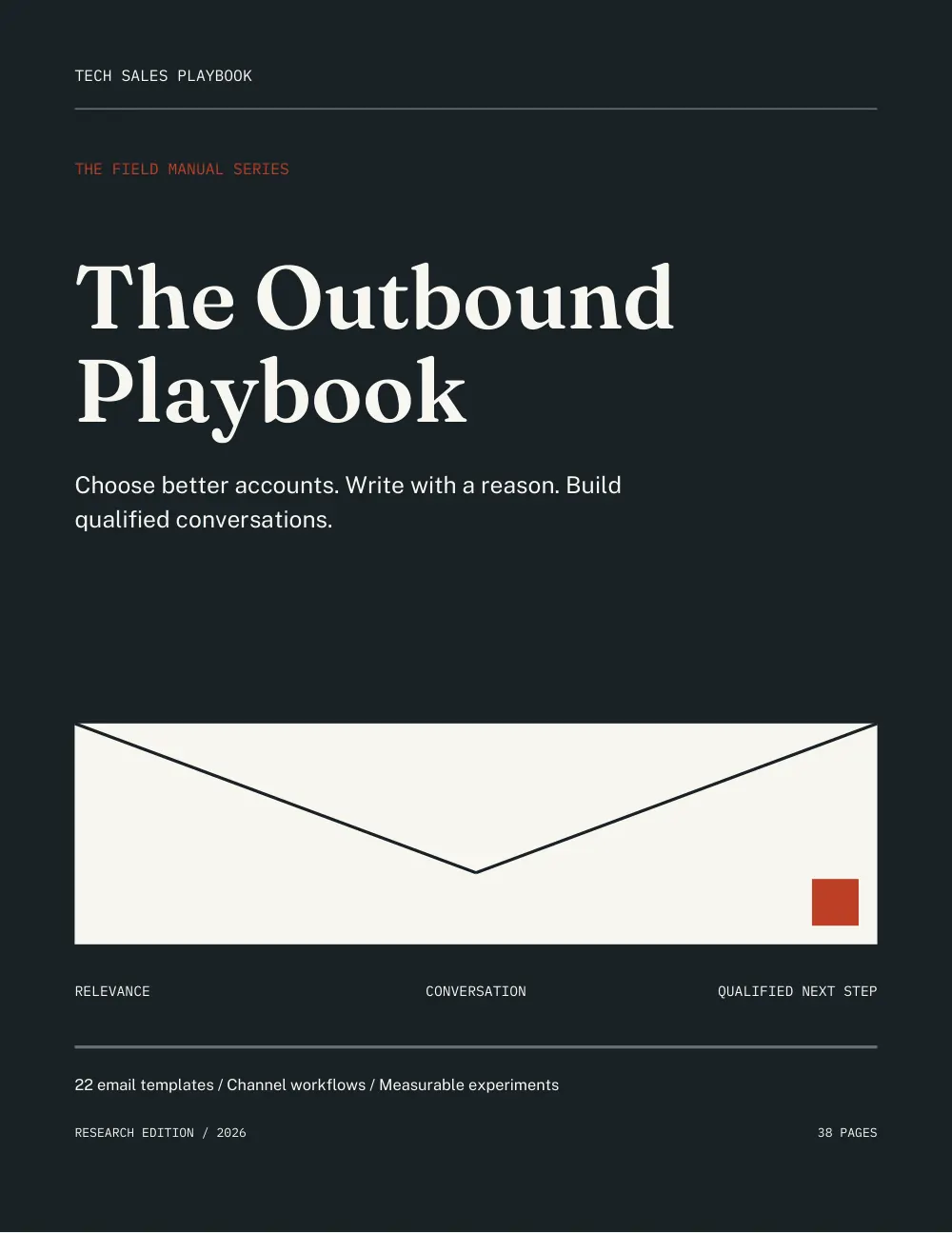
TECH SALES PLAYBOOK THE FIELD MANUAL SERIES The Outbound Playbook Choose better accounts. Write with a reason. Build qualified conversations. RELEVANCE CONVERSATION QUALIFIED NEXT STEP 22 email templates / Channel workflows / Measurable experiments RESEARCH EDITION / 2026 38 PAGES
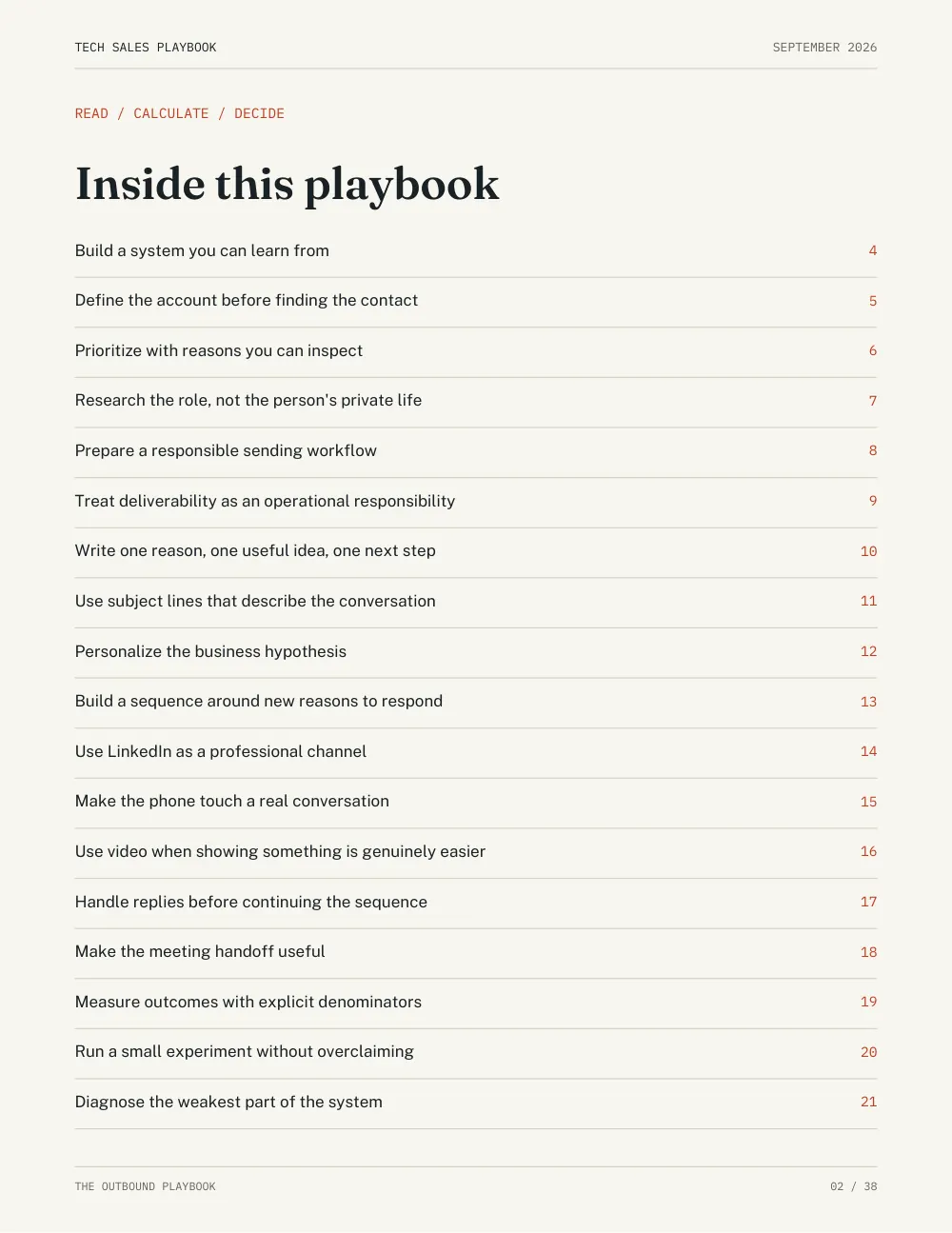
TECH SALES PLAYBOOK SEPTEMBER 2026 THE OUTBOUND PLAYBOOK 02 / 38 READ / CALCULATE / DECIDE Inside this playbook Build a system you can learn from 4 Define the account before finding the contact 5 Prioritize with reasons you can inspect 6 Research the role, not the person's private life 7 Prepare a responsible sending workflow 8 Treat deliverability as an operational responsibility 9 Write one reason, one useful idea, one next step 10 Use subject lines that describe the conversation 11 Personalize the business hypothesis 12 Build a sequence around new reasons to respond 13 Use LinkedIn as a professional channel 14 Make the phone touch a real conversation 15 Use video when showing something is genuinely easier 16 Handle replies before continuing the sequence 17 Make the meeting handoff useful 18 Measure outcomes with explicit denominators 19 Run a small experiment without overclaiming 20 Diagnose the weakest part of the system 21
TECH SALES PLAYBOOK SEPTEMBER 2026 THE OUTBOUND PLAYBOOK 03 / 38 READ / CALCULATE / DECIDE Tools for the decision Use the template library as a set of starting points 22 Templates 01-02: a verified company trigger 23 Templates 03-04: a role-relevant question 24 Templates 05-06: offer a useful resource 25 Templates 07-08: connect capability to a task 26 Templates 09-10: genuine referral and requested contact 27 Templates 11-12: real event and prior conversation 28 Templates 13-14: add a substantive follow-up 29 Templates 15-16: respond to a correction 30 Templates 17-18: timing and requested information 31 Templates 19-20: convert interest into a useful next step 32 Templates 21-22: close or correct the sequence 33 Case file: fewer bookings, better learning 34 Worksheet: the account and message brief 35 Worksheet: sequence and stopping rules 36 Worksheet: the weekly outcome review 37 Sources and edition notes 38
TECH SALES PLAYBOOK SEPTEMBER 2026 THE OUTBOUND PLAYBOOK 04 / 38 FIELD GUIDE / START HERE Build a system you can learn from Outbound begins with a hypothesis: a particular person at a particular organization may have a problem your company can help address. Your first job is to test that hypothesis respectfully. Your second is to learn from the result without confusing activity with progress. This book is for SDRs, BDRs and AEs prospecting for B2B technology products. It covers account selection, research, email, LinkedIn, phone, video, sequence design, reply handling and measurement. The template library contains 22 original email starting points, each with a specific use case. The operating loop Choose a narrow audience. Identify a plausible business issue. Write one relevant message. Use approved channels. Record the response and the resulting meeting quality. Change the part of the system that the evidence points to. What you will build An account brief, a short sequence with stopping rules, a message experiment and a weekly outcome review. The worksheets at the end help you repeat the process without turning every send into a new improvisation. All companies, people, figures and scenarios in this book are fictional teaching examples. Cadences and scripts are starting experiments, not universal best practices or guaranteed conversion methods. US B2B scope; research checked September 2026. Applicable laws, provider policies and employer requirements still depend on the recipients, location and tools. The source notes distinguish those requirements from this book's original operating recommendations.
TECH SALES PLAYBOOK SEPTEMBER 2026 THE OUTBOUND PLAYBOOK 05 / 38 01 / CHOOSE WHERE TO FOCUS Define the account before finding the contact An account list should reflect a reason your product might matter. A large collection of company names is not a strategy. Start with a use case, the conditions under which it appears and the constraints that could rule an account out. A fictional account hypothesis SignalPath sells a workflow product. The initial audience is service businesses with several teams involved in customer onboarding. The working hypothesis is that missing handoff information creates avoidable chasing. That remains a hypothesis until buyers confirm it. Selection factor What to look for Relevant workflow Evidence the account performs the work you support Complexity A plausible reason the existing process becomes difficult Trigger A recent event that makes a conversation timely Compatibility Known product, geography or implementation constraints Exclusion A clear reason the product would not fit Start narrow enough to compare If your first batch mixes small agencies, global manufacturers and software companies, their different buying contexts may obscure what the messages teach you. Use a coherent segment and document the selection logic. Avoid the false shortcut Funding, hiring or growth is not proof of a problem or available budget. Use a public signal to form a question, not to announce what is happening inside the organization. Account statement: "This organization may fit because [observable condition]. I still need to verify [important uncertainty]."
TECH SALES PLAYBOOK SEPTEMBER 2026 THE OUTBOUND PLAYBOOK 06 / 38 01 / CHOOSE WHERE TO FOCUS Prioritize with reasons you can inspect A simple prioritization method helps you decide where deeper research is worthwhile. It should not produce a mysterious score that looks scientific but hides weak assumptions. An original starting rubric Score each factor 0 for absent or unknown, 1 for partial evidence, or 2 for clear evidence. Keep the supporting observation beside the score. The total is a sorting aid, not a buying probability. Factor What earns attention Workflow fit The account appears to perform the relevant work Timely reason A current, verifiable event relates to that work Reachable owner A relevant role can be identified through approved sources Product fit Known requirements appear compatible with your offering Use the result carefully An account with an 8 is not twice as likely to buy as one with a 4. The score simply records more supporting evidence under this rubric. A single mandatory incompatibility can override the total. Review after conversations If apparently strong accounts repeatedly reveal no meaningful issue, revisit the selection criteria. Do not respond only by increasing send volume or making the message more dramatic. Keep an exclusion log Record why an account was removed: wrong workflow, unsupported region, incompatible technical requirement or no relevant use case. Those patterns can improve future sourcing. Prioritization should make your judgment easier to challenge. If you cannot explain the score in a sentence, the underlying account brief needs work.
TECH SALES PLAYBOOK SEPTEMBER 2026 THE OUTBOUND PLAYBOOK 07 / 38 01 / CHOOSE WHERE TO FOCUS Research the role, not the person's private life Useful personalization connects a business observation to a responsibility the recipient likely owns. A reference to a hobby or unrelated personal detail can feel intrusive and still explain nothing about the value of the message. A three-part research note Record the source and date, the observation, and the possible implication. Keep the implication explicitly unconfirmed. Item Fictional example Source Company's published onboarding-team job posting Observation Role includes coordinating technical handoffs Possible implication Ownership across teams may be important Question How are incomplete handoffs handled today? Identify the relevant owner Look for responsibility, not only seniority. An operations lead may understand the workflow better than an executive who has little reason to answer a detailed process question. A later buying decision may involve both. Set a research limit Use a short, agreed time budget for ordinary accounts and deeper preparation for a smaller set of high-priority accounts. Stop when you can write a credible reason to contact the person. More details do not necessarily make the message more relevant. Keep data provenance Use approved sources. Record contact-data provenance; public visibility is not blanket permission. Personalization test: if the researched detail disappeared, would the business reason for the message change? If not, it may be decoration rather than relevance.
TECH SALES PLAYBOOK SEPTEMBER 2026 THE OUTBOUND PLAYBOOK 08 / 38 02 / CHECK THE CHANNEL Prepare a responsible sending workflow US commercial email rules apply to B2B messages too. The FTC's CAN-SPAM guidance requires accurate sender information and subjects, clear advertising identification, a valid postal address and a usable opt-out. Requests must be honored within 10 business days; the mechanism must remain usable for at least 30 days. Outsourcing does not remove responsibility. FTC: CAN-SPAM guide Footer A: attach to every library email Replace the fields with your employer's approved information. Ensure the reply route actually accepts and processes requests. [Sender name] | [Company] | [Valid physical postal address] This is a commercial message. Reply "unsubscribe" to stop marketing emails from [Company]. Unsubscribe: [working unsubscribe URL] The library's "Footer A" label is an instruction to append this completed footer, not text to send. A visible footer does not replace provider-required unsubscribe headers or any stricter requirement that applies to your campaign. Original operating checklist Before enrolling a contact, check the approved contact source, account ownership, prior communication, suppression status and the rules for the recipient and channel. Verify that another rep is not already holding an active conversation. Make suppression immediate as an operating standard. Route ambiguous opt-out requests for prompt review; do not continue automated messages while debating the wording. A template is only one part of a send-ready message. Correct recipient selection, truthful content and a functioning response workflow matter just as much.
TECH SALES PLAYBOOK SEPTEMBER 2026 THE OUTBOUND PLAYBOOK 09 / 38 02 / CHECK THE CHANNEL Treat deliverability as an operational responsibility Copy cannot compensate for a misconfigured sending system. Ask the responsible administrator to verify authentication, transport, domain records, unsubscribe behavior and monitoring before a campaign. For mail to personal Gmail accounts, Google requires SPF or DKIM for all senders and additional authentication for bulk senders, including SPF, DKIM and DMARC. Relevant bulk marketing traffic also needs one-click unsubscribe and a visible body link. Google prohibits misleading presentation such as fake reply subjects. Google: sender guidelines Ask the administrator for a clear preflight Check Evidence to request Authentication A test message passes the required checks Sender identity From name and domain accurately identify the company Unsubscribe Visible route and required headers work Suppression Opt-outs stop all applicable sequences Monitoring Owner reviews errors and complaints Know the scope of the rule Google's FAQ describes bulk status as close to 5,000 or more messages to personal Gmail in 24 hours, aggregated across the same primary domain. Subdomains do not provide a way around that aggregation, and status persists once triggered. These inbound rules are not a universal statement about Google Workspace recipients. Google: sender FAQ Authentication is not permission to send unwanted messages and does not guarantee inbox placement. Follow the sending provider's own terms as well as recipient-side requirements. If delivery errors rise, investigate before expanding volume. Do not keep changing copy while ignoring the system that sends it.
TECH SALES PLAYBOOK SEPTEMBER 2026 THE OUTBOUND PLAYBOOK 10 / 38 03 / WRITE THE MESSAGE Write one reason, one useful idea, one next step The recipient needs to understand why the message is relevant and what you are asking them to do. Use enough detail to establish that connection, then stop. A practical message structure Begin with a verified observation or a role-relevant question. Connect it to a plausible workflow issue without claiming inside knowledge. State an accurate capability or offer a useful resource. Finish with one reasonable next step. Fictional body example "Hi Priya, your onboarding-team posting mentions technical handoffs. I wondered how the team handles cases that arrive without complete requirements. SignalPath helps teams assign those exceptions to a visible owner. Is that a workflow you are reviewing, or is it working well enough today?" This example assumes the posting and capability are accurate. A live message also needs the completed Footer A and any required sending-system features. Edit the weak version "We help innovative companies streamline operations and unlock efficiency" does not tell the buyer what changes. Replace broad benefits with a specific task or decision the buyer can recognize. Keep the question easy to answer Do not ask for a 45-minute demonstration, a referral and a document review in the same first message. Choose the smallest useful action for the context. There is no universal winning word count. Read the message aloud and remove sentences that do not explain relevance, clarify value or support the next step.
TECH SALES PLAYBOOK SEPTEMBER 2026 THE OUTBOUND PLAYBOOK 11 / 38 03 / WRITE THE MESSAGE Use subject lines that describe the conversation A subject should help the recipient understand the topic. A misleading subject can earn attention while damaging trust and creating compliance problems. Do not imitate an existing conversation with a fake "Re:" or "Fwd:" prefix. Google: sender guidelines Original subject patterns to test Pattern Fictional example Appropriate when Workflow Onboarding handoffs The body addresses that workflow Specific question Owner for incomplete requirements? You ask a relevant ownership question Resource Handoff review checklist You are offering the named resource Actual follow-up Notes from our call A call really occurred Keep the experiment narrow If you compare subjects, keep the audience, message body and sending conditions as similar as practical. Decide beforehand which outcome matters. A subject that draws replies from confused recipients has not necessarily improved the campaign. Avoid curiosity without relevance "Quick question" is vague. An urgent-looking subject is inappropriate when there is no actual urgency. A buyer should not need to open the email to discover that the premise was misleading. Inspect replies, not just a dashboard Read what recipients say. If they respond with "Who are you?" or "What is this about?", the subject and body may not establish enough context even if response volume rises. A useful subject sets an honest expectation that the body fulfills.
TECH SALES PLAYBOOK SEPTEMBER 2026 THE OUTBOUND PLAYBOOK 12 / 38 03 / WRITE THE MESSAGE Personalize the business hypothesis Personalization can happen at several levels. Match the research effort to the value of the account and the strength of the evidence, rather than inserting a token compliment into every message. Level What changes Example Segment Shared workflow or constraint Service teams coordinating onboarding Account Verifiable company event Published expansion of onboarding roles Role Responsibility and language Operations ownership versus technical fit Conversation What this buyer actually said Their agreed question about exceptions A useful boundary Do not infer that a person is struggling simply because their team is hiring. Write "I wondered whether..." when the situation is uncertain. If you know only the role, a relevant question can be more honest than a fabricated trigger. Keep product claims stable Personalization should not cause the product to acquire a different capability for every account. Use approved descriptions and verify any customer proof before including it. Apply a quick quality test Can the recipient tell why you chose them? Is the observation accurate and recent enough? Does the proposed issue relate to their work? Can you explain the offered value without an unsupported outcome claim? The best personalization is not necessarily more personal. It is more specific about the work and the reason to talk. Store the source note with the account brief so a reviewer can check the message without repeating the research.
TECH SALES PLAYBOOK SEPTEMBER 2026 THE OUTBOUND PLAYBOOK 13 / 38 04 / COORDINATE THE TOUCHES Build a sequence around new reasons to respond A sequence is a plan for a conversation attempt, not a requirement to send every scheduled message. Each touch should add something useful or test a different relevant angle. Stop or change the plan when the buyer responds. Fictional starting sequence Relative day Channel Purpose 1 Email Test the workflow hypothesis 3 Live call, if permitted Ask whether the issue is relevant 6 Email Offer a concrete diagnostic resource 9 LinkedIn, if appropriate Make a brief role-relevant introduction 13 Email Close the sequence respectfully This is an original test cadence, not an optimal schedule or a rule that five touches are necessary. Adapt it to recipient expectations, permitted channels, prior contact and your employer's requirements. Define stopping rules before launch Stop on opt-out, explicit rejection, a confirmed mismatch, an active conversation or a request to use another channel. Pause on a data-quality issue or a delivery problem. A reply belongs with a person, not the next automated step. Coordinate across reps Use one account owner or an agreed account plan. Several sellers independently contacting the same team can create conflicting messages and an inaccurate picture of engagement. Sequence quality is not the number of touches. It is whether each proposed touch has a truthful reason and whether the system responds correctly when the buyer does.
TECH SALES PLAYBOOK SEPTEMBER 2026 THE OUTBOUND PLAYBOOK 14 / 38 04 / COORDINATE THE TOUCHES Use LinkedIn as a professional channel LinkedIn prohibits unauthorized scraping and tools that automate activity such as sending messages or adding contacts. Use approved native or manual workflows and follow current platform rules. LinkedIn: prohibited software A role-relevant connection note "Hi Priya, I work on onboarding handoff workflows at [company]. Your role appears connected to that area. I would be glad to connect if the topic is relevant to your work." Only use the claim about their role when supported. A connection acceptance is not proof of buying interest or consent to an unrelated bulk campaign. After a relevant response "Thanks for connecting. I was curious how your team handles incomplete requirements between sales and onboarding. If that is outside your scope or not a current priority, no problem." Contribute before asking where appropriate If you respond to a public post, address its actual content. Do not use an unrelated comment as a pretext for a concealed sales pitch or imply the author endorsed your product. Keep the channel coordinated Record a meaningful reply in the account workflow so email automation does not continue as if nothing happened. Honor a request to stop and do not move to another channel simply to evade it. Platform access is not an unlimited outreach entitlement. Use the channel in a way a professional recipient can understand and decline.
TECH SALES PLAYBOOK SEPTEMBER 2026 THE OUTBOUND PLAYBOOK 15 / 38 04 / COORDINATE THE TOUCHES Make the phone touch a real conversation Use an employer-approved calling process. Recipient number type, calling technology, consent and jurisdiction can change the applicable rules. A business title does not automatically make a mobile number exempt from restrictions. eCFR: 47 CFR 64.1200 The FTC's 2024 changes also extended prohibitions on misrepresentations to B2B telemarketing. Do not invent a referral, a prior relationship or a customer result. FTC: B2B telemarketing changes Original live-call opening "Hi Priya, this is Alex with [company]. This is an unexpected sales call about onboarding handoffs. Is now a reasonable moment for a brief explanation?" If they agree: "We work on assigning incomplete handoffs to a clear owner. I wondered whether that is a process your team is reviewing or whether it is working well today." If the timing is wrong Respect the answer. Ask about a later time only if the person is open to it. An explicit request not to call should enter the approved suppression process. Keep the scope narrow This book's phone workflow assumes a live human conversation using approved systems. Prerecorded drops, autonomous voice, texting and recording require their own review; the email cadence does not establish permission for them. Your first objective is relevance and permission to continue, not forcing a meeting before understanding whether the topic belongs with this buyer.
TECH SALES PLAYBOOK SEPTEMBER 2026 THE OUTBOUND PLAYBOOK 16 / 38 04 / COORDINATE THE TOUCHES Use video when showing something is genuinely easier A short video can demonstrate a workflow more clearly than a paragraph. It can also create extra friction if the recipient cannot tell what the link contains or why it matters. Choose it for a visual explanation, not simply because it is another channel. Original video outline Start with your identity and the verified context. Show one relevant workflow using approved or synthetic data. Explain the question the clip helps answer. End with a simple invitation to respond. "I am Alex at [company]. This example shows how an incomplete onboarding handoff can be assigned to an owner. The open question is whether this resembles the way your team works. If useful, I can explain the assumptions in a brief conversation." Prepare the message around the clip State what the recipient will see and provide a text summary. Use an approved hosting service and a recognizable link. Do not imply that viewing is required to receive basic information. Protect the data Close unrelated tabs and remove customer names, credentials, private pricing and internal notifications before recording. Use a fictional scenario unless sharing actual information is authorized. Review the final clip before sending it. Evaluate the outcome A play or click does not establish qualified interest. Look for a relevant reply and a useful next conversation. If recipients do not engage, ask whether the video adds clarity or just another task. A good clip answers one question. It is not a compressed full product demonstration.
TECH SALES PLAYBOOK SEPTEMBER 2026 THE OUTBOUND PLAYBOOK 17 / 38 05 / TURN RESPONSES INTO DECISIONS Handle replies before continuing the sequence Route replies to a responsible person. Read the actual message before selecting a response; automatic sentiment labels can miss nuance or a clear request to stop. Reply type Next action Interested Clarify the relevant issue and propose a useful meeting Not now Ask about timing only if the buyer invites future contact Wrong person Clarify ownership without pressuring for a referral Already solved Acknowledge; explore only if they welcome discussion No interest Respect the answer and stop the sequence Opt-out Suppress promptly through the approved process Out of office Pause and review the stated return context A positive reply is not a qualified opportunity "Sure, send something" could mean mild curiosity. Ask which question the information should answer. A meeting becomes more useful when both sides understand the purpose and who should attend. Preserve the buyer's words Record what they actually said and what you agreed. If they ask for a resource, do not mark a demonstration booked. If they say to try in November, do not continue the current sequence in September. Avoid the channel escape Do not treat an email refusal as an invitation to call repeatedly or message another profile. Coordinate the contact preference across your approved systems. Reply handling is part of outbound quality. A well-written opening followed by an irrelevant automated follow-up still creates a poor experience.
TECH SALES PLAYBOOK SEPTEMBER 2026 THE OUTBOUND PLAYBOOK 18 / 38 05 / TURN RESPONSES INTO DECISIONS Make the meeting handoff useful Before sending an invitation, establish a topic the buyer recognizes. Confirm the participants, duration, time zone and the question the conversation will address. Original meeting confirmation "Thanks, Priya. I will send a 20-minute invitation for [confirmed date/time and zone]. The purpose is to understand your handoff process and assess whether our approach is relevant. [AE name] will join because they can answer the workflow questions. Please let me know if another topic would make the meeting more useful." Handoff notes for the AE Item What to include Why the buyer replied Their actual words or a faithful summary Context Verified account and role information Hypothesis What remains unconfirmed Prior material What you sent or discussed Meeting purpose Agreed question and participants Constraints Timing, channel preferences or known mismatch Do not oversell the booking internally A buyer agreeing to discuss a workflow has not confirmed pain, budget or purchase intent. Explain the state accurately so the AE can begin at the right point. Learn from the meeting result Ask the AE whether the context was accurate and whether the conversation was useful. Look for patterns in mismatched expectations. Improve the targeting or message rather than trying to make every booking appear qualified. The handoff is successful when the next conversation starts with shared context instead of correcting the promise that secured the calendar slot.
TECH SALES PLAYBOOK SEPTEMBER 2026 THE OUTBOUND PLAYBOOK 19 / 38 06 / LEARN FROM THE RESULTS Measure outcomes with explicit denominators Choose a small set of measures and define them before comparing campaigns. Separate people, accounts, messages and meetings. Mixing them can produce impressive-looking percentages with no clear meaning. Fictional cohort: one first email per contact Measure Count Defined rate Attempted messages 200 Starting cohort Delivered messages 190 190 / 200 = 95% Positive replies 8 8 / 190 = 4.2%, rounded Meetings booked 5 Reported count Meetings held 4 4 / 5 = 80% of booked Accepted opportunities 2 2 / 4 = 50% of held These are original example definitions and numbers, not benchmarks. "Delivered" here means reported as accepted by the receiving system; it does not prove inbox placement or human reading. Follow the cohort over time State the observation window and allow time for meetings to occur. Do not compare a fully matured campaign with one that launched yesterday. If one contact receives several emails, distinguish message-level rates from unique-contact outcomes. Inspect quality alongside volume Read representative replies and review why meetings were accepted or rejected. A higher positive-reply rate may not produce better opportunities if the audience or promise is wrong. Put the denominator and period beside every rate. If you cannot name both, do not use the number to justify a campaign decision.
TECH SALES PLAYBOOK SEPTEMBER 2026 THE OUTBOUND PLAYBOOK 20 / 38 06 / LEARN FROM THE RESULTS Run a small experiment without overclaiming Choose one important uncertainty: audience fit, problem framing, subject or call to action. Change one main factor where practical, and keep a record of other differences that could influence the result. Fictional comparison Two message variants each reach 100 delivered contacts in the same defined segment. Variant A receives four positive replies; B receives six. That is 4% versus 6%, a two-percentage-point difference. It does not establish that B will reliably outperform A in the next campaign. Before launching Write the hypothesis, audience, assignment method, primary outcome, observation window and stopping rules. If you cannot assign contacts comparably, describe the test as an observational comparison rather than a controlled experiment. Inspect the actual replies Maybe B attracts more requests for a free resource but fewer qualified conversations. Maybe one account generated several responses. Review those details before declaring a winner. Decide what to do next You might continue collecting comparable evidence, test the message in a second cohort, revise the audience or stop a weak angle. Do not keep sending indefinitely just to reach a hoped-for result. A small test can improve your next question even when it cannot establish a reliable performance difference. Avoid universal claims about ideal send times, touch counts or word counts unless you have evidence that fits your audience and context. Treat proposed schedules as experiments.
This is meant to be opened while you work. The sections are concrete enough to copy, practice, adapt, and reuse during applications, interviews, calls, and weekly execution.
Email copywriting fundamentals for sales
Subject line testing and reply-rate diagnostics
LinkedIn outreach sequences
Multi-touch cadence design
Personalization strategies at scale
Video prospecting tactics
20+ practical email templates
Build a researched account hypothesis.
Adapt twenty-two templates to a real account.
Measure delivery, replies and meeting quality.
The sample exists so buyers can inspect the writing style, structure, and depth before purchase. If the sample feels useful, the full PDF continues with the same practical format.
What you are buying
Before you decide
Start with the question that matters to you. You can use the free material without making a purchase.
Try one relevant task first. If that resolves your immediate question, keep using the free resources. Inspect the book’s sample when you need more structured practice.
Try the related free resourceBuild relevant outreach and measure the response with clear definitions.
Use this as a self-study routine, adjusting it to the material. Completing a session is not a certification or an assessment of hiring readiness.
Choose one book for a focused gap. Consider a bundle only if you will use its listed books; compare the exact contents and avoid paying twice for material you already own.
A PDF is self-directed preparation. Individual feedback on your own resume is a separate service with its own scope and availability.
Compare the resume serviceCheck the current price, included files, delivery instructions and refund terms before opening checkout.
Read the actual sample and file details on this page. If you need help with an order or access, contact support with your question rather than placing a second order.
Read purchase and refund termsAsk a product or access question$29 PDF download
$29 PDF download
$39 PDF download
$29 PDF download
$19 PDF download
$19 PDF download
$19 PDF download
$19 PDF download
$19 PDF download