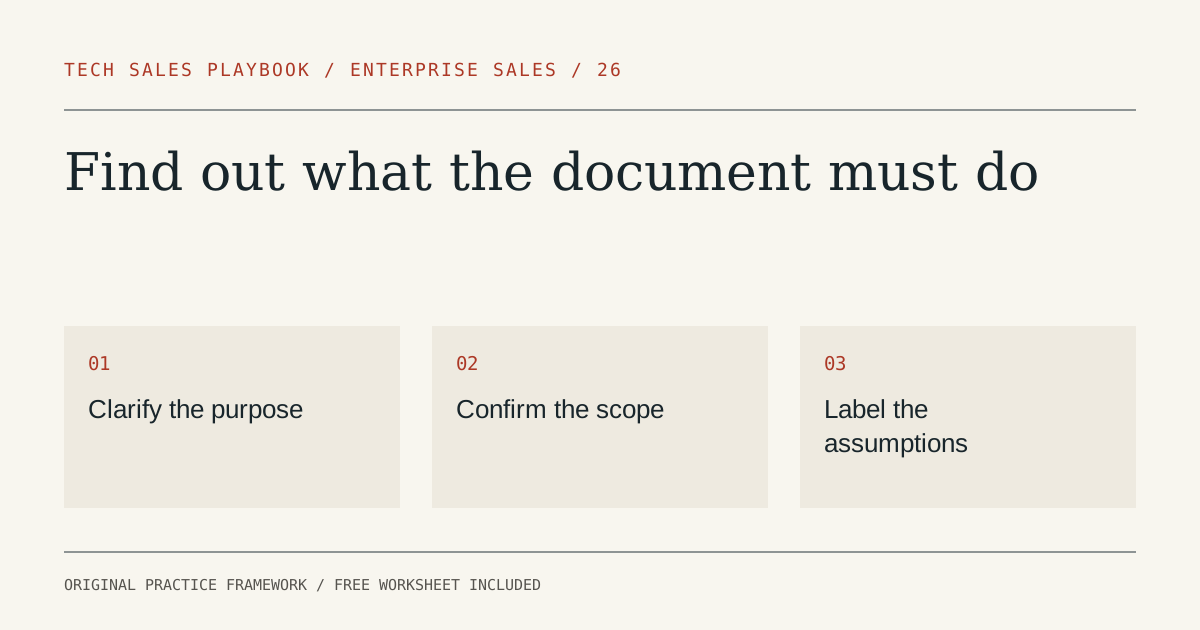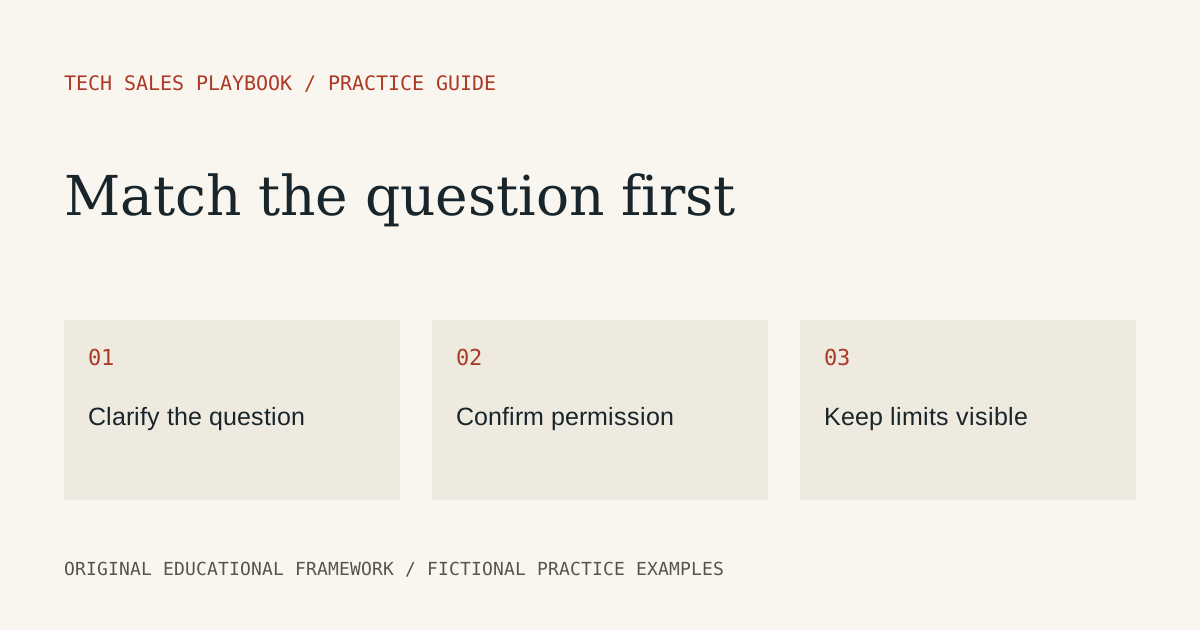
Use this as a working guide, not a passive read. Skim the sections, copy the frameworks, then connect the advice to a real role, interview, call, or account you are working on this week.
Start with a free resourceDownload the mutual action planNo signup required. Browse the free resource library
Put this guide to work
The Enterprise Playbook
$19 USD · One-time purchase · Downloadable PDF
Preview this playbookWhen a prospect asks to speak with a customer, first clarify the question they want that conversation to answer. A reference call can illuminate someone's implementation experience. It cannot prove that your prospect will get identical results, replace a technical evaluation, or authorize you to share a customer's contact details.
Write the question before choosing the reference
Ask: “What would you like to understand from someone who has used the product?” Then narrow the topic. Implementation effort, user adoption and support experience may call for different people. A familiar company logo is less useful than a relevant experience the person is willing and authorized to discuss.
Prepare a short brief with the buyer's role, the question, relevant workflow, intended duration and topics outside scope. Do not include confidential deal notes, pricing or personal information the recipient does not need. Route the request through your company's reference owner or approved customer-success process.
Confirm permission and suitability
GitLab's developer-relations operational guidelines provide a concrete example of documenting consent and checking a person's authority when using references. The following checklist is our own practice framework, not a description of every vendor's program:
- Confirm that the customer agreed to this activity, audience and topic.
- Check whether the person can speak about the relevant experience.
- Ask the program owner about availability and recent requests so one advocate is not repeatedly burdened.
- Confirm which details may be introduced or shared with each side.
- Agree whether the seller attends and how follow-up will work.
Do not assume a public case study means its subject is available for a private call. Do not promise a particular reference before the responsible team confirms it. Recording, transcription and reuse require the applicable permissions; a conversation invitation alone is not that permission.
Use a neutral 25-minute agenda
This timing is a suggested format, not a benchmark. Spend the first three minutes on introductions and the question. Give the customer about five minutes to describe their context. Reserve twelve minutes for the buyer's questions and the final five for remaining uncertainty and next steps. Adjust to the participants' preferences.
Useful prompts include: “What did your team need to prepare?” “Which part took more effort than expected?” “What would you check before doing it again?” Avoid feeding the customer answers or interrupting every limitation with a sales pitch. If the buyer asks about an unsupported product capability, take that question back to the appropriate specialist.
Compare two fictional matches
A fictional buyer wants to understand the effort of migrating an established reporting workflow. Reference A has a recognizable brand but started with a new team and no migration. Reference B has a smaller organization and recently migrated a similar workflow. If Reference B has permission and availability, their experience may address the question more directly. Neither account proves the buyer's migration will take the same time.
A useful introduction says: “You both agreed to discuss the preparation work for migration. Your environments differ, so please treat this as one team's experience.” An unhelpful introduction promises: “They will show you that your migration will be easy.” The second statement pre-decides an answer the seller cannot guarantee.
Close with learning, not borrowed proof
Thank the participants using the approved process. Ask the buyer what they learned and which questions remain. Record only information permitted for your internal notes. Do not turn private comments into a testimonial or publish a quote without separate authorization.
Use the reference-call preparation resource comparison for a free brief and broader account-planning study options. If the unresolved question is technical, return to the proof-of-concept success criteria guide. Keep stakeholder context in your enterprise account plan, while respecting the customer's sharing preferences.
Put this guide to work
The Enterprise Playbook
Plan complex accounts, align stakeholders, and guide evaluation through rollout.
$19 USD · One-time purchase · Downloadable PDF
Preview this playbookRead the sample and see what is included before you buy.
Need the broader set? Compare The Deal Execution Bundle for $39. Includes this book.