Use this as a working guide, not a passive read. Skim the sections, copy the frameworks, then connect the advice to a real role, interview, call, or account you are working on this week.
Start with a free resourceDownload this guide's free practice worksheetNo signup required.
Put this guide to work
The Comp Playbook
$19 USD · One-time purchase · Downloadable PDF
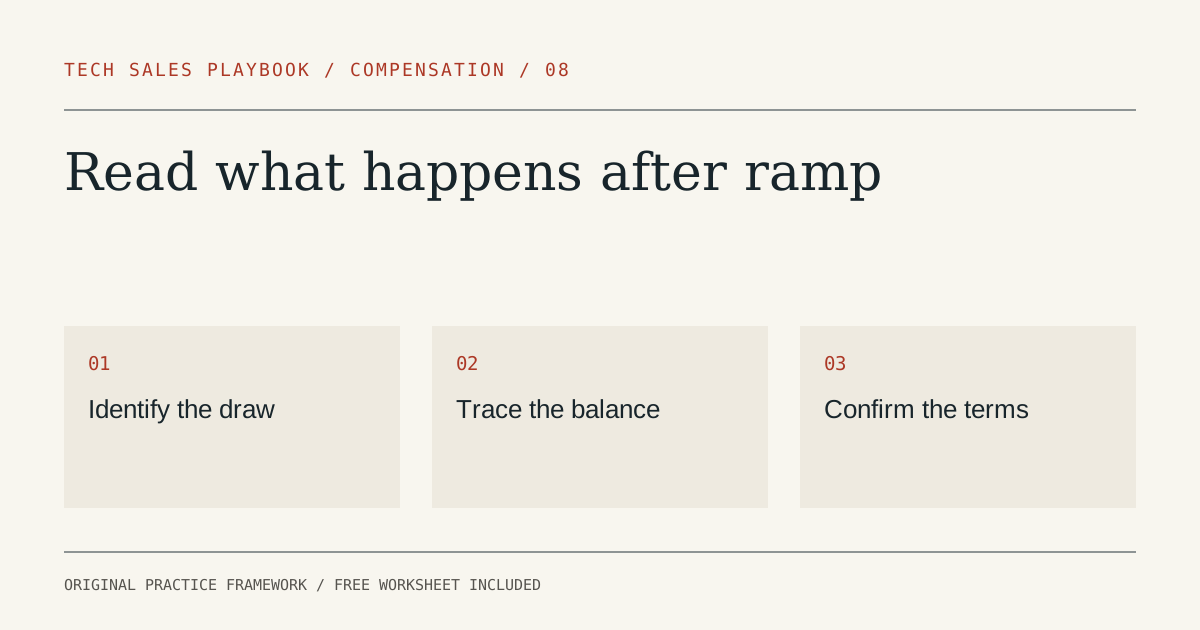
Preview this playbookA recoverable draw generally advances money against future commission; a nonrecoverable draw generally does not create a balance to recover from later commission. The written plan determines the actual mechanics. Before accepting a sales offer, ask how the draw interacts with commission, how long it lasts, and what happens afterward.
Salesforce's explanation of recoverable draws distinguishes the two structures. Use it for terminology, then request examples from the employer's own plan. This guide organizes questions and arithmetic; it does not determine your contractual rights.
Trace one simple hypothetical balance
Suppose a fictional recoverable plan advances $3,000 in month one and credits $1,000 in commission against it. Under an assumed dollar-for-dollar carryover rule, the outstanding balance would be $2,000. The example is deliberately simplified: a real plan may use different periods, floors, or recovery rules.
Do not add the full draw and the commission together as though both are automatically additional earnings. Ask the employer to show the calculation on a sample statement.
| Question | Why it matters |
|---|---|
| Is the draw recoverable? | Establishes whether later commission may offset an advance |
| Which earnings reduce the balance? | Clarifies the relevant commission components |
| Does a balance carry forward? | Shows whether one period affects another |
| When does the draw end? | Identifies the transition to the normal plan |
| What happens if employment ends? | Points to terms that need careful written review |
Separate ramp quota from ramp pay
A reduced quota and a draw solve different questions. One changes the target; the other changes the pay arrangement. An offer may have either, both, or neither. Write their start and end dates separately so you can see whether support ends before you are expected to reach full productivity.
Ask for an example with low commission during ramp and another with commission above the draw. Those two cases often reveal details that a single OTE figure hides. Keep taxes and other deductions outside this simplified comparison.
Ask a precise follow-up
Try: “Could you show how the draw and earned commission interact in the first three periods, including any balance that carries forward? I'd also like to understand the written terms at the end of ramp.” This is more useful than asking whether the draw is “good.”
If terms about repayment or departure are unclear, get qualified advice on the actual documents and relevant jurisdiction. Do not assume a blog example settles that question. For your comparison sheet, mark uncertain amounts as unknown and evaluate the guaranteed base separately from conditional variable earnings.
Use the free worksheet
Download the recoverable vs. nonrecoverable draw worksheet. It opens in a spreadsheet and requires no signup. Use fictional details for practice and your approved systems for real customer or employer information.
Choose your next step
Evaluate Sales Ramp Compensation Before Accepting an Offer explains the free exercise, the relevant paid resource, and who it fits. Read the product preview before deciding whether you need the broader self-study manual.
Continue with Sales Commission Accelerators: A Worked Tier Calculation.
Put this guide to work
The Comp Playbook
Compare pay plans, model cash scenarios, and negotiate specific terms.
$19 USD · One-time purchase · Downloadable PDF
Preview this playbookRead the sample and see what is included before you buy.