Best For
- Candidates comparing offers
- Reps evaluating compensation plans
Loading...
A 33-page field manual for evaluating tech sales compensation. Covers OTE, quotas, linear and accelerated payouts, draws, ramp, equity, competing offers, negotiation scripts, and three worksheets with worked examples.
Compare pay plans, model cash scenarios, and negotiate specific terms.
33 pages
Finished PDF playbook
20-page preview
Review the sample first
30-day guarantee
Instant access after checkout
Look inside
The full playbook runs 33 pages.
These 20 are the real thing, not a summary.
Page 1 / 20
Text from the same public sample shown above. Use the page images or PDF for diagrams, tables and original layout.
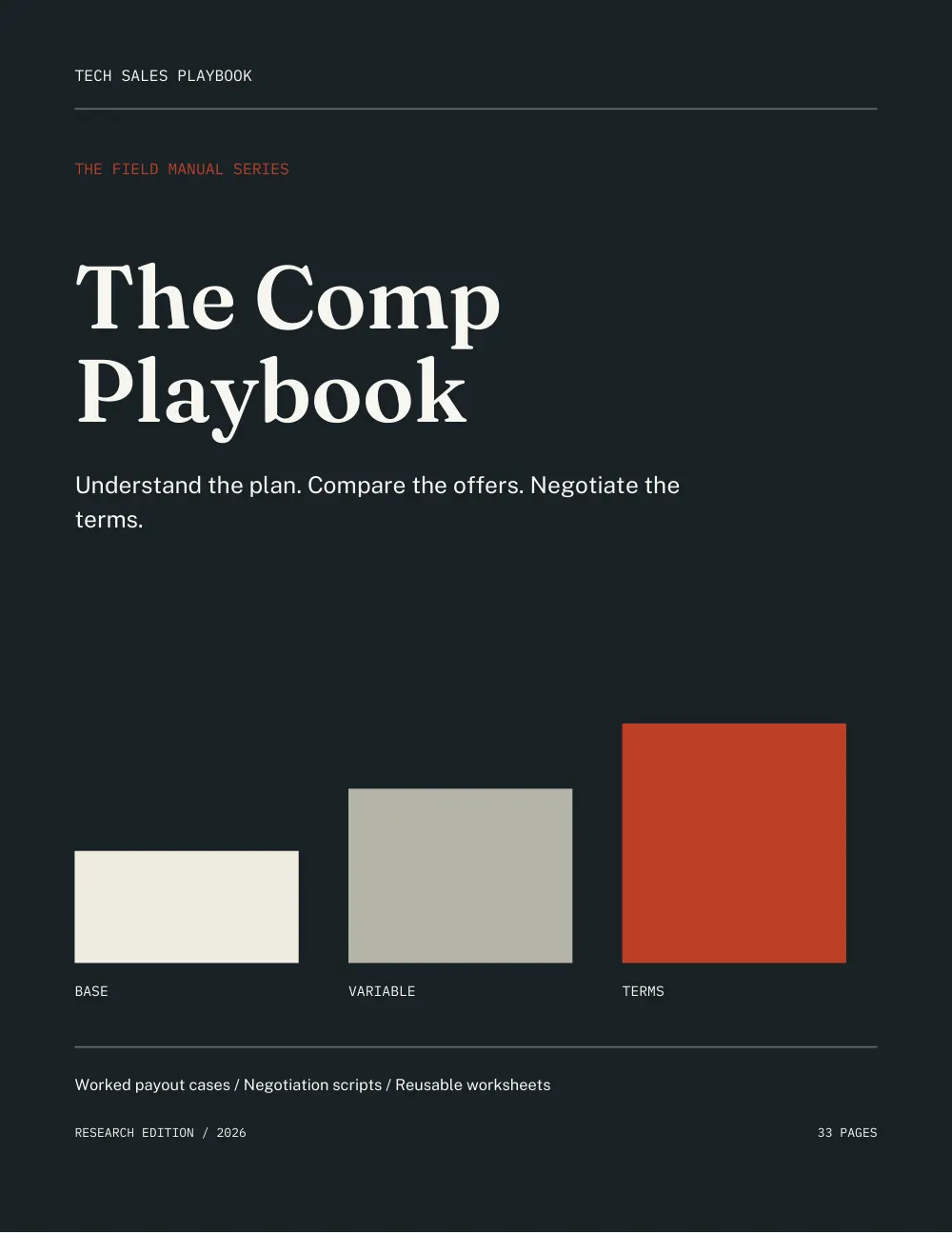
TECH SALES PLAYBOOK THE FIELD MANUAL SERIES The Comp Playbook Understand the plan. Compare the offers. Negotiate the terms. BASE VARIABLE TERMS Worked payout cases / Negotiation scripts / Reusable worksheets RESEARCH EDITION / 2026 33 PAGES
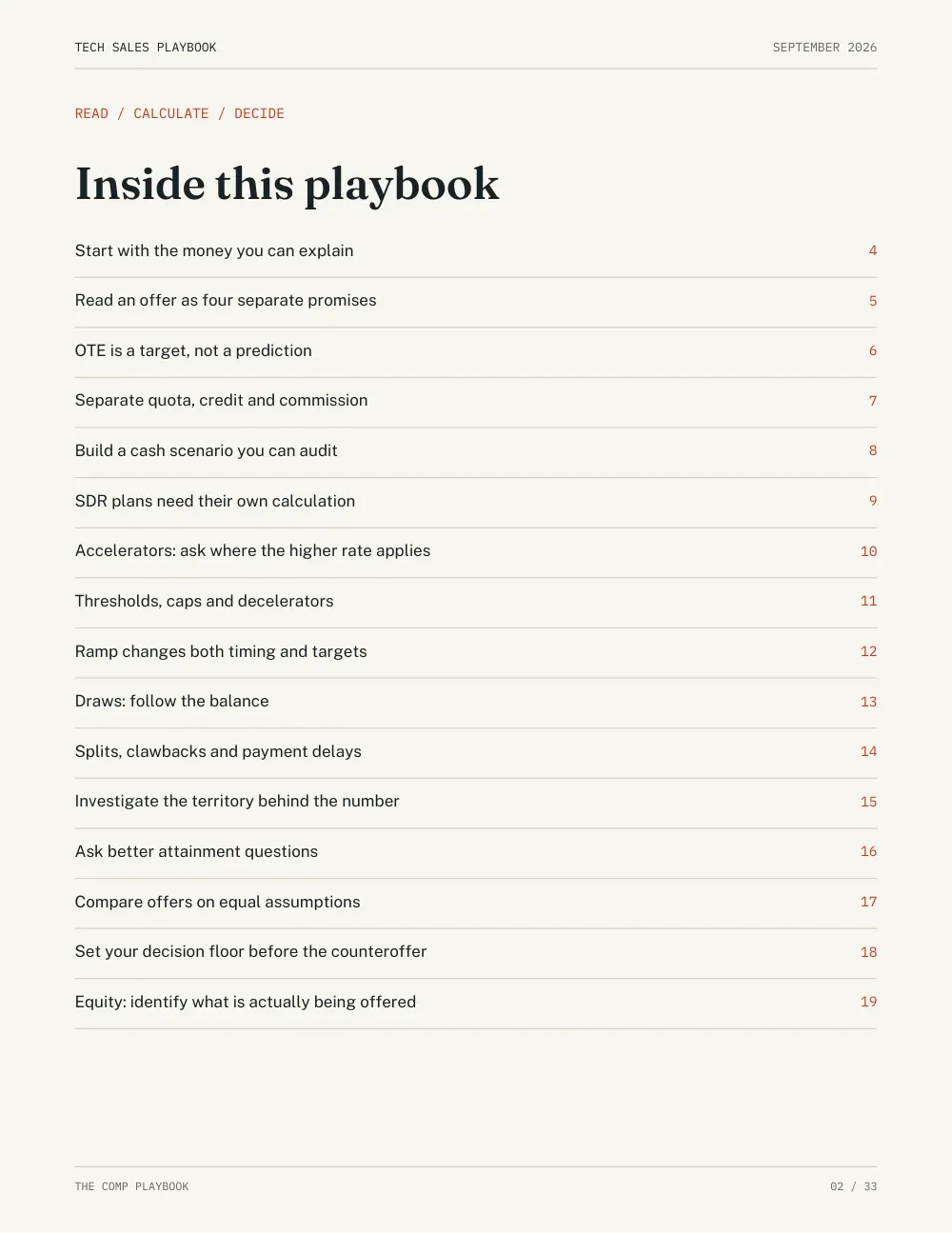
TECH SALES PLAYBOOK SEPTEMBER 2026 THE COMP PLAYBOOK 02 / 33 READ / CALCULATE / DECIDE Inside this playbook Start with the money you can explain 4 Read an offer as four separate promises 5 OTE is a target, not a prediction 6 Separate quota, credit and commission 7 Build a cash scenario you can audit 8 SDR plans need their own calculation 9 Accelerators: ask where the higher rate applies 10 Thresholds, caps and decelerators 11 Ramp changes both timing and targets 12 Draws: follow the balance 13 Splits, clawbacks and payment delays 14 Investigate the territory behind the number 15 Ask better attainment questions 16 Compare offers on equal assumptions 17 Set your decision floor before the counteroffer 18 Equity: identify what is actually being offered 19
TECH SALES PLAYBOOK SEPTEMBER 2026 THE COMP PLAYBOOK 03 / 33 READ / CALCULATE / DECIDE Tools for the decision A paper gain is not spendable cash 20 Choose the right moment and the right asks 21 The counteroffer email 22 When the recruiter pushes back 23 Trade issues without losing the objective 24 Close the offer in writing 25 Audit the first commission statement 26 Handle a changed plan deliberately 27 Worksheet: the offer evidence brief 28 Worksheet: build three payout cases 29 Worksheet: prepare a focused counteroffer 30 Worked decision: Maya's two offers 31 Your next seven days 32 Sources and edition notes 33
TECH SALES PLAYBOOK SEPTEMBER 2026 THE COMP PLAYBOOK 04 / 33 FIELD GUIDE / HOW TO USE THIS BOOK Start with the money you can explain A compensation package is a set of rules that converts work into money. The headline number is only the invitation to investigate. Your job is to understand which outcomes earn credit, how the payout is calculated, when cash arrives, and what can change after you join. This playbook is for SDRs, BDRs and AEs evaluating a new role or a revised plan. Work through it with the actual offer letter, commission plan and equity documents beside you. If an answer is missing, write a question; do not fill the gap with the most attractive interpretation. Choose your route Offer due soon: read the OTE, payout, offer-comparison and counteroffer pages, then complete the acceptance checklist. Plan looks complicated: work through the calculation cases and crediting questions before negotiating anything. Already employed: start with the commission audit, plan-change conversation and quarterly review. What you will produce One evidence-backed offer brief, three cash scenarios, a prioritized counteroffer, and a written acceptance record. The worksheets near the end can be printed or copied into your own notes. They are intentionally reusable. All companies, offers and people in the cases are fictional. Dollar figures are teaching examples, not market benchmarks or forecasts. No script guarantees a concession, a job or an earnings outcome. US context. Research checked September 5, 2026. This is general education; individual commission disputes, equity decisions and tax consequences depend on the documents and applicable rules. Framework and source notes appear beside the relevant teaching and at the end.
TECH SALES PLAYBOOK SEPTEMBER 2026 THE COMP PLAYBOOK 05 / 33 01 / DECODE THE PACKAGE Read an offer as four separate promises Separate compensation into four buckets before making comparisons. Mixing them makes a risky offer look safer than it is. Bucket What to establish What can be uncertain Base pay Annual rate, start date, payroll schedule Partial-year earnings and changes Variable pay Target amount, measures, payout rules Attainment, crediting and collection One-time cash Amount, payment date, conditions Repayment terms or delayed payment Equity Award type, units, vesting, liquidity Future value and tax treatment A fictional offer of $80,000 base, $80,000 target variable and a $10,000 sign-on payment is not a $170,000 recurring salary. Its recurring at-target cash is $160,000; its first-year at-target cash could be $170,000 only if the stated sign-on conditions are satisfied. Neither number includes taxes, benefits deductions or equity. Ask for the documents behind the summary Request the offer letter and compensation plan, including exhibits that define quotas and rates. For equity, ask for the proposed award type and the documents that describe approval and vesting. Distinguish a proposed grant from an approved grant. Decision rule: if you cannot identify which document controls a number, treat that number as unconfirmed. Write each bucket on a separate line. Put a document name and a date beside it. A recruiter summary is useful context; a mismatch with the written plan is a question to resolve before relying on it.
TECH SALES PLAYBOOK SEPTEMBER 2026 THE COMP PLAYBOOK 06 / 33 01 / DECODE THE PACKAGE OTE is a target, not a prediction On-target earnings combine base pay with variable compensation earned when the plan's target conditions are met. They do not tell you how likely those conditions are. Salesforce: OTE A clean starting calculation Imagine $80,000 base and $80,000 target variable. OTE is $160,000. If the only commission measure is an $800,000 annual credited-revenue quota and the plan is linear, the at-target rate is $80,000 / $800,000 = 10%. That 10% inference is valid only for this stated structure. A real plan might divide variable pay among revenue, product mix, meetings, team performance or other measures. It may include thresholds, caps, splits or non-linear rates. Ask for each component before calculating. The attainment trap Suppose a recruiter says that 30% of the team hit quota. That does not tell you whether the remaining reps achieved 99% or 10%, whether they were fully ramped, or what their payout curves looked like. It cannot convert a $200,000 OTE into a particular expected salary. Ask for the distribution of attainment for comparable fully ramped reps, the time period, headcount and treatment of people who left. Then ask how your territory and quota will differ. Even good historical data are context, not a personal forecast. Replace "What will I make?" with "Under these written rules, what would I earn at each of these outcomes?"
TECH SALES PLAYBOOK SEPTEMBER 2026 THE COMP PLAYBOOK 07 / 33 01 / DECODE THE PACKAGE Separate quota, credit and commission The customer signing a contract, the company recognizing revenue, and your receiving commission can be different events. Build a chain from the customer action to your paycheck. Step Question to resolve Eligible event Signature, activation, invoice, collection or another event? Eligible value ARR, ACV, total contract value, margin or another basis? Your credit Full amount, split amount, capped amount or no credit? Your earnings Which rate and attainment band apply? Payment What payroll date and adjustment rules apply? Three-year contract example A customer signs a three-year agreement at $40,000 per year. Total contract value is $120,000. If the plan credits first-year recurring value only, quota credit is $40,000. At a 10% rate, commission is $4,000 before any split or other adjustment. A plan that credits all $120,000 would produce a different number. Do not assume a multiyear contract creates multiyear commission. Ask how free months, implementation fees, usage charges, renewals, amendments and foreign currencies are treated. The question that exposes ambiguity "Could we walk one representative deal from contract signature through quota credit and payroll, including the credit date and any split?" Record the response beside the relevant plan clause. If the calculation and the clause disagree, ask the plan owner to reconcile them. A worked example is a diagnostic tool, not a replacement for the controlling terms.
TECH SALES PLAYBOOK SEPTEMBER 2026 THE COMP PLAYBOOK 08 / 33 02 / MODEL THE PAYOUT Build a cash scenario you can audit Use scenarios to understand exposure, not to manufacture certainty. Start with the simplest version and add the actual plan's rules one at a time. Fictional annual plan Base: $80,000. Target variable: $80,000. Annual quota: $800,000. Commission: 10% of credited revenue. Full year employed. No threshold, cap, split, draw, accelerator or adjustment. All earned commission paid within the year. Attainment Credited revenue Commission Total gross cash 50% $400,000 $40,000 $120,000 75% $600,000 $60,000 $140,000 100% $800,000 $80,000 $160,000 125% $1,000,000 $100,000 $180,000 The 75% row follows three steps: $800,000 x 0.75 = $600,000 credit; $600,000 x 0.10 = $60,000 commission; $80,000 + $60,000 = $140,000 cash. Keep each step visible so another person can reproduce it. Add reality carefully If one deal is split, adjust its credit before calculating attainment if that is how the plan works. If commission is paid on collection, model a payment delay separately. If you join midyear, use the written ramp quota and eligible period rather than mechanically halving every figure. Label every model with its assumptions. A precise spreadsheet can still answer the wrong question when its inputs do not match the plan.
TECH SALES PLAYBOOK SEPTEMBER 2026 THE COMP PLAYBOOK 09 / 33 02 / MODEL THE PAYOUT SDR plans need their own calculation An SDR plan may reward several events. You need to know which event you control and who decides whether it qualifies. A booked meeting can be a different measure from a held meeting or an accepted opportunity. Fictional monthly SDR plan Base is $50,400 a year. Target monthly variable is $1,800: $900 for 12 qualifying held meetings and $900 for 6 accepted opportunities. In this example, each component pays linearly without a cap or threshold: $75 per qualifying held meeting and $150 per accepted opportunity. Component Actual result Calculation Earned Held meetings 10 qualifying meetings 10 x $75 $750 Accepted opportunities 4 accepted opportunities 4 x $150 $600 Total variable One month $750 + $600 $1,350 Monthly base is $4,200; gross cash for this month is $5,550 if all variable is paid then. At target for all 12 months, annual variable is $21,600 and OTE is $72,000. These are example terms, not a recommended pay level. Questions before accepting this structure Who accepts an opportunity, against what criteria, and within what review period? Can a rejection be appealed? What happens to a rescheduled meeting, a duplicate account, an absent AE or a customer who cancels? Can one event earn both components? Document each answer. A high rate attached to an undefined event is difficult to evaluate and difficult to audit later.
TECH SALES PLAYBOOK SEPTEMBER 2026 THE COMP PLAYBOOK 10 / 33 02 / MODEL THE PAYOUT Accelerators: ask where the higher rate applies An accelerator raises the payout rate under specified conditions. The phrase "15% above quota" is not enough. Ask whether the higher rate applies only to sales above the threshold or retroactively to a wider set of sales. Providers and employers may use different labels. Salesforce Trailhead: tier payouts Same sales, different mechanics Use $80,000 base, an $800,000 quota and $1,000,000 in credited sales. Ignore all other plan rules for this illustration. Structure Commission calculation Total gross cash Marginal $800,000 x 10% + $200,000 x 15% = $110,000 $190,000 Retroactive $1,000,000 x 15% = $150,000 $230,000 The $40,000 difference comes entirely from where the 15% rate applies. Neither interpretation should be assumed from a recruiter conversation. Find the reset rule Does attainment reset monthly, quarterly or annually? Do later credits trigger a catch-up payment? Does the accelerator apply to all products or one component? Are split deals tested before or after dividing credit? Are exceptional large deals handled separately? Ask the plan owner to calculate payouts at 99%, 100%, 101% and 125% of quota. Threshold examples reveal rules that an at-target example can hide. Keep the answers with the dated plan version. If a plan changes, rerun these same boundary cases so you can identify the practical difference.
TECH SALES PLAYBOOK SEPTEMBER 2026 THE COMP PLAYBOOK 11 / 33 02 / MODEL THE PAYOUT Thresholds, caps and decelerators Read the bottom of the payout curve as carefully as the top. A threshold can delay or eliminate payouts below a specified result. A cap can stop further payouts. A decelerator lowers a rate in a specified band. The precise effect depends on the written formula. Two threshold interpretations Assume a $100,000 quota and a stated 10% rate, with a $50,000 threshold. At $60,000 of credited sales, a plan paying 10% only on the amount above the threshold yields $1,000. A plan that unlocks 10% on all credited sales after crossing the threshold yields $6,000. Do not call these equivalent because both mention "a 50% threshold." Ask whether the threshold is a gate, a deductible band, or part of another formula. Ask what happens exactly at the boundary. Check the cap's basis A cap might limit commission dollars, attainment, individual-deal credit or one incentive component. A promise of "uncapped commission" does not resolve a separate large-deal exception or approval clause. Request the complete terms and an example involving a large deal. Model the bad quarter Run an outcome below target before running the optimistic case. Identify which portion of your living costs can be covered by dependable cash and which would require uncertain commission. Keep this personal threshold separate from the employer's target. Negotiation priority: resolving an ambiguous payout rule can be more valuable than winning a small increase in headline OTE.
TECH SALES PLAYBOOK SEPTEMBER 2026 THE COMP PLAYBOOK 12 / 33 02 / MODEL THE PAYOUT Ramp changes both timing and targets Ramp is a period with defined onboarding or compensation treatment. The word alone does not establish a reduced quota, a guaranteed commission payment, or protection from performance expectations. Ask for a month-by-month ramp schedule. Include base, target variable, quota, any guarantee or draw, eligibility dates and the first date normal rules apply. Clarify whether a guarantee replaces earned commission or is added to it. Fictional first-quarter cash schedule Assume monthly base of $5,000. The employer offers a non-recoverable variable minimum of $3,000 in months one and two, paid as the greater of earned variable or that minimum. Month three has no minimum. Month Earned variable Minimum Variable paid Gross cash 1 $500 $3,000 $3,000 $8,000 2 $2,000 $3,000 $3,000 $8,000 3 $2,500 None $2,500 $7,500 This is $23,500 gross cash over three months. It is not base plus the minimum plus earned commission. A differently written plan could produce a different result. Practical negotiation If the sales cycle is long and no inherited pipeline exists, ask how ramp treatment bridges the time before you can reasonably receive credit. Tie the request to onboarding milestones and the role's cycle rather than asserting a universal ramp length. Source for the minimum concept: Salesforce: non-recoverable draw. The schedule above is an original illustration.
TECH SALES PLAYBOOK SEPTEMBER 2026 THE COMP PLAYBOOK 13 / 33 02 / MODEL THE PAYOUT Draws: follow the balance A recoverable draw advances future commission; later earned commission can offset the advance according to the plan. A non-recoverable draw does not carry the shortfall forward for recovery in the same way. Ask how your employer implements either term. Salesforce: recoverable draw and non-recoverable draw. Recoverable example with explicit rules Start with a zero balance. Each month the plan advances enough to bring variable cash to $3,000 if current commission is lower. Excess later commission repays the balance before additional variable cash is paid. Base is separate. Month Earned commission New advance Balance repaid Variable cash End balance 1 $1,000 $2,000 $0 $3,000 $2,000 2 $5,000 $0 $2,000 $3,000 $0 Across the two months, earned commission totals $6,000 and variable cash totals $6,000. The first month's cash arrived earlier than the underlying commission. The advance did not create an extra $2,000 of compensation. Resolve the departure question Ask how any remaining balance is handled if employment ends, the territory changes, or the plan resets. A label does not establish a lawful personal repayment obligation. Get the exact clause and seek qualified local advice if the potential obligation affects your decision. Do not compare a recoverable draw with a sign-on payment as though both were permanent additional cash.
TECH SALES PLAYBOOK SEPTEMBER 2026 THE COMP PLAYBOOK 14 / 33 02 / MODEL THE PAYOUT Splits, clawbacks and payment delays These rules can change the cash outcome after a successful sale. Read them before celebrating an attractive headline rate. Split-credit illustration A $100,000 eligible deal is split 60/40 between two reps. If both quota credit and commission use the split value, your 60% share is $60,000. At 10%, your commission is $6,000. A plan can split quota credit differently from payout credit; ask about both. Adjustment questions Under what circumstances can earned or paid commission be reversed? Is the trigger customer cancellation, nonpayment, a contract reduction, a crediting error or something else? Is there a time limit? Who makes the decision, and how does the rep challenge an error? Avoid assuming that a clawback clause is valid or invalid in every location. If a material dispute exists, preserve the plan and statement and obtain advice for your jurisdiction. Cash can lag credit Suppose $8,000 is earned on a credited deal in March but paid after collection in May under the stated plan. Your attainment report and March bank balance will tell different stories. Model earned commission and paid commission separately. Before accepting: ask for one split-deal example, one cancellation example, and the usual sequence from credit to payroll. These reveal operational risk that an OTE figure leaves out. Keep sensitive customer and commission data in employer-approved systems. Use anonymized examples in personal offer comparisons.
TECH SALES PLAYBOOK SEPTEMBER 2026 THE COMP PLAYBOOK 15 / 33 03 / EVALUATE THE OPPORTUNITY Investigate the territory behind the number A compensation formula can be clear while the opportunity to earn remains uncertain. Evaluate how work reaches your desk and what you will inherit. Topic Question Evidence to request Territory Named accounts, geography or inbound pool? Assignment rules and change policy Pipeline What exists on day one? Anonymized stage and age summary Capacity How many reps cover the segment? Current and planned coverage Support SDR, marketing and technical resources? Actual allocation and handoff process Product fit Where are deals won or lost? Recent segment-level examples Read the answer in context "There is a huge market" is different from an assigned account list. "Marketing generates pipeline" is different from a documented routing rule. Ask for enough detail to understand the system without demanding confidential customer information. A useful manager conversation "If I join next month, which accounts or lead sources can I work, which are excluded, and what would a credible first-quarter plan look like with that coverage?" Ask what changed in the last two quarters: quotas, territories, pricing, product readiness, staffing or qualification rules. Historical earnings from a different operating model may be a poor guide to the current role. Record facts, unresolved questions and your interpretation in separate columns. Confidence should come from the quality of evidence, not the warmth of the interview.
TECH SALES PLAYBOOK SEPTEMBER 2026 THE COMP PLAYBOOK 16 / 33 03 / EVALUATE THE OPPORTUNITY Ask better attainment questions A single average can hide variation. A single top performer can hide almost everything. Seek comparable groups and clear denominators before using performance history to assess an offer. A practical question sequence "For fully ramped reps in this segment over the last completed year, how many were included, what was median attainment, and what share finished below 50%, between 50% and 99%, and at or above 100%?" Then ask whether departed reps were included, how midyear hires were treated and whether the quota or territory model changed. If the company cannot share exact numbers, ask for anonymized ranges and the reason for the limitation. Fictional comparison Team A has ten fully ramped reps: six reach 100%, four reach 95%. Team B also has ten: six reach 100%, four reach 20%. Both have 60% of reps at quota. Their below-target distributions are very different. Even that comparison leaves out quota size, payout curves, territory quality and timing. Use it to generate questions, not to predict your individual result. What a refusal means A refusal may reflect confidentiality, missing reporting or avoidance. You cannot know which from the refusal alone. Request an alternative: a range, a manager walkthrough or a conversation with a rep in the relevant segment. If uncertainty remains, record it as uncertainty. Strong due diligence neither assumes every employer claim is true nor treats every incomplete answer as proof of a bad employer.
TECH SALES PLAYBOOK SEPTEMBER 2026 THE COMP PLAYBOOK 17 / 33 03 / EVALUATE THE OPPORTUNITY Compare offers on equal assumptions Normalize the period, payout basis and assumptions before choosing a winner. Keep equity outside the core cash table unless you have a clearly justified and separate valuation scenario. Two fictional full-year offers Both examples pay variable linearly with no threshold, cap, draw, split or accelerator. All earned amounts are paid within the year. The sign-on in A is paid in year one and retained under the example's conditions. Item Offer A Offer B Annual base $90,000 $80,000 Target variable $60,000 $90,000 Recurring OTE $150,000 $170,000 First-year sign-on $10,000 $0 First-year cash at 50% $130,000 $125,000 First-year cash at 75% $145,000 $147,500 First-year cash at 100% $160,000 $170,000 At 75%, A is $90,000 + $45,000 + $10,000; B is $80,000 + $67,500. B is $2,500 higher in this specific scenario. A has more base pay. Those facts can matter differently to different people. Do not assume equal attainability A shared 75% scenario shows how the plans behave at equal attainment. It does not establish that achieving 75% is equally plausible in both jobs. Compare territory, cycle, support and comparable-rep evidence alongside the table. Repeat the comparison for year two without the sign-on. Add benefits and commuting costs separately using your actual figures.
TECH SALES PLAYBOOK SEPTEMBER 2026 THE COMP PLAYBOOK 18 / 33 03 / EVALUATE THE OPPORTUNITY Set your decision floor before the counteroffer Your decision floor is the minimum set of conditions under which you are willing to accept. It may include dependable cash, role scope, location, manager fit or a written ramp provision. It is different from the number you ask for. Keep three concepts separate Target: the package you would like to achieve. Acceptance threshold: the least attractive package you would still choose after considering your situation. Alternative: what you will actually do if no agreement is reached. Negotiation teaching calls the best available alternative a BATNA. A credible alternative might be remaining in your current role or continuing an affordable search. An interview with no offer is not equivalent to a signed competing offer. Harvard PON: BATNA Make the alternative concrete Write the action, its timing, the costs and what is uncertain. Compare it on the same time horizon as the proposed job. A better headline salary can be less attractive after considering a move, a lost bonus or a riskier ramp. Decide privately You do not have to disclose your minimum acceptable number or invent a competing offer. A straightforward explanation of the conditions you need is enough. Before speaking to the recruiter, finish this sentence: "If the final package stays as written, I will ___ because ___." If you cannot finish it, you need more information or a clearer personal decision, not a more forceful script.
TECH SALES PLAYBOOK SEPTEMBER 2026 THE COMP PLAYBOOK 19 / 33 04 / READ THE EQUITY Equity: identify what is actually being offered Equity is not interchangeable with cash. Start by identifying the award type, the number of units, the conditions attached and the documents governing the award. Options generally give you the right to purchase shares at a specified exercise price. Restricted stock units (RSUs) generally do not require an exercise-price payment, but ownership rights, vesting and settlement are restricted by the award terms. Taxes can still apply. Remaining employed may be a vesting condition. Employer-stock concentration also creates risk. FINRA: stock awards Question Why you need the answer What award type and share class? Different rights and mechanics How many units, and approved when? A dollar headline may not be a fixed grant What vesting schedule and conditions? Unvested awards may not become yours What purchase or exercise cost? Some awards require cash to acquire shares What settlement and sale restrictions? Ownership may not mean immediate liquidity What happens after employment ends? Time limits and forfeiture can matter Treat percentages carefully If an employer quotes ownership percentage, ask for the share-count basis and date. Future issuance can change the percentage. Do not assume a financing valuation is the price at which your particular shares can be sold. Put equity in a separate decision box. A cash budget should not depend on an assumed sale of an illiquid award. Ask for a written explanation from the stock-plan administrator. Do not rely on the recruiter to interpret every provision.
TECH SALES PLAYBOOK SEPTEMBER 2026 THE COMP PLAYBOOK 20 / 33 04 / READ THE EQUITY A paper gain is not spendable cash Consider a fictional grant of 5,000 options with a $4 exercise price. Exercising all of them would cost $20,000 before any tax or fees. If a hypothetical share price were $10, the arithmetic spread would be $30,000: 5,000 x ($10 - $4). That spread is not a guaranteed cash payment. You would still need vested, exercisable options, the resources to exercise, and a permitted sale opportunity at a real price. Other award terms and tax consequences can change the outcome. Separate the questions Can I exercise, and by when? What cash would exercise require? What tax could arise before a sale? Can I sell, to whom, and subject to what restrictions? What happens if the shares lose value or never become liquid? US federal tax treatment differs between statutory and nonstatutory options. ISO exercise can raise alternative minimum tax questions; nonstatutory options can create compensation income under different rules. Do not assume every exercise is tax-free or every later gain is a capital gain. IRS: Topic 427 Make a bounded decision Before an exercise or sale, take the grant documents, dates, prices and proposed transaction to a qualified tax adviser. Ask them to compare the specific alternatives. This book intentionally does not compute personal tax liability or value private-company shares. During offer evaluation, negotiate clarity about the award first. Treat a recruiter estimate of future value as an estimate.
This is meant to be opened while you work. The sections are concrete enough to copy, practice, adapt, and reuse during applications, interviews, calls, and weekly execution.
Understanding OTE and quota structures
Base vs. variable ratio analysis
Equity and RSU fundamentals
Accelerator and decelerator terms
When to negotiate (and when not to)
Counter-offer scripts and tactics
Evaluating competing offers
Separate base, variable pay and one-time payments.
Calculate payout scenarios under written assumptions.
Prepare a specific compensation request.
The sample exists so buyers can inspect the writing style, structure, and depth before purchase. If the sample feels useful, the full PDF continues with the same practical format.
What you are buying
Before you decide
Start with the question that matters to you. You can use the free material without making a purchase.
Try one relevant task first. If that resolves your immediate question, keep using the free resources. Inspect the book’s sample when you need more structured practice.
Try the related free resourceCompare pay plans, model cash scenarios, and negotiate specific terms.
Use this as a self-study routine, adjusting it to the material. Completing a session is not a certification or an assessment of hiring readiness.
Choose one book for a focused gap. Consider a bundle only if you will use its listed books; compare the exact contents and avoid paying twice for material you already own.
A PDF is self-directed preparation. Individual feedback on your own resume is a separate service with its own scope and availability.
Compare the resume serviceCheck the current price, included files, delivery instructions and refund terms before opening checkout.
Read the actual sample and file details on this page. If you need help with an order or access, contact support with your question rather than placing a second order.
Read purchase and refund termsAsk a product or access question$29 PDF download
$29 PDF download
$39 PDF download
$29 PDF download
$19 PDF download
$19 PDF download
$19 PDF download
$19 PDF download
$19 PDF download