Use this as a working guide, not a passive read. Skim the sections, copy the frameworks, then connect the advice to a real role, interview, call, or account you are working on this week.
Start with a free resourceDownload this guide's free practice worksheetNo signup required.
Put this guide to work
The Discovery Playbook
$19 USD · One-time purchase · Downloadable PDF
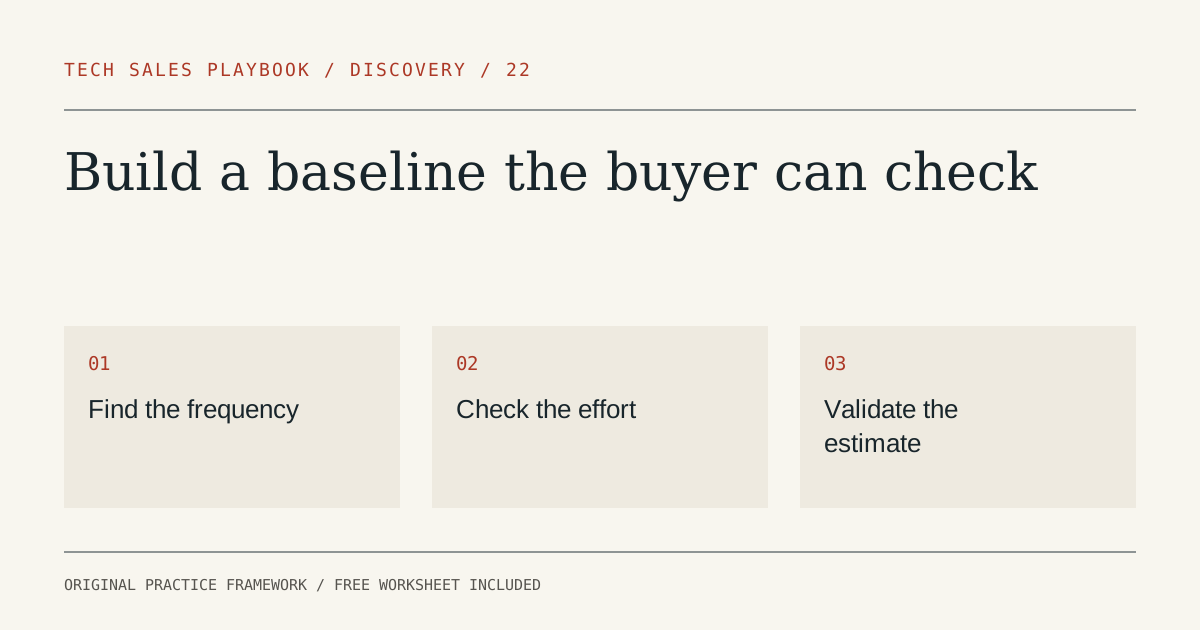
Preview this playbookTo quantify a business problem, ask how often it occurs, what work it creates, and where those observations can be checked. Start with an operational baseline. Do not turn estimated time into guaranteed savings or claim your product will remove all of the work.
GitLab's metrics discussion addresses evidence in value conversations. The arithmetic and questions below are original examples for practicing a more careful discovery conversation.
Ask for the work before its value
Try: “When this handoff fails, what does someone have to do next?” Follow with frequency, effort, and ownership questions. A broad statement such as “it wastes a lot of time” is a reason to investigate, not a completed business case.
| Question | What it establishes |
|---|---|
| How often did this happen in the last period? | A bounded frequency |
| Who handles the extra work? | The affected role |
| How long does a typical instance take? | An estimate of effort |
| Where could we check that? | A source and evidence owner |
| Which cases differ? | Exceptions and uncertainty |
Work through a hypothetical baseline
Suppose a buyer estimates 40 rework cases per month at 15 minutes each. That is 600 minutes, or 10 hours of estimated monthly effort. It is not automatically 10 hours of cash savings, and it is not proof that a new system would remove all 40 cases.
Ask whether the cases overlap, whether the time is recorded or recalled, and whether a representative sample could validate the estimate. A range may be more honest than a single precise-looking number.
Separate three layers
Keep the current baseline, the possible operational change, and the financial interpretation in different rows. The baseline comes from the customer's process. The expected change requires evidence from a suitable evaluation. The financial interpretation needs the buyer's assumptions about cost, capacity, and priorities.
If the buyer cannot supply a baseline, propose a modest measurement step rather than filling the gap with an industry statistic. A public benchmark can provide context, but it cannot establish this customer's specific result.
Make uncertainty visible in the recap
Write “estimated by the operations lead; sample review pending” next to an unverified figure. Ask the owner to correct it. For practice, have a colleague challenge the frequency, the time estimate, and the assumption that all work disappears. A sound business conversation should become more accurate under those questions instead of collapsing because its ROI depended on hidden assumptions.
Use the free worksheet
Download the quantify business pain in discovery without inventing roi worksheet. It opens in a spreadsheet and requires no signup. Use fictional details for practice and your approved systems for real customer or employer information.
Choose your next step
Business Impact Discovery Practice With Defensible Baselines explains the free exercise, the relevant paid resource, and who it fits. Read the product preview before deciding whether you need the broader self-study manual.
Continue with Second Discovery Call Agenda: Resolve What the First Call Could Not.
Put this guide to work
The Discovery Playbook
Understand the customer’s workflow, test impact, and clarify the next decision.
$19 USD · One-time purchase · Downloadable PDF
Preview this playbookRead the sample and see what is included before you buy.
Need the broader set? Compare The Deal Execution Bundle for $39. Includes this book.