Best For
- SDRs practicing discovery
- Account executives
Loading...
A 35-page field manual for discovery and qualification. Covers SPIN and MEDDIC, workflow questions, impact calculations, champions, stakeholders, budget, and next steps. Includes an annotated conversation and three worksheets.
Understand the customer’s workflow, test impact, and clarify the next decision.
35 pages
Finished PDF playbook
20-page preview
Review the sample first
30-day guarantee
Instant access after checkout
Look inside
The full playbook runs 35 pages.
These 20 are the real thing, not a summary.
Page 1 / 20
Text from the same public sample shown above. Use the page images or PDF for diagrams, tables and original layout.
TECH SALES PLAYBOOK THE FIELD MANUAL SERIES The Discovery Playbook Find the real problem. Validate the impact. Earn the next step. EVIDENCE IMPACT NEXT STEP Annotated conversations / Impact cases / Practical worksheets RESEARCH EDITION / 2026 35 PAGES
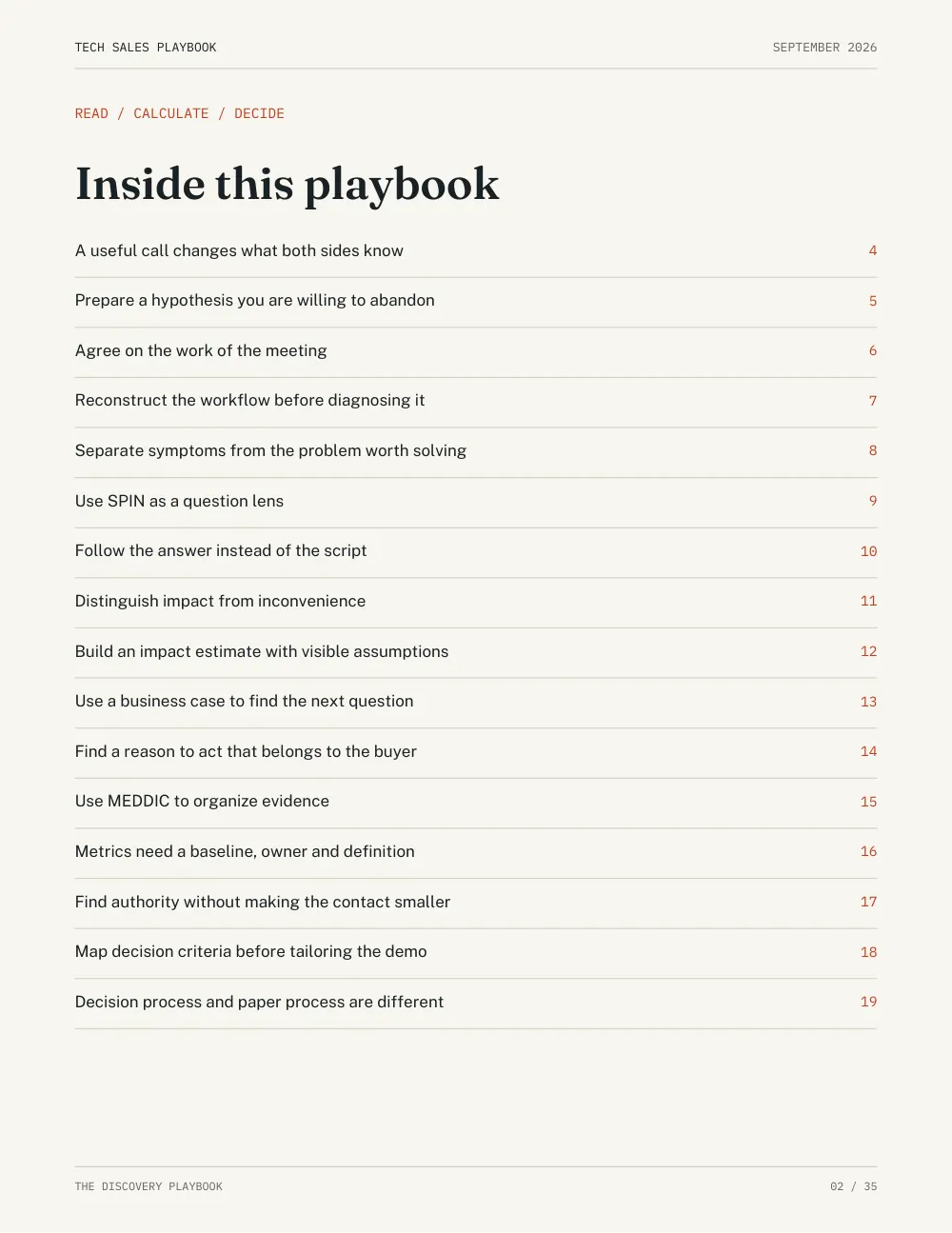
TECH SALES PLAYBOOK SEPTEMBER 2026 THE DISCOVERY PLAYBOOK 02 / 35 READ / CALCULATE / DECIDE Inside this playbook A useful call changes what both sides know 4 Prepare a hypothesis you are willing to abandon 5 Agree on the work of the meeting 6 Reconstruct the workflow before diagnosing it 7 Separate symptoms from the problem worth solving 8 Use SPIN as a question lens 9 Follow the answer instead of the script 10 Distinguish impact from inconvenience 11 Build an impact estimate with visible assumptions 12 Use a business case to find the next question 13 Find a reason to act that belongs to the buyer 14 Use MEDDIC to organize evidence 15 Metrics need a baseline, owner and definition 16 Find authority without making the contact smaller 17 Map decision criteria before tailoring the demo 18 Decision process and paper process are different 19
TECH SALES PLAYBOOK SEPTEMBER 2026 THE DISCOVERY PLAYBOOK 03 / 35 READ / CALCULATE / DECIDE Tools for the decision Test a champion through observable action 20 Add stakeholders with a purpose 21 Discuss budget as an investment process 22 Explore alternatives, including doing nothing 23 Move from discovery to a focused demonstration 24 End with a decision, not a vague promise 25 Send a recap the buyer can correct 26 Build a mutual action plan only when it is mutual 27 Write CRM notes that separate evidence from belief 28 Annotated conversation: recover from the early pitch 29 Coach the behavior you can observe 30 Worksheet: prepare the next call 31 Worksheet: the discovery evidence map 32 Worksheet: test the impact calculation 33 Run a seven-day discovery practice cycle 34 Sources and edition notes 35
TECH SALES PLAYBOOK SEPTEMBER 2026 THE DISCOVERY PLAYBOOK 04 / 35 FIELD GUIDE / START HERE A useful call changes what both sides know Discovery is a working conversation about whether a problem is worth solving and whether you can help. A good call leaves the buyer with a clearer view of the situation and leaves you with evidence for the next decision. It can also reveal that there should be no next sales meeting. This book is for SDRs learning to qualify and AEs running deeper evaluation conversations in B2B technology sales. The methods are intentionally adaptable. A ten-minute inbound call and a complex operational workshop do not need identical agendas or identical levels of detail. The outputs you are working toward A specific description of the current workflow and the problem within it. A buyer-confirmed account of impact, importance and desired change. A map of who needs to participate in the evaluation and decision. One useful, agreed next step, or a clear reason to stop. Use the book with a real opportunity Read the preparation pages, run the call, then use the evidence worksheet and coaching rubric. Compare what the buyer actually said with what you entered in the CRM. Work through the fictional Northstar case if you do not have a live opportunity. Northstar Services, its people and all numerical examples are fictional. Scripts, worksheets and scoring rules are original teaching tools, not experimentally validated performance guarantees. Research reviewed September 2026. SPIN and MEDDIC are attributed frameworks; this is independent practical instruction, not official certification. Sources support the definitions noted beside them. They do not prove that using a script will produce a sale.
TECH SALES PLAYBOOK SEPTEMBER 2026 THE DISCOVERY PLAYBOOK 05 / 35 01 / BEFORE THE CONVERSATION Prepare a hypothesis you are willing to abandon Research should help you ask a relevant question. It should not convince you that you already know the answer. Separate what you observed from what you inferred. Preparation item Fictional Northstar example Status Public observation Northstar advertised five onboarding roles Observed posting; date recorded Possible implication Customer onboarding volume may be growing Hypothesis Possible problem Handoffs may be difficult to coordinate Unconfirmed Useful opening question What prompted the investment in onboarding? To ask Before the meeting, review the company, the attendee's role, the reason the conversation exists and any approved prior notes. Write one likely workflow, two possible challenges and one reason your hypothesis could be wrong. A new hiring round might reflect replacement hiring rather than growth. Prepare the right proof Choose a relevant product capability and an approved example you can show if the conversation supports it. Do not prepare a long demonstration around a problem the buyer has not acknowledged. Bound the research For an ordinary first meeting, use a time budget that matches the opportunity and your workload. Stop when you can explain why the meeting might matter and identify the unknowns. More browsing is not automatically better preparation. Pre-call sentence: "I noticed ___. That might mean ___, but I need to ask ___ before treating it as a problem." Never invent customer results, relationships or internal company knowledge to make the hypothesis sound authoritative.
TECH SALES PLAYBOOK SEPTEMBER 2026 THE DISCOVERY PLAYBOOK 06 / 35 01 / BEFORE THE CONVERSATION Agree on the work of the meeting Open with a purpose the buyer can edit. Confirm the time, acknowledge their reason for attending, and explain how you propose to use the conversation. Leave space for a different priority. "Thanks for making time, Priya. We have 30 minutes. You mentioned that onboarding handoffs have become harder to track. I suggest we understand the current process, look at where it breaks down, and decide whether there is a useful next step. What would you add or change?" If the buyer wants a demonstration immediately, do not defend your agenda as a rule. Ask for the minimum context needed to make the demonstration relevant: "Happy to show it. Which workflow should I focus on, and what would you need to see to judge whether it fits?" An adaptable 30-minute starting structure Time Work to accomplish First 3 minutes Purpose, buyer priorities and meeting shape Next 10 minutes Current workflow and a concrete problem example Next 10 minutes Impact, desired change and relevant stakeholders Final 7 minutes Summarize, test fit and agree on the next decision This is an original planning aid, not an optimal timing formula. Move with the conversation. A serious issue may need more exploration; a clear mismatch may justify ending early. If recording or using an AI note-taking tool, follow your employer's approved process and applicable consent requirements. Explain its presence. Do not activate it merely because a platform permits the button press.
TECH SALES PLAYBOOK SEPTEMBER 2026 THE DISCOVERY PLAYBOOK 07 / 35 02 / UNDERSTAND THE CURRENT STATE Reconstruct the workflow before diagnosing it Ask the buyer to walk through a recent event. Specific events reveal sequence, ownership and exceptions more clearly than abstract statements such as "our process is inefficient." A workflow walk-through "Take the most recent customer onboarding. What started the process, who picked it up, and what happened before the customer reached their first milestone?" Follow the story. Ask what happens at each handoff, what information is required, and where the record lives. If they say a step is automated, ask what the automation actually does and what still requires a person. Element Question to clarify Trigger What starts this work? Owner Who is responsible at this point? Input What information or approval is needed? Handoff How does the next person know it is their turn? Exception What happens when something is missing? Finish How do you know this case is complete? Northstar example Priya says sales enters a closed deal in the CRM, an onboarding coordinator copies details into a spreadsheet, and a technical specialist receives an email. The record becomes difficult to follow when the specialist needs missing information from sales. You now have a candidate issue: the missing-information loop. You do not yet know its frequency, importance or whether your product can address it. Ask about the last occurrence before suggesting a fix. Summarize in their language: "So the uncertainty starts when the specialist needs information that did not arrive with the handoff. Have I understood that correctly?"
TECH SALES PLAYBOOK SEPTEMBER 2026 THE DISCOVERY PLAYBOOK 08 / 35 02 / UNDERSTAND THE CURRENT STATE Separate symptoms from the problem worth solving Buyers can name a symptom before they can describe its cause. "We need a dashboard" is a proposed solution. "We cannot tell which onboarding cases are waiting on sales" is a problem statement you can investigate. Follow the chain without forcing it Ask what the buyer cannot do today, when that limitation matters, who feels it and what they have tried. Avoid treating your preferred cause as established fact. Buyer statement Useful follow-up "Everything is manual." Which manual step creates the most rework? "We need better reporting." What decision is difficult with the current report? "The team is frustrated." What happened the last time that frustration showed up? "We lose visibility." What information is missing, and at which handoff? A disconfirming question "When does the current process work well? What is different in those cases?" If Northstar's small customers onboard smoothly while large customers stall, the problem may involve complexity, missing technical information or ownership rather than a universal lack of dashboards. The exception is useful evidence. Do not manufacture pain If the buyer describes a mild inconvenience with little consequence, do not escalate the language until it sounds urgent. Ask where it sits among their priorities. It may be reasonable for them to live with it. Working problem statement: "When [event] happens, [person/team] cannot [specific action], which leads to [observed consequence]." Keep "observed consequence" empty until the buyer supplies evidence. An empty field is more honest than a plausible story you invented.
TECH SALES PLAYBOOK SEPTEMBER 2026 THE DISCOVERY PLAYBOOK 09 / 35 02 / UNDERSTAND THE CURRENT STATE Use SPIN as a question lens SPIN describes Situation, Problem, Implication and Need-payoff questions. Huthwaite presents these as a flexible framework, not a fixed sequence that every conversation must follow. Huthwaite: SPIN methodology The original Northstar examples below show how you might apply those question types. Use them to identify what you need to learn, then choose natural wording for the buyer. Lens Original question What the answer can clarify Situation How is an onboarding case assigned today? Workflow and ownership Problem Where did the last assignment get stuck? A concrete difficulty Implication What did that delay change for the team or customer? Consequences Need-payoff If that handoff worked reliably, what would become easier? Desired benefit Listen for the next useful question If a buyer begins with a specific consequence, you do not need to drag them back to basic company facts. Explore the consequence, then fill missing context when it becomes necessary. Avoid the interrogator's version Asking four questions in rapid succession does not create a useful discussion. Acknowledge the answer, summarize what it means, and let the buyer correct you. Share relevant information when it helps them reason through the issue. Practice drill: take a real buyer statement and write two possible follow-ups. Choose the one that tests the most important uncertainty, not the one that completes an acronym. Afterward, review whether the question helped the buyer explain their situation. Counting how often you used each category is less useful than examining what you learned.
TECH SALES PLAYBOOK SEPTEMBER 2026 THE DISCOVERY PLAYBOOK 10 / 35 02 / UNDERSTAND THE CURRENT STATE Follow the answer instead of the script Many discovery calls become shallow because the rep moves on as soon as the buyer mentions the expected topic. Stay with a meaningful answer long enough to understand it. The follow-up ladder Clarify: "When you say 'late,' what does late mean here?" Locate: "Where in the workflow does the delay begin?" Illustrate: "Could you take me through the most recent example?" Quantify carefully: "How often has that happened in the period you track?" Test interpretation: "Is the main issue the time spent or the uncertainty it creates?" These are optional moves. Do not ask all five automatically. If the buyer does not know a number, ask who could verify it or whether a small sample would be useful. Northstar exchange Priya: "Onboarding is too slow." Rep: "Where do you see the time accumulating?" Priya: "Usually waiting for the technical requirements." Rep: "What happened in the last case where those requirements were missing?" The rep has moved from a general complaint to a testable workflow issue. The next step is to understand the case, not immediately claim that the product eliminates delays. Give the buyer room Ask one question at a time. If silence follows, allow thinking time rather than filling it with several alternatives. If a term is unfamiliar, ask for its meaning in their organization. Useful listening is visible: your next question should make sense only because you heard the last answer.
TECH SALES PLAYBOOK SEPTEMBER 2026 THE DISCOVERY PLAYBOOK 11 / 35 03 / ESTABLISH THE BUSINESS CASE Distinguish impact from inconvenience Impact is the effect of the problem on work the buyer values. It may involve cost, time, customer experience, risk or capacity. Not every effect can or should be converted immediately into dollars. Explore three layers First, identify the operational consequence: repeated data entry, a delayed handoff or a missed service commitment. Then ask who is affected and what they do in response. Finally, ask which business objective this changes. For Northstar, a missing requirements document might cause a specialist to chase sales, push back a kickoff and require the coordinator to update several people. Those are separate effects. Some may overlap; avoid counting the same time twice. Questions that preserve accuracy "What did the team do because of the delay?" "Which of those effects do you measure today, and which are estimates?" "If the delay disappeared, would that release capacity, reduce spending, or mainly improve predictability?" Respect the buyer's priorities A process can waste time without justifying a purchase. Ask how the issue compares with other work competing for budget and attention. A quantified effect is part of a decision, not proof that your solution is necessary. Working distinction: time released is not automatically cash saved. Cash savings require a credible explanation of which spending changes and when. Label softer benefits in their own terms. "Fewer status-chasing messages" can be a useful operational goal without inventing a financial value for every message.
TECH SALES PLAYBOOK SEPTEMBER 2026 THE DISCOVERY PLAYBOOK 12 / 35 03 / ESTABLISH THE BUSINESS CASE Build an impact estimate with visible assumptions Start with a small model that the buyer can correct. Use their measured inputs where available and clearly label estimates. Keep the model separate from a product-performance promise. Fictional Northstar capacity case Northstar estimates 60 onboarding cases per month, with 25 minutes of avoidable chasing per case. A fully loaded labor assumption of $48 per hour is supplied for the exercise. The annual period is 12 months. Step Calculation Result Monthly time 60 x 25 / 60 25 hours Annual time 25 x 12 300 hours Annual capacity value 300 x $48 $14,400 Illustrative 50% reduction 150 hours x $48 $7,200 The 50% reduction is a hypothetical scenario to test, not an established product outcome. The $14,400 is a capacity valuation of the estimated work, not verified recoverable cash. A buyer who keeps the same staffing and spending may realize capacity rather than a budget reduction. Stress-test the estimate What share of cases actually has this problem? Does the 25-minute estimate include overlapping work? Was the hourly rate supplied by the right person? Is the period representative? What new work would the proposed solution introduce? Send the assumptions with the result: "This estimate depends on 60 cases, 25 minutes and a $48 rate. Which inputs should we revise before using it?" The strongest model may be smaller than your first estimate. Credibility matters more than a large headline.
TECH SALES PLAYBOOK SEPTEMBER 2026 THE DISCOVERY PLAYBOOK 13 / 35 03 / ESTABLISH THE BUSINESS CASE Use a business case to find the next question An early value estimate should guide evaluation. It should not become a polished ROI claim before the inputs and costs are understood. A sobering extension of the Northstar example Suppose a proposed system costs $12,000 annually plus $3,000 for first-year implementation. If the only supported benefit is the hypothetical $7,200 capacity value from the prior page, the first-year benefit minus cost is negative $7,800. The stated case does not support buying on labor value alone. Do not repair the result by inventing churn prevention or attributing all future revenue to the product. Ask whether there are other material outcomes and what evidence would support them. The buyer may value predictability enough to proceed, but that should be their stated rationale. If you report a ratio For the simplified example, (benefit - cost) / cost equals ($7,200 - $15,000) / $15,000 = -52%. This is an illustrative value-to-cost calculation using capacity value. It is not a forecast of cash ROI and excludes timing, tax and discounting. Learn what would change the conclusion Could a limited pilot measure the actual time difference? Would the system replace a documented expense? Is there a higher-priority workflow where it is more relevant? Or should the opportunity stop? A discovery rep earns trust by naming a weak business case. Your job is to help evaluate fit, not to make every spreadsheet turn positive. Record the unresolved input and the person who can validate it. That is a concrete next step.
TECH SALES PLAYBOOK SEPTEMBER 2026 THE DISCOVERY PLAYBOOK 14 / 35 03 / ESTABLISH THE BUSINESS CASE Find a reason to act that belongs to the buyer A real deadline connects to a buyer event, a consequence and the work required beforehand. Your quarter-end date is not automatically the buyer's reason to change. Test the timing "What happens on October 15 that makes this date important?" "What would need to be working before then?" "If the date moved, what would change for the business?" "What other projects or approvals could affect the schedule?" If the buyer cannot identify a meaningful consequence, record the date as a preference rather than an immovable deadline. A preference is still useful; it simply supports a different level of confidence. Northstar's event Priya wants a new process before a planned onboarding volume increase. The rep asks whether the hiring date, customer commitments and internal training schedule are confirmed. If those events are still tentative, the evaluation plan should reflect that uncertainty. Work backward carefully Separate a purchase decision from implementation readiness. A signature on the desired launch date may be too late if configuration and training take additional time. Ask the responsible teams to estimate their own tasks rather than inventing a standard implementation duration. An honest urgency statement: "You want the workflow ready before [event] because [consequence]. We still need [owner] to confirm [dependency]." Do not introduce false scarcity or imply that a buyer's problem becomes worse on your pricing deadline. Keep commercial terms and operational timing distinct.
TECH SALES PLAYBOOK SEPTEMBER 2026 THE DISCOVERY PLAYBOOK 15 / 35 04 / QUALIFY THE OPPORTUNITY Use MEDDIC to organize evidence MEDDIC names six qualification areas: Metrics, Economic Buyer, Decision Criteria, Decision Process, Identify Pain and Champion. MEDDICC adds Competition; MEDDPICC also includes Paper Process and, in MEDDICC's current terminology, uses Implicate Pain. Keep the variants distinct. MEDDICC: methodology definitions Use your employer's chosen version consistently. The original working questions below help turn labels into evidence rather than a completed-looking CRM form. Area Working question for your notes Metrics Which outcome is measured, on what basis? Economic Buyer Who can authorize the investment? Decision Criteria What will the buyer use to judge fit? Decision Process Which people and steps lead to a decision? Identify Pain What specific problem matters enough to examine? Champion Who can and will advocate internally? Do not make the buyer sit through the acronym You can gather relevant evidence over several conversations. A first call may establish a problem and introduce the right operational owner without resolving final approval. Record the missing evidence and choose the next conversation accordingly. Qualification changes An initial advocate may leave. A budget owner may change. A new requirement may emerge. Revisit important assumptions when the opportunity changes rather than treating an old answer as permanently true. For each field, record the buyer's evidence, your interpretation and what remains unknown. A label without supporting evidence is a hypothesis.
TECH SALES PLAYBOOK SEPTEMBER 2026 THE DISCOVERY PLAYBOOK 16 / 35 04 / QUALIFY THE OPPORTUNITY Metrics need a baseline, owner and definition A metric is useful only if the participants mean the same thing by it. "Reduce onboarding time" could refer to days from contract to kickoff, hours of employee effort, or days until the customer reaches a milestone. Make the measure operational Element Northstar working definition Metric Days from complete requirements to kickoff Start event Requirements checklist accepted End event Customer kickoff held Baseline To be calculated from a defined sample Owner Onboarding operations lead Desired change Buyer to set after baseline review The first and last events matter. Measuring from signature in the baseline but from complete requirements in the pilot would make the comparison misleading. Ask about the data Who maintains the record? How many cases are available? Are canceled or atypical cases included? Is the measure an average, a median or a range? What other changes might influence it during the evaluation? Avoid easy-looking targets Do not suggest a percentage improvement merely because it looks good in a proposal. Establish what the buyer needs, what is technically plausible and how the result can be measured. A pilot can test an uncertain outcome; it cannot guarantee it in advance. Confirmation prompt: "Before we use this number, can we agree on the start event, end event, sample and owner?" Without reliable data, agree on how to collect a baseline. Keep guesses separate from measurements.
TECH SALES PLAYBOOK SEPTEMBER 2026 THE DISCOVERY PLAYBOOK 17 / 35 04 / QUALIFY THE OPPORTUNITY Find authority without making the contact smaller Your contact can be knowledgeable and influential without holding final spending authority. Ask about how decisions are made without implying that their participation is unimportant. The economic buyer concept concerns overall buying authority. Job title alone is not enough to establish it. MEDDICC: economic buyer Respectful process questions "If the team decides this is worth pursuing, who needs to approve the investment?" "How did a similar purchase move through the organization?" "What will that person need to see to evaluate the proposal?" "Would it be useful to review the assumptions with them once we have the baseline?" Bring a reason for access Do not ask for an executive meeting simply to satisfy your qualification checklist. Explain the decision it would help: confirming the business priority, validating investment criteria or resolving a tradeoff the operational team cannot settle alone. When access is not available Ask how the buyer wants the decision brief prepared, which questions should be answered and when feedback can be shared. Record the access limitation without automatically disqualifying the deal or pretending the limitation does not matter. Internal note: "Priya says the VP approves new software above the team's authority. We have not confirmed the VP's priorities or reviewed the proposed investment with them." That note is more useful than "economic buyer identified" because it exposes the remaining work.
TECH SALES PLAYBOOK SEPTEMBER 2026 THE DISCOVERY PLAYBOOK 18 / 35 04 / QUALIFY THE OPPORTUNITY Map decision criteria before tailoring the demo Decision criteria describe how the buyer will judge a solution. Some are mandatory constraints; others are preferences or commercial tradeoffs. Your product feature list is not the buyer's criteria list. Build a short criteria map Criterion Type Proof needed Owner Existing CRM integration Must-have Approved workflow test Systems lead Clear exception ownership Desired outcome Buyer scenario demonstration Operations Acceptable access controls Must-have Security review Security team Affordable total cost Tradeoff Scope and cost review Budget owner All entries are fictional. In a live opportunity, let the buyer correct the list and identify who judges each item. A requirement described by one person may mean something different to another team. Ask about priority and failure "Which requirements would rule a solution out?" "Where are you willing to trade convenience against cost or effort?" "What evidence would count as a satisfactory answer?" Do not quietly redefine a requirement If your product cannot meet an important criterion, say so. Explore whether an approved alternative meets the underlying need, but do not label a workaround equivalent without the buyer's agreement. Demo preparation starts here: select the smallest set of scenarios that tests the buyer's most important criteria. Avoid demonstrating every feature simply because time is available. Record unresolved technical claims as questions for the appropriate specialist. Discovery is not permission to invent an integration or security capability.
TECH SALES PLAYBOOK SEPTEMBER 2026 THE DISCOVERY PLAYBOOK 19 / 35 04 / QUALIFY THE OPPORTUNITY Decision process and paper process are different A team can prefer your solution before the organization is ready to sign. Legal review, vendor setup and security checks may still remain. MEDDICC's paper-process guidance distinguishes these completion steps from the decision to buy. MEDDICC: paper process Build two connected maps The decision map records how the buyer evaluates options and authorizes investment. The completion map records the approvals, documents and administrative steps required afterward or in parallel. The exact order belongs to the buyer's process. Step Owner Dependency to clarify Workflow evaluation Operations Agreed success criteria Technical review Systems team Integration information Investment approval Budget owner Cost and outcome brief Security review Security team Requested evidence Contract review Legal or procurement Current approved terms Vendor setup Finance operations Required supplier details Ask without pretending to know the duration "Which of these steps apply here, who owns them, and which can happen at the same time?" "What has caused delays in similar purchases?" "When should we involve those teams so they have enough time?" A date in the CRM is not a completion plan. Every material dependency needs an owner and evidence that the step is understood. Keep sensitive security and contract materials in approved channels. Bring specialists into questions that require their authority rather than promising an answer during discovery.
TECH SALES PLAYBOOK SEPTEMBER 2026 THE DISCOVERY PLAYBOOK 20 / 35 04 / QUALIFY THE OPPORTUNITY Test a champion through observable action MEDDICC describes a champion as having influence, advocating internally and holding a vested interest in the outcome. A friendly or helpful contact may be a coach without meeting all those conditions. MEDDICC: champion The practical checks below are original applications. They are not a demand that a buyer perform favors for you. Observation What it suggests What it does not prove Explains internal priorities Useful organizational knowledge Spending authority Corrects the business case Investment in an accurate outcome Approval to purchase Introduces a relevant stakeholder Ability to coordinate participation Final consensus Advances an agreed internal action Active advocacy Guaranteed deal success Offer something useful to carry internally Help your contact summarize the problem, the evidence, the open questions and the proposed evaluation. Make the brief credible enough that they can use it without you present. Do not write an inflated ROI case that puts their reputation at risk. Northstar test Priya agrees to review the baseline with the operations analyst and invites the systems lead to assess the integration requirement. Those actions provide evidence of coordination. The rep still needs to understand the budget owner's priorities and the team's willingness to implement a change. Better internal language: "Priya has taken these two actions; advocacy with the budget owner is still untested." If your contact cannot make an introduction, ask what would help or what constraint exists. Avoid equating every access limit with lack of support.
This is meant to be opened while you work. The sections are concrete enough to copy, practice, adapt, and reuse during applications, interviews, calls, and weekly execution.
MEDDIC qualification deep dive
SPIN Selling for SaaS
Pain vs. problem: Finding the real issue
Champion identification tactics
Multi-threading strategy
Discovery call structure and flow
Question frameworks that reveal budget
Ask questions that follow the buyer’s answer.
Test impact with explicit assumptions.
Map stakeholders and agree on a useful next step.
The sample exists so buyers can inspect the writing style, structure, and depth before purchase. If the sample feels useful, the full PDF continues with the same practical format.
What you are buying
Before you decide
Start with the question that matters to you. You can use the free material without making a purchase.
Try one relevant task first. If that resolves your immediate question, keep using the free resources. Inspect the book’s sample when you need more structured practice.
Try the related free resourceUnderstand the customer’s workflow, test impact, and clarify the next decision.
Use this as a self-study routine, adjusting it to the material. Completing a session is not a certification or an assessment of hiring readiness.
Choose one book for a focused gap. Consider a bundle only if you will use its listed books; compare the exact contents and avoid paying twice for material you already own.
A PDF is self-directed preparation. Individual feedback on your own resume is a separate service with its own scope and availability.
Compare the resume serviceCheck the current price, included files, delivery instructions and refund terms before opening checkout.
Read the actual sample and file details on this page. If you need help with an order or access, contact support with your question rather than placing a second order.
Read purchase and refund termsAsk a product or access question$29 PDF download
$29 PDF download
$39 PDF download
$29 PDF download
$19 PDF download
$19 PDF download
$19 PDF download
$19 PDF download
$19 PDF download