Use this as a working guide, not a passive read. Skim the sections, copy the frameworks, then connect the advice to a real role, interview, call, or account you are working on this week.
Start with a free resourceDownload the mutual action planNo signup required. Browse the free resource library
Put this guide to work
The Enterprise Playbook
$19 USD · One-time purchase · Downloadable PDF
Preview this playbookAn RFP arriving in your inbox is an invitation to evaluate an opportunity, not proof that your team should write a response. Before requesting hours from solutions engineering, security or delivery, establish whether you can answer the requirements accurately and complete the process responsibly. This checklist is an original planning exercise; your employer's approval rules and the buyer's instructions govern the actual response.
Separate fit from enthusiasm
Start with a requirements screen. For each mandatory requirement, record the exact request, the approved evidence, the responsible specialist and one status: supported, unsupported or unknown. A feature planned for later is not evidence that it is available today. An unfamiliar requirement is a question for an owner, not an automatic yes.
GitLab's RFI/RFP process is a useful primary-source example: it tells its teams to discuss requirements that do not match the product with the account owner. That is GitLab's process, not a universal procurement rule. The screen below helps you identify similar questions in your own organization.
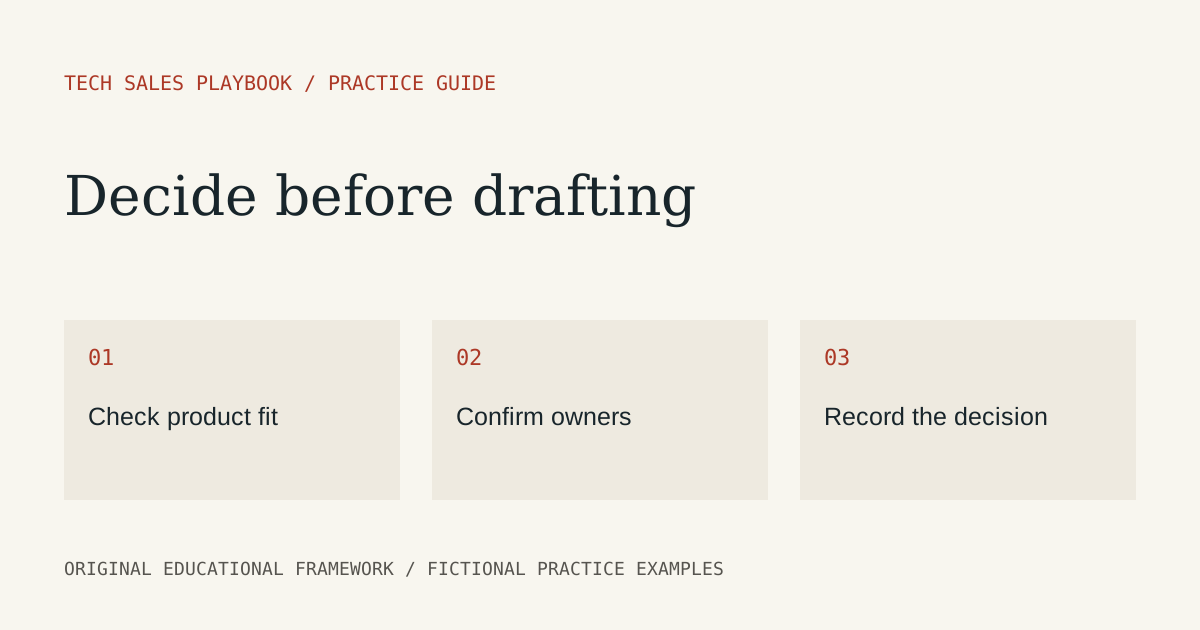
Use five checks before committing
- 1Scope: Can the current approved offering address the mandatory use case? Identify any exceptions that need a decision.
- 2Process: Do you understand the submission format, deadline and permitted clarification channel? Do not contact evaluators outside the stated process.
- 3Evidence: Can named owners substantiate the answers? Separate a published capability from a promise requiring approval.
- 4Capacity: Have the people needed for the response accepted the work and review dates? A salesperson's deadline is not a specialist's commitment.
- 5Decision context: What is known about the problem, evaluation criteria and next step? Mark missing information as unknown; do not invent a win probability.
Use a short decision note: “Proceed,” “Clarify before deciding,” or “Do not bid under current conditions.” Attach the unresolved item and its owner. A numeric score can hide a mandatory failure, so do not average an unsupported must-have into an otherwise attractive total.
Work through a fictional request
Imagine a fictional reporting platform receives an RFP requiring an export format it supports, a deployment model it does not offer, and a completed response in four working days. The account executive likes the potential account. The solutions engineer has capacity for only the export section.
A defensible note is: “Clarify whether the deployment requirement is mandatory through the permitted channel. Ask the bid owner to confirm response capacity. Do not commit to submission until both questions have an approved answer.” If the unsupported requirement remains mandatory, the team can document a no-bid decision through its normal process. It should not describe an unapproved workaround as supported.
Contrast that with a smaller request whose mandatory requirements have approved evidence and whose reviewers have accepted the schedule. Proceeding can be reasonable even without a personal relationship with the buyer. Lack of informal access is not a reason to bypass a formal process.
Turn a yes into a response plan
Assign one response owner and one approver for each section. Record the source and date for factual answers. Set an internal review deadline before submission and check file formats, word limits and required attachments. Route security, contractual and pricing questions to the people authorized to answer them. This guide does not interpret contract obligations.
If the decision is no, preserve a concise reason in approved systems. Distinguish a product gap, a capacity problem and a weak fit; each calls for a different future action. Do not blame the buyer or imply that a decline predicts the outcome of their process.
Choose the right next resource
Use RFP bid-decision resources to compare this free exercise with broader enterprise-sales self-study. For a buyer already waiting on your proposal, use the separate proposal-readiness checklist. For an active procurement process after evaluation, see the procurement checklist. Those solve later problems; they do not replace the initial bid decision.
Put this guide to work
The Enterprise Playbook
Plan complex accounts, align stakeholders, and guide evaluation through rollout.
$19 USD · One-time purchase · Downloadable PDF
Preview this playbookRead the sample and see what is included before you buy.
Need the broader set? Compare The Deal Execution Bundle for $39. Includes this book.