Use this as a working guide, not a passive read. Skim the sections, copy the frameworks, then connect the advice to a real role, interview, call, or account you are working on this week.
Start with a free resourceDownload the mutual action planNo signup required. Browse the free resource library
Put this guide to work
The Discovery Playbook
$19 USD · One-time purchase · Downloadable PDF
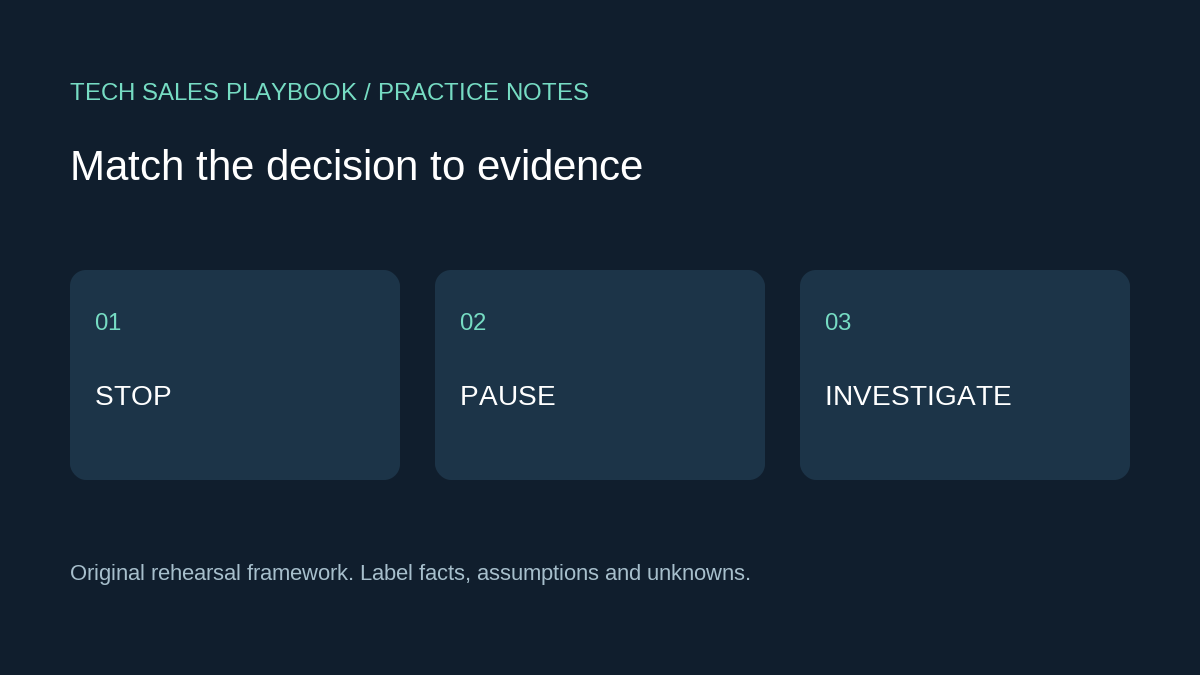
Preview this playbookDisqualify an opportunity when confirmed evidence shows that pursuing the defined use case is not appropriate. Pause it when a specific dependency prevents progress. Investigate when the missing fact could change the decision and there is a reasonable way to learn it. An unanswered question is not automatically a failed qualification.
Salesforce Trailhead's qualification overview describes several qualification models and notes that prospects may not know all the answers to budget, authority, need and timing questions. The decision record below is our original practice framework. Apply your team's stage definitions and review process to actual opportunities.
Distinguish a hard mismatch from an unknown
| Observation | What it supports | What it does not prove |
|---|---|---|
| Buyer confirms an essential capability is unsupported | The defined use case has a fit problem | Every possible use case at the company is unsuitable |
| Contact does not know the budget | Budget remains unknown | The organization cannot fund a purchase |
| Buyer asks to stop contact | Stop outreach and follow the applicable process | Permission to put the contact into another sequence |
| Project depends on an unapproved internal change | A dependency needs resolution | A reliable close date |
| Buyer is slow to reply | Engagement has changed | Why it changed |
Record the evidence source and date. “No budget” is a different statement from “budget not discussed.” “No fit” needs a defined requirement and a confirmed limitation. If the evidence is second-hand, label it and identify who can confirm it.
Use a bounded decision record
Copy these fields into an approved workspace: defined use case; confirmed requirement; current product capability; missing fact; decision; reason; review owner; and reopening trigger. Avoid customer-sensitive information in public practice documents.
A reopening trigger describes evidence that could change the decision. “Check again next month” is a date, not a reason. A confirmed change in the required workflow or a documented supported capability may be a reason. Do not promise a future feature or assume that a roadmap discussion resolves today's mismatch.
Work through three fictional opportunities
Orchard Services: stop the defined use case. The buyer needs a fully offline workflow. The approved product documentation says the proposed workflow requires connectivity, and the buyer confirms offline operation is essential. Record the mismatch, explain it respectfully and follow the team's process for closing this opportunity. Do not hide the limitation in a proposal.
Beacon Studio: investigate one missing fact. The operations contact confirms a workflow problem but has not discussed funding with the decision owner. Ask how an investment like this would be evaluated and whether a scoped next conversation is useful. The missing budget answer alone does not establish a bad fit. If no further discussion is wanted, respect that decision.
Northline Labs: pause on a dependency. The workflow fits the known requirement, but the buyer says evaluation cannot start until an internal system migration is complete. Record the dependency and ask whether they want a follow-up when a named milestone occurs. Do not move the close date forward repeatedly without fresh buyer evidence.
These cases contain invented organizations and facts. They are not customer outcomes or a universal scoring model. Their purpose is to practice matching a decision to the evidence available.
Explain a mismatch without blaming the buyer
For Orchard: “You confirmed that offline operation is essential. The workflow we discussed requires connectivity, so I do not want to propose it as a solution to that requirement. I will record that limitation and close this evaluation under our process. If the required workflow changes, we can reassess the fit.”
Keep the explanation tied to the defined requirement. Avoid suggesting that the buyer is unqualified as a person or that they should remove an essential need just to buy. If a different supported use case exists, ask whether they want to discuss it; do not treat that possibility as an active opportunity without agreement.
Keep CRM facts and follow-up consistent
Use the approved reason code and a short evidence note. Remove speculative next steps, correct the forecast under your team's rules and tell relevant internal owners what changed. Where contact preferences have changed, follow the applicable suppression process. Do not delete useful history to make pipeline hygiene look better.
For a paused opportunity, state what must happen before another evaluation step is useful. If the buyer has not agreed to future contact, do not describe a nurture plan as mutually agreed. Keep a team's internal review task separate from permission to reach out.
Rehearse a manager challenge
Ask a practice partner to challenge your decision: “Are we closing this too early?” Answer with the confirmed requirement, its source, the missing facts and what would reverse the decision. If you cannot identify those, improve the record before defending the conclusion.
Compare the disqualification practice resources if you need broader qualification study. For unknown budget, use the budget discovery guide. For an otherwise qualified evaluation that has stopped moving, use the separate no-decision diagnosis guide.
Put this guide to work
The Discovery Playbook
Understand the customer’s workflow, test impact, and clarify the next decision.
$19 USD · One-time purchase · Downloadable PDF
Preview this playbookRead the sample and see what is included before you buy.
Need the broader set? Compare The Deal Execution Bundle for $39. Includes this book.


