Use this as a working guide, not a passive read. Skim the sections, copy the frameworks, then connect the advice to a real role, interview, call, or account you are working on this week.
Start with a free resourceBuild your free demo rehearsal briefNo signup required. Browse the free resource library
Put this guide to work
The Discovery Playbook
$19 USD · One-time purchase · Downloadable PDF
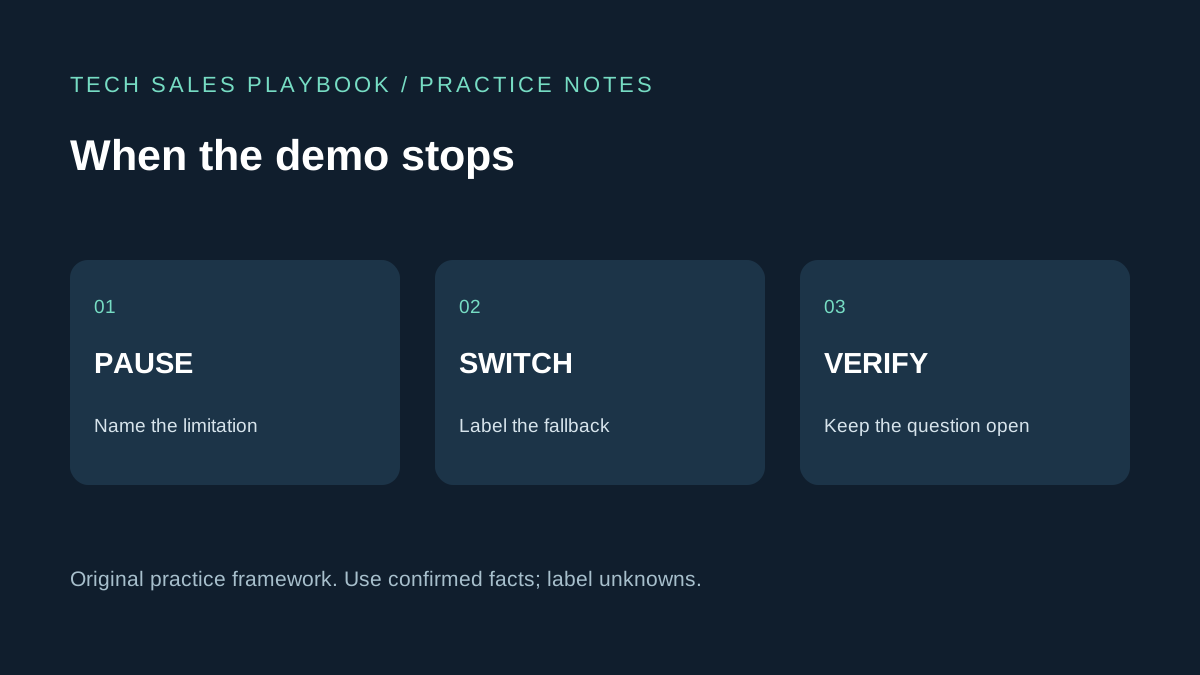
Inspect the sample and contentsWhen a sales demo fails, state what the audience can no longer observe, choose a permitted fallback, and keep the unresolved question visible. Repeated clicks are rarely a useful explanation. A recovery should protect the audience's ability to judge the workflow, even if the original demonstration cannot continue.
This is an original practice drill, not an employer assessment rubric or a product troubleshooting guide. GitLab's demonstrations handbook provides a concrete example of organized demo environments and preparation resources. The failure decisions below are our own teaching framework. Use your team's approved environment and actual interview instructions.
Prepare a fallback before the meeting
Write the decision the demo must support. Then identify the single step that provides essential evidence. A backup should help explain that step without pretending it happened live.
| Item | Prepare | Boundary to state |
|---|---|---|
| Live workflow | Starting state, synthetic data, permissions and expected result | What this environment can actually demonstrate |
| Screenshot sequence | Dated before/action/after images from your approved practice setup | Static images do not prove today's execution |
| Short recording | A permitted recording of the same bounded workflow | A recorded path does not validate a different configuration |
| Diagram | Inputs, processing step, output and unanswered dependency | An explanation is not a successful technical test |
| Follow-up | Question, owner, evidence needed and proposed timing | Timing needs agreement; it is not a unilateral promise |
Confirm whether backup materials are allowed in an interview. Do not use customer records, internal credentials or confidential screenshots in a practice deck. If an approved fallback is unavailable, a clear explanation and a scoped follow-up are better than invented proof.
Use a pause, switch or stop decision
Pause briefly when the issue is understood, safe to correct and unlikely to consume the remaining conversation. Switch when a permitted backup can still explain the relevant workflow. Stop the demonstration when the failure prevents the audience from assessing the essential question or when continuing would expose information you should not show.
Agree on a troubleshooting limit with your practice partner before the drill. For example, allow one attempt to reload a synthetic environment, then require a decision. This is a rehearsal constraint, not a universal time limit for customer calls.
Avoid diagnosing an outage without evidence. “The page is not loading in this session” reports an observation. “Your network is broken” attributes a cause you may not know. Do not bypass access controls to keep the presentation moving.
Work through a fictional interruption
Imagine that you are demonstrating a support-ticket routing workflow to a fictional operations lead and administrator. You created a synthetic ticket, but the routing result does not appear. The decision was whether the administrator can inspect the assigned owner and the reason for the assignment.
Say: “The assignment result is not appearing in this session, so I cannot demonstrate that step live. I have a recording from the same practice configuration. May I use it to explain the expected path, then capture what we still need to verify?”
If they agree, label the recording and its context before showing it. Point out the owner and rule history. Then add: “This recording shows a previous execution. It does not establish why today's attempt failed. The open validation item is a successful rerun in the agreed environment with the assignment history visible.”
If the administrator needs to test their own inputs, the recording will not answer that question. Offer a focused technical follow-up rather than treating the fallback as acceptance. If the panel forbids recordings, explain the workflow verbally and ask how they would like you to use the remaining time.
Capture a recovery note
Use four fields: observed failure, fallback used, conclusion supported, and unresolved validation. For the fictional example: “Assignment result absent; approved practice recording used; expected inspection path explained; current live execution and cause of failure remain unverified.” Add a named owner and agreed next action for a real engagement.
Do not mark the technical criterion passed merely because the meeting ended positively. Keep technical evidence, buyer reaction and commercial next steps separate.
Run the drill twice
Ask a colleague to interrupt a synthetic rehearsal at the key evidence step. On the first attempt, note whether you named the limitation, asked before switching, labeled the fallback and closed with a specific unresolved question. On the second, have the colleague reject your preferred fallback. Practice ending the demonstration constructively.
Review observable actions instead of giving a confidence score. Did you distinguish a recording from live proof? Could your partner repeat what still needs verification? Did you avoid promising an unconfirmed fix? Those answers identify the next practice task.
Use the demo recovery preparation comparison to decide whether this free drill is enough or broader discovery self-study would help. For planning the original walkthrough, return to the sales engineer demo interview guide and the free demo planner.
Put this guide to work
The Discovery Playbook
Build the underlying sales conversation and preparation skills. This existing sales guide complements the SE exercises; it is not product-specific technical training.
$19 USD · One-time purchase · Downloadable PDF
Inspect the sample and contentsRead the sample and see what is included before you buy.
Need the broader set? Compare The Deal Execution Bundle for $39. Includes this book.