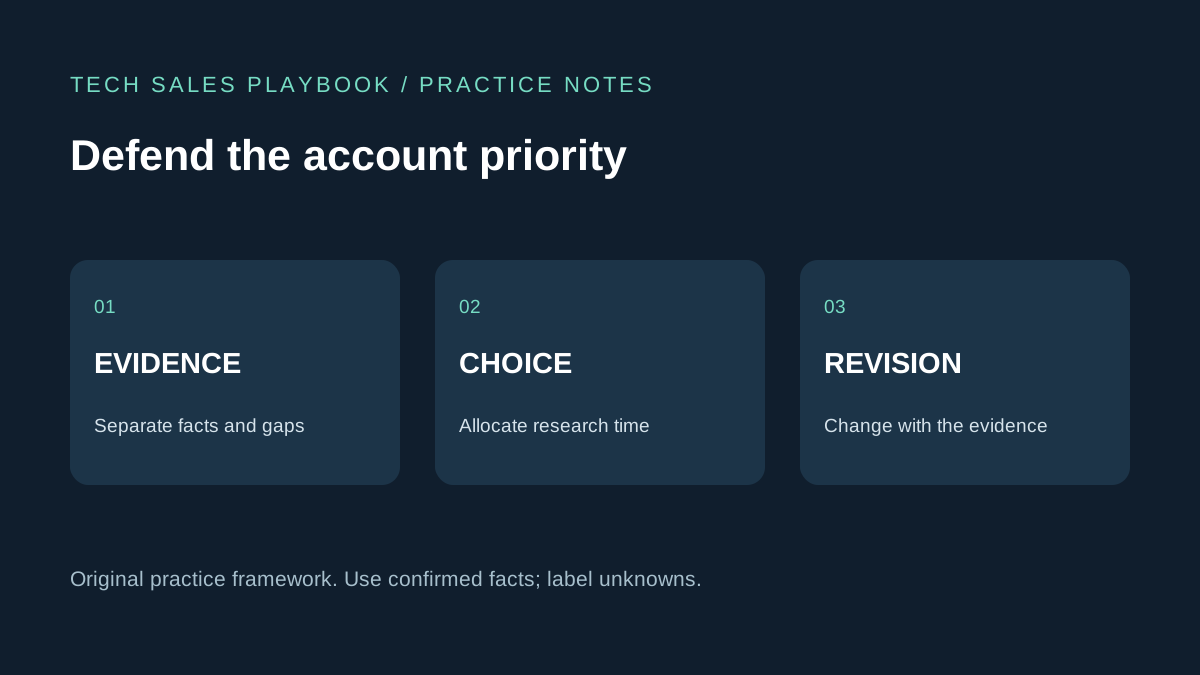
Use this as a working guide, not a passive read. Skim the sections, copy the frameworks, then connect the advice to a real role, interview, call, or account you are working on this week.
Start with a free resourceDownload the interview practice worksheetNo signup required. Browse the free resource library
Put this guide to work
The Tech Sales Interview Playbook
$29 USD · One-time purchase · Downloadable PDF
Preview this playbookA territory interview presentation should explain where you would investigate first, why that choice is reasonable and what would change it. A list of famous logos does not show how you allocate limited time. Start with the employer's assignment, then separate supplied evidence from your own assumptions.
The fictional case below is our original rehearsal exercise. It is not a real employer assignment, market forecast or recommended revenue model. Salesforce's quota-attainment planning documentation describes prioritizing accounts and tracking expected revenue in a territory plan. That product workflow provides context; it does not establish an interview scoring standard.
Clarify the assignment before researching
Confirm the territory boundary, segment, product, permitted sources and presentation time. Ask whether the exercise concerns new business, expansion or an inherited pipeline. Establish whether you may choose accounts or must use a supplied list. Do not contact real prospects on the employer's behalf unless separately authorized.
State what the case cannot establish. Public hiring news may justify investigation, but it does not prove budget, purchase intent or dissatisfaction. An employee count can be relevant to fit without predicting deal value.
Compare three fictional accounts
Assume a fictional workflow product serves operations teams with several handoff points. You have two hours to investigate three accounts and must choose one initial discovery hypothesis. The facts in this table exist only for the exercise.
| Account | Supplied evidence | Important unknown | First action |
|---|---|---|---|
| Cedar Logistics | Two regional teams recently combined their support process | Whether ownership gaps are a current priority | Investigate the new process and identify the relevant operational role |
| Harbor Software | Strong size and workflow fit; no recent change supplied | Whether a problem is important enough to revisit the process | Validate a problem hypothesis before proposing urgency |
| Summit Retail | Visible expansion, but its described workflow requires an unsupported offline capability | Whether there is a different supported use case | Check fit; do not lead with an unsupported promise |
Cedar is a reasonable first research choice because the supplied change relates to the product's supported workflow. Harbor remains a fit hypothesis without an urgency claim. Summit has a disqualifying risk for the described use case despite its attractive expansion story. Explain those distinctions instead of inventing a precise probability of purchase.
Allocate a finite research budget
For this two-hour exercise, spend 25 minutes checking the supplied assumptions and territory rules, 40 on Cedar's workflow hypothesis, 25 on Harbor's fit question, 15 testing Summit's capability mismatch, and 15 writing the decision record. The total is 120 minutes. These are teaching allocations, not productivity benchmarks.
Name a stopping rule for each account. Stop researching Cedar once you can describe the workflow, likely owner and unresolved question clearly enough for a bounded outreach hypothesis. Do not keep collecting news that would not change the choice. Pause Summit if the unsupported capability remains essential; escalate the product question instead of improvising a feature claim.
Present five decisions, not five dense slides
- 1Assignment: audience, territory, objective and constraints.
- 2Evidence: the facts supplied, your sources and the unknowns.
- 3Priority: why Cedar comes first and why the alternatives do not.
- 4Action: the research or discovery step, owner and time budget.
- 5Revision rule: which new evidence would change the order.
A concise opening could be: “I would investigate Cedar first because its stated process change connects to the supported workflow. I have not established a buying project. My first objective is to confirm whether the change created a problem worth discussing.” This makes the distinction between prioritization and qualification explicit.
Handle the panel's new information
Now change the case: Cedar has just completed a solution rollout, while Harbor's operations lead has asked for help understanding unresolved handoffs. Move Harbor ahead if that inquiry and ownership are confirmed. Explain that the ranking changed because evidence changed, not because your first answer was something to defend at all costs.
If the panel asks for a revenue forecast, request the assumptions needed to calculate it. You can show scenario arithmetic with clearly labeled inputs, but do not present invented contract values or conversion rates as observed performance. Account priority is not a forecast category.
Review your reasoning
Ask a practice partner to identify your strongest fact, weakest assumption and stopping rule. If they can only repeat the account names, simplify the presentation. Keep a one-page evidence log that records the source, date, implication and uncertainty for each meaningful claim.
For broader preparation choices, compare the territory case-study resources. Use the enterprise account-planning guide when the task moves inside one qualified account, or the AE deal-walkthrough guide when the interviewer asks about a past deal you actually worked.
Put this guide to work
The Tech Sales Interview Playbook
A structured interview system for SDR, BDR, AE, and career-change candidates preparing for stronger interview loops.
$29 USD · One-time purchase · Downloadable PDF
Preview this playbookRead the sample and see what is included before you buy.


