Use this as a working guide, not a passive read. Skim the sections, copy the frameworks, then connect the advice to a real role, interview, call, or account you are working on this week.
Start with a free resourceDownload the interview practice worksheetNo signup required. Browse the free resource library
Put this guide to work
The Tech Sales Interview Playbook
$29 USD · One-time purchase · Downloadable PDF
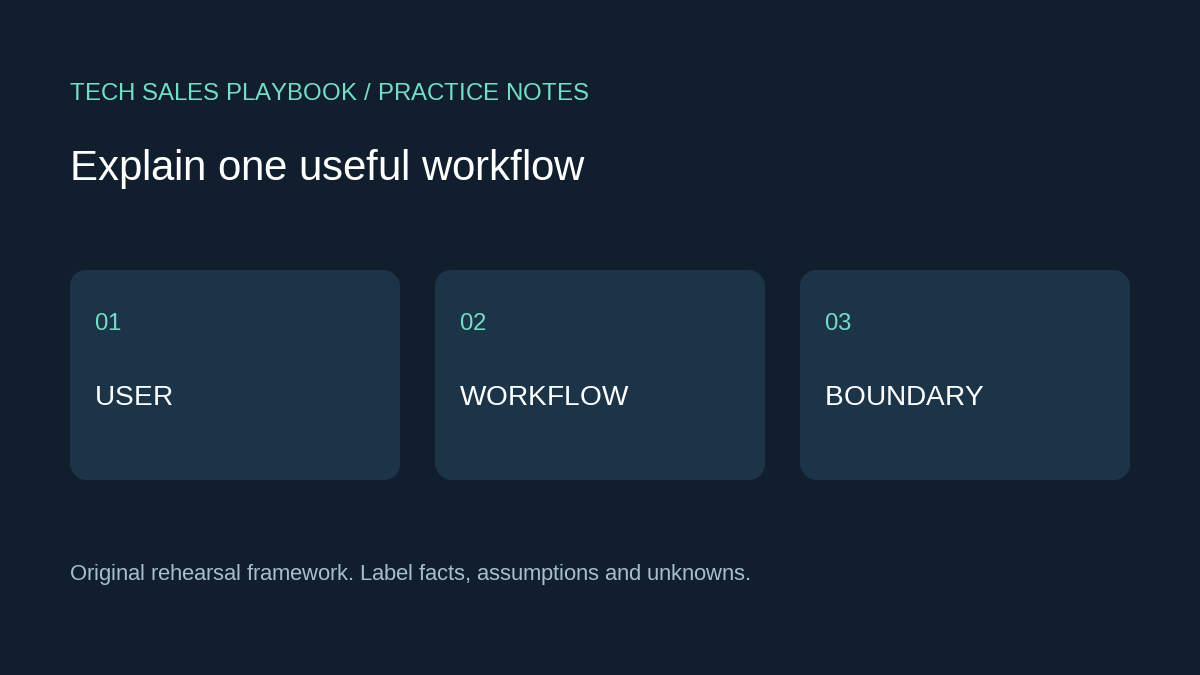
Preview this playbookA product teach-back asks you to explain what you learned to an audience that may not share your vocabulary. Prepare around one user, one problem and one supported workflow. A feature list alone does not show that you can translate product knowledge into a useful conversation.
This is an original interview rehearsal, not a claim that a particular employer uses this assignment. HubSpot's Sales Interview Kit provides broader hiring-process context across sales roles. Confirm your actual assignment, audience, permitted materials and time limit with the recruiter before adapting this exercise.
Clarify what you are being asked to teach
Ask whether the task is a product explanation, a live demonstration, a discovery role-play or a presentation about a past deal. They require different evidence. A teach-back can explain a workflow without proving a live environment works. If the assignment is a demonstration, use the sales engineer demo interview guide instead.
Choose a feature supported by current official documentation. Record the source, the relevant limitation and the date checked. Avoid claims about roadmap items, integrations, pricing or customer results unless the source supports the exact claim. If the employer supplies a brief, identify which statements come from that brief and which you researched separately.
Build a five-minute outline
The timing below is a practice constraint, not an employer scoring standard. Adapt it to the actual instructions.
| Time | Teaching task | Check |
|---|---|---|
| 0:00–0:45 | Name the user and the problem | Is the problem understandable without product jargon? |
| 0:45–2:15 | Explain the before, action and after | Can the listener follow one complete workflow? |
| 2:15–3:00 | State a boundary or prerequisite | What does the explanation not establish? |
| 3:00–4:00 | Ask the listener to apply the idea | Can they identify the relevant next action? |
| 4:00–5:00 | Answer one question and recap | Did you address the question rather than repeat the pitch? |
Keep a separate source note for claims. Do not put a dense research dump on the teaching slide. One diagram with labeled inputs and outputs is often enough for a rehearsal; use screenshots only when you have permission and can explain their context.
Use this fictional product example
Assume a fictional product called QueueMap routes incoming support requests using rules an administrator configures. For this exercise, it supports category-based routing and a visible assignment history. It does not automatically understand every message or guarantee a response time. These capabilities are invented for practice and do not describe an actual vendor.
Opening: “A support lead needs to see who owns each new request. In this example, requests arrive in a shared queue, and someone manually assigns them. QueueMap lets an administrator define a category rule, then shows the assigned owner and the rule used.”
Workflow: “A synthetic request enters with the category billing. The configured rule assigns it to the billing team. The lead checks the assignment history to understand that choice. The administrator must define the categories and rules first.”
Boundary: “This explains the routing model. It does not show that the right person is available, that every request is categorized correctly or that a customer will receive a response by a particular time.”
Application question: “If a request reaches the wrong team, which two things would you inspect first?” In this fictional case, look at the incoming category and the rule history. Invite another answer and explore it rather than marking the listener wrong immediately.
Handle a question outside your evidence
Have a partner ask, “Does it connect to our finance system?” Do not invent an integration. Say: “That capability is not established in the brief. I would check the current integration documentation and confirm the required workflow before answering.” Then ask what information needs to move between the systems. You are showing how you handle an unknown, not hiding it.
If the listener says the explanation is too technical, replace the terms with the actual user action. If it is too basic, add the relevant dependency rather than rushing through every remaining feature. Keep the core workflow intact.
Review the recording without grading charisma
Use synthetic information and record only with participants' agreement. Ask your partner to describe the user, workflow and limitation in their own words. Compare their summary with your intended explanation. If they remember the product name but cannot explain the action, reduce the feature count and make the transition clearer.
Run a second attempt for a different audience: first a team lead, then an administrator. Change the depth and questions while preserving the same facts. Note one specific improvement, such as naming the prerequisite before showing the output.
Use the teach-back preparation comparison to choose the free drill or broader Interview Playbook practice. For general presentation structure, continue to the AE interview presentation guide.
Put this guide to work
The Tech Sales Interview Playbook
A structured interview system for SDR, BDR, AE, and career-change candidates preparing for stronger interview loops.
$29 USD · One-time purchase · Downloadable PDF
Preview this playbookRead the sample and see what is included before you buy.