Use this as a working guide, not a passive read. Skim the sections, copy the frameworks, then connect the advice to a real role, interview, call, or account you are working on this week.
Start with a free resourceDownload the mutual action planNo signup required. Browse the free resource library
Put this guide to work
The Enterprise Playbook
$19 USD · One-time purchase · Downloadable PDF
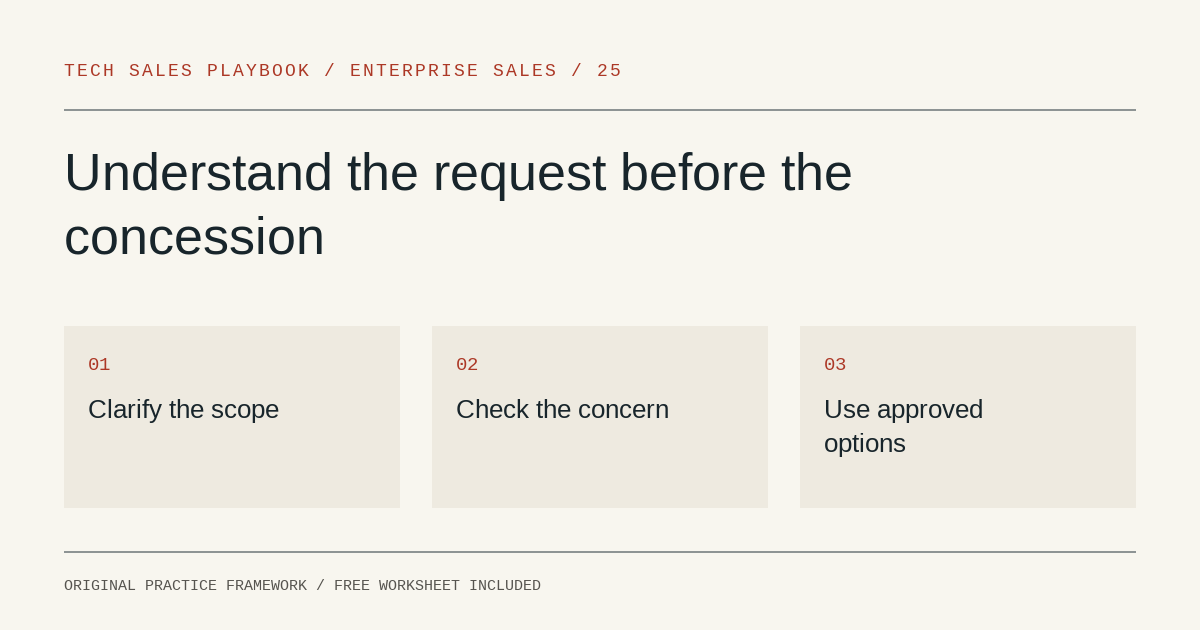
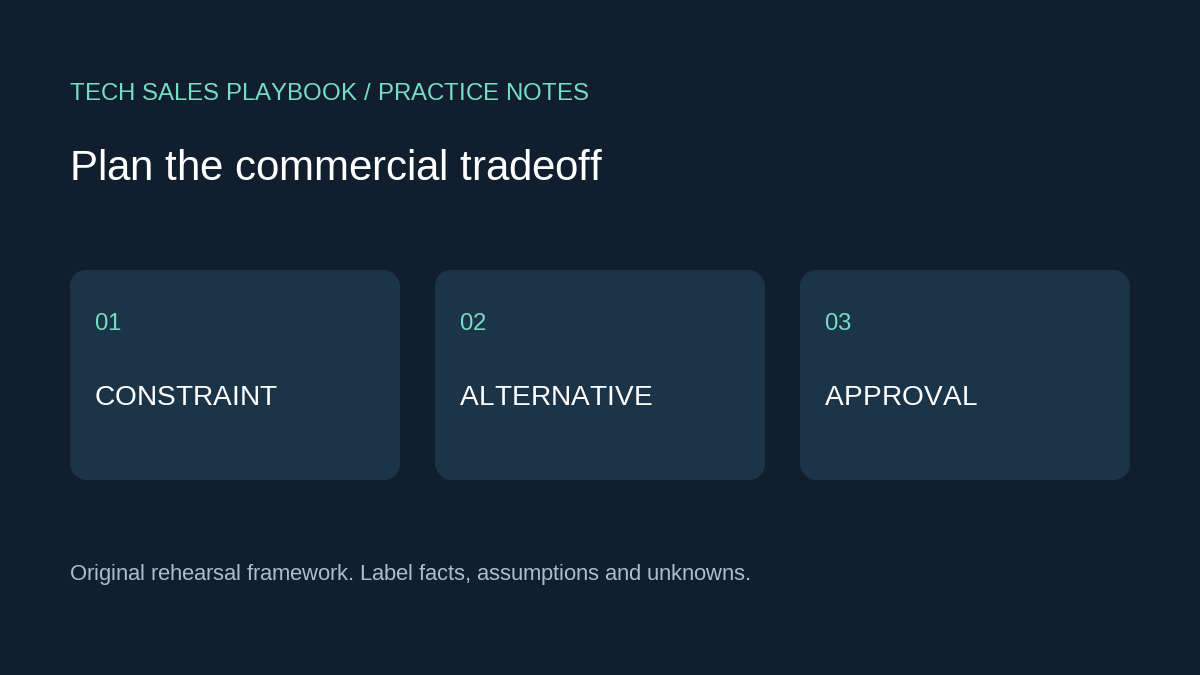
Preview this playbookA concession plan records what a buyer is asking for, why it matters, what you are authorized to discuss and what would make an alternative workable. Use it before a late-stage commercial conversation. It is different from answering an early price objection: the buyer has already evaluated a defined scope, and the remaining task is to compare acceptable packages.
GitLab's negotiation handbook discusses preparation and reciprocal concessions in its sales process. The worksheet and fictional exercise below are our own teaching framework. They are not GitLab policy, contract advice or authorization to offer terms.
Separate a request from the reason behind it
“We need a lower price” does not identify whether the problem is total spend, timing, unused scope or an internal approval threshold. Ask which constraint the proposed change solves. Record the buyer's answer separately from your interpretation. A smaller initial scope might address unused capacity; it will not necessarily resolve a payment-timing constraint.
Before proposing alternatives, confirm the current scope, the decision process, the buyer's priorities and your internal approval route. If these are unsettled, return to discovery or the proposal-readiness guide. A negotiation worksheet cannot make an unqualified proposal ready.
Copy the six-column worksheet
| Buyer request | Underlying constraint | Possible alternative | Buyer consideration | Internal approval | Status |
|---|---|---|---|---|---|
| What change was requested? | What did the buyer actually confirm? | What package could address that constraint? | What would the buyer need to agree to? | Who can authorize the proposal? | Exploring, approved to offer, accepted or rejected |
Keep the status precise. “Manager will review” is not “approved.” A buyer's willingness to discuss a longer term is not acceptance. Neither party owes a concession simply because the other proposed one. A give-get plan should make tradeoffs explicit without using fabricated deadlines or pressure.
Work through a fictional scope negotiation
Imagine a fictional workflow-software proposal covering four teams. The buyer says only two teams can begin this quarter and asks to pay less. No prices, discounts or contract terms in this exercise represent a real offer.
| Option | What changes | What must be checked | What remains open |
|---|---|---|---|
| Keep four-team scope | Original scope remains | Whether the buyer still wants all four teams now | Budget and implementation capacity |
| Start with two teams | Initial scope becomes smaller | Product packaging, delivery feasibility and pricing approval | Future expansion is not committed |
| Discuss a phased rollout | Timing changes while scope may remain | Commercial and delivery owners must review the actual structure | Payment and acceptance terms are not assumed |
Start by asking: “Is the constraint the total investment, or that two teams cannot use the product yet?” If the buyer confirms the second, investigate smaller initial scope with the relevant internal owners. Do not call unused scope a discount. Explain exactly which scope and obligations change.
If the buyer proposes a longer commitment in exchange for a commercial adjustment, record it as a package to review. Do not promise that a longer term automatically earns a lower price. Your company may have different limits, and the buyer may need separate authority to commit.
Rehearse conditional language
Try: “If a two-team starting scope meets your immediate need, I can ask our commercial and delivery owners to review that option. I cannot confirm pricing or rollout terms today. Would that option solve the constraint you described?”
Then have your practice partner respond: “Just put the discount in writing.” A useful reply is: “I can summarize the request and the review needed. I will label it as a request until the authorized owner approves an offer.” This keeps the conversation moving without creating a commitment you cannot make.
Do not trade security controls, truthful capability statements or implementation promises as bargaining chips. Questions about legal terms belong with the authorized reviewer. The exercise concerns preparation and communication, not deciding what a contract permits.
Close with a decision record
Record the package discussed, the scope that remains unchanged, the approvals still needed, the responsible people and the agreed next conversation. Keep a version date so old alternatives do not become competing promises. If no acceptable package exists, say which constraint remains rather than inventing a last-minute exception.
Review your rehearsal against four observable checks: Did you uncover the constraint? Did you distinguish an option from an offer? Did you name the approval owner? Could the buyer repeat the remaining decision? Repeat the weakest part with a different constraint.
Compare the negotiation preparation resources for free practice versus broader Enterprise Playbook study. For an early request before value and scope are established, use the separate early discount discussion guide.
Put this guide to work
The Enterprise Playbook
Plan complex accounts, align stakeholders, and guide evaluation through rollout.
$19 USD · One-time purchase · Downloadable PDF
Preview this playbookRead the sample and see what is included before you buy.
Need the broader set? Compare The Deal Execution Bundle for $39. Includes this book.