Use this as a working guide, not a passive read. Skim the sections, copy the frameworks, then connect the advice to a real role, interview, call, or account you are working on this week.
Start with a free resourceBuild your free demo rehearsal briefNo signup required. Browse the free resource library
Put this guide to work
The Discovery Playbook
$19 USD · One-time purchase · Downloadable PDF
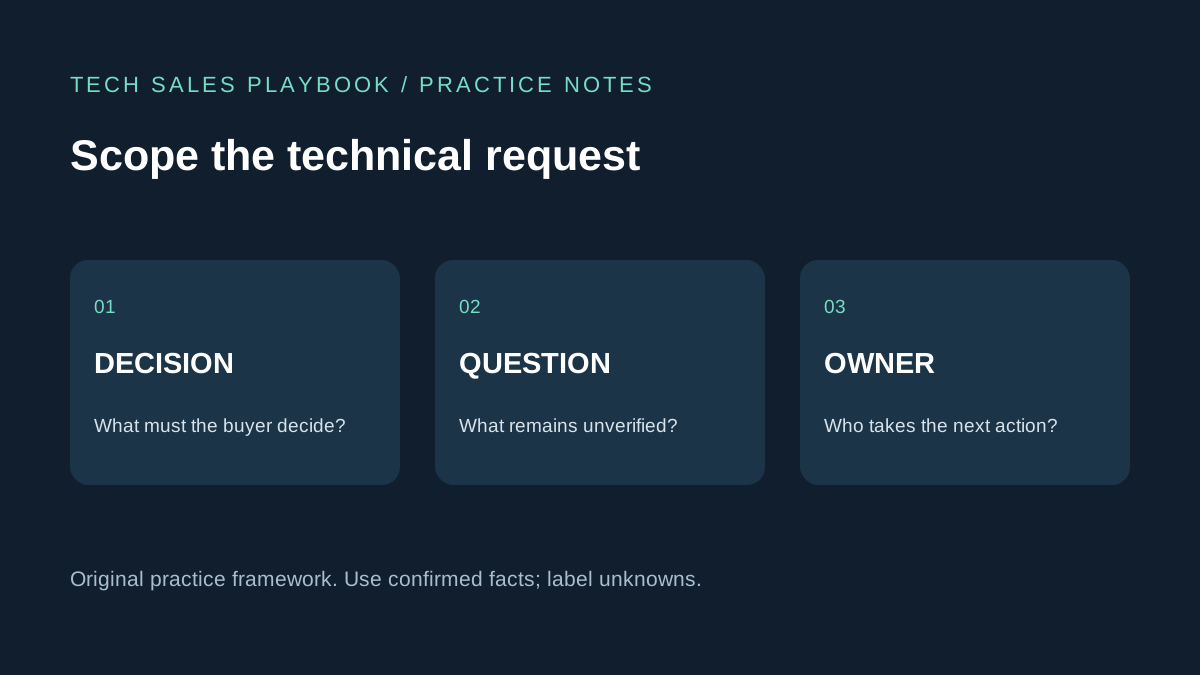
Inspect the sample and contentsAn AE-to-sales-engineer brief should explain the customer decision that needs technical help. Include the workflow already understood, the question still open, the people needed and the evidence the meeting should produce. A calendar invitation saying “show the platform” leaves the specialist to reconstruct the purpose.
Follow your own team's engagement rules. For one company-specific example, GitLab's published solutions architecture rules describe qualified opportunities, completed business discovery and scoping before SA engagement. Those stages are GitLab's process, not a universal rule. The brief below is an original adaptable worksheet, not a request form for GitLab or a promise of specialist availability.
Copy the seven-field request
| Field | What belongs here | What to avoid |
|---|---|---|
| Buyer decision | What the next conversation must help the buyer decide | A generic desire to see features |
| Business context | Stated workflow, problem and source of the information | Unverified ROI or seller-invented urgency |
| Known environment | Confirmed systems and relevant constraints | Credentials or unnecessary customer data |
| Technical uncertainty | A specific question the AE cannot yet answer | An implied promise that the product supports it |
| Evidence needed | Observation, documentation or bounded test that would answer the question | Treating a demo as proof of every requirement |
| People and roles | Buyer participant, AE role, specialist role and decision owner if known | Assuming an attendee has approval authority |
| Meeting and follow-up | Proposed agenda, dependencies, request deadline and next-action owner | Booking specialist time before acceptance |
Mark an unknown explicitly. The specialist can help refine a technical question, but should not have to guess whether a statement came from the customer or from an internal hypothesis. Keep source records in approved systems and use access-controlled links where your team permits them.
Turn a vague request into a scoped brief
Original fictional request: “Cedar needs a demo Thursday. They care about integration. Can you join and show everything?”
Improved fictional brief: “Cedar's support operations lead wants to decide whether to evaluate automated ticket assignment. They described an email-to-ticket workflow and inconsistent team ownership after escalation. Their administrator has not confirmed which system supplies the team identifier. We need a 25-minute technical discovery conversation to map that input, identify the assignment condition and decide whether a later demonstration is feasible. No integration compatibility has been promised.”
For roles, add: “The AE will open with the business context and capture commercial next steps. The SE will clarify the input mapping and evidence needed. The buyer's administrator is invited to explain the current configuration. The operations lead will confirm whether the proposed evaluation addresses the stated problem.” All names and arrangements are fictional teaching assumptions.
Choose discovery, demonstration or another next step
Request technical discovery when the environment or requirement is still unclear. Request a focused demonstration when the workflow and relevant question are sufficiently understood. Request a specialist review when documentation or a scoped technical answer is more useful than another meeting. Your team's process determines who accepts and schedules each request.
In the Cedar example, a broad demonstration is premature because the input dependency is unresolved. A useful result from discovery might be an agreed test plan, a documented mismatch or a decision that more information is needed. A meeting does not have to produce a product demo to be worthwhile.
Agree on the boundary together
Before the customer meeting, ask the SE to restate the decision and the unknown. If the request is unclear, revise the brief. Confirm who handles commercial questions and who records technical follow-up. Avoid asking the specialist to guarantee a capability or delivery date outside their authority.
For the fictional meeting, one acceptance check is: “We can describe the required input, its owner and the next validation step. We have not yet claimed integration support.” This is a check on the meeting output, not technical acceptance of the product.
Close with an evidence and ownership note
Afterward, record the confirmed facts, unresolved questions, promised materials and owners. Example: “Administrator confirmed the email system supplies a team label; field mapping remains unverified. SE will identify the approved test approach. AE will confirm who can authorize access to the test environment. Timing will be agreed after those dependencies are checked.”
Do not convert the note into a closed-won handoff or mark a proof of concept successful. This brief coordinates an early technical engagement. The security-questionnaire handoff and post-sale handoff address different stages and responsibilities.
Use the AE–SE engagement preparation comparison to decide whether the free brief solves your immediate need or broader discovery practice is useful. The sales engineer discovery questions help turn the brief into a conversation that tests the requirement behind the request.
Put this guide to work
The Discovery Playbook
Build the underlying sales conversation and preparation skills. This existing sales guide complements the SE exercises; it is not product-specific technical training.
$19 USD · One-time purchase · Downloadable PDF
Inspect the sample and contentsRead the sample and see what is included before you buy.
Need the broader set? Compare The Deal Execution Bundle for $39. Includes this book.