Best For
- Account executives
- Sales managers and founders
Loading...
A 35-page field manual for buyer decisions and late-stage execution. Includes annotated negotiation, conditional concessions, discount and term calculations, procurement, signature, expansion, and three worksheets.
Buyer decisions, negotiation scripts, discount economics, and a clear path to signature.
35 pages
Finished PDF playbook
20-page preview
Review the sample first
30-day guarantee
Instant access after checkout
Look inside
The full playbook runs 35 pages.
These 20 are the real thing, not a summary.
Page 1 / 20
Text from the same public sample shown above. Use the page images or PDF for diagrams, tables and original layout.
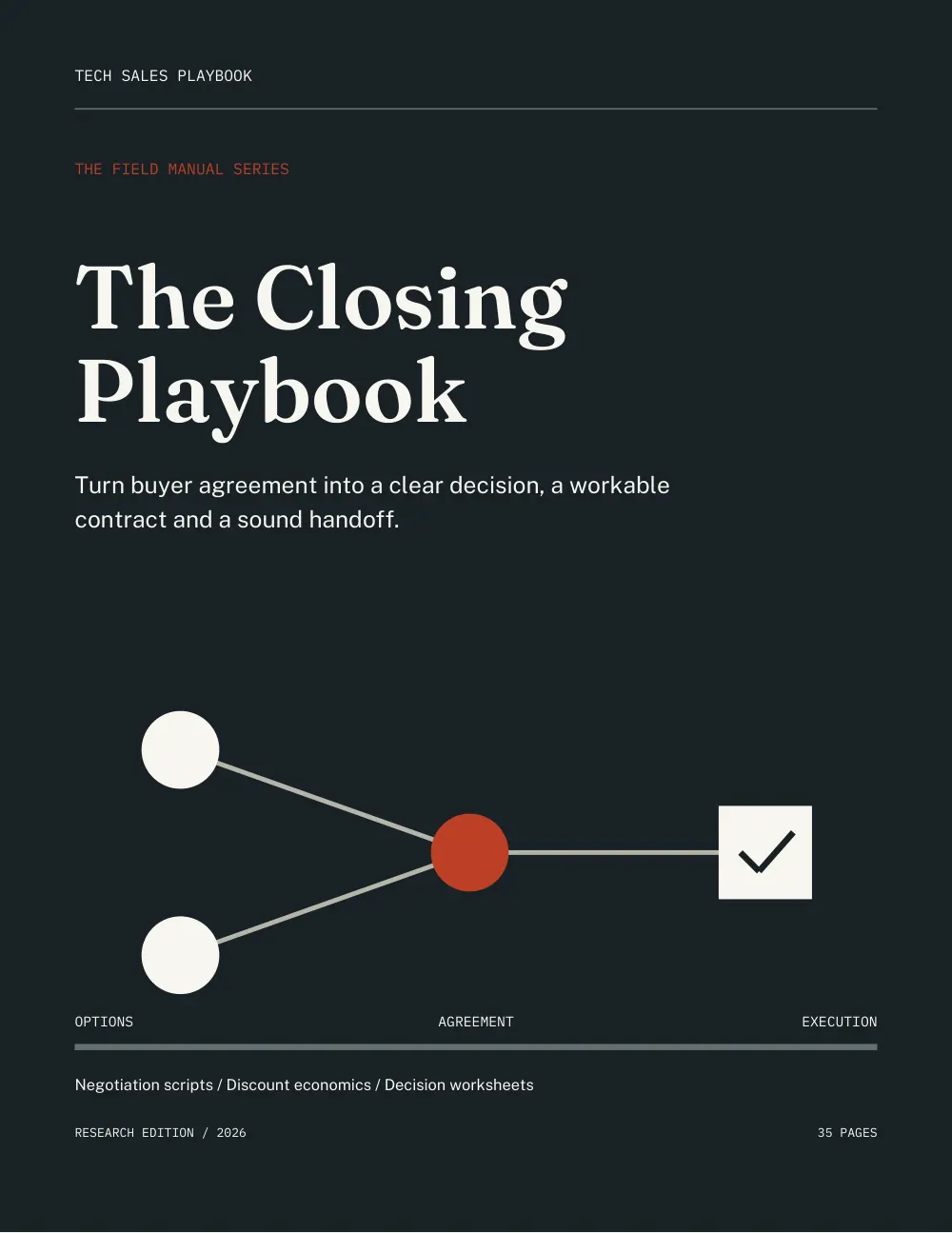
TECH SALES PLAYBOOK THE FIELD MANUAL SERIES The Closing Playbook Turn buyer agreement into a clear decision, a workable contract and a sound handoff. OPTIONS AGREEMENT EXECUTION Negotiation scripts / Discount economics / Decision worksheets RESEARCH EDITION / 2026 35 PAGES
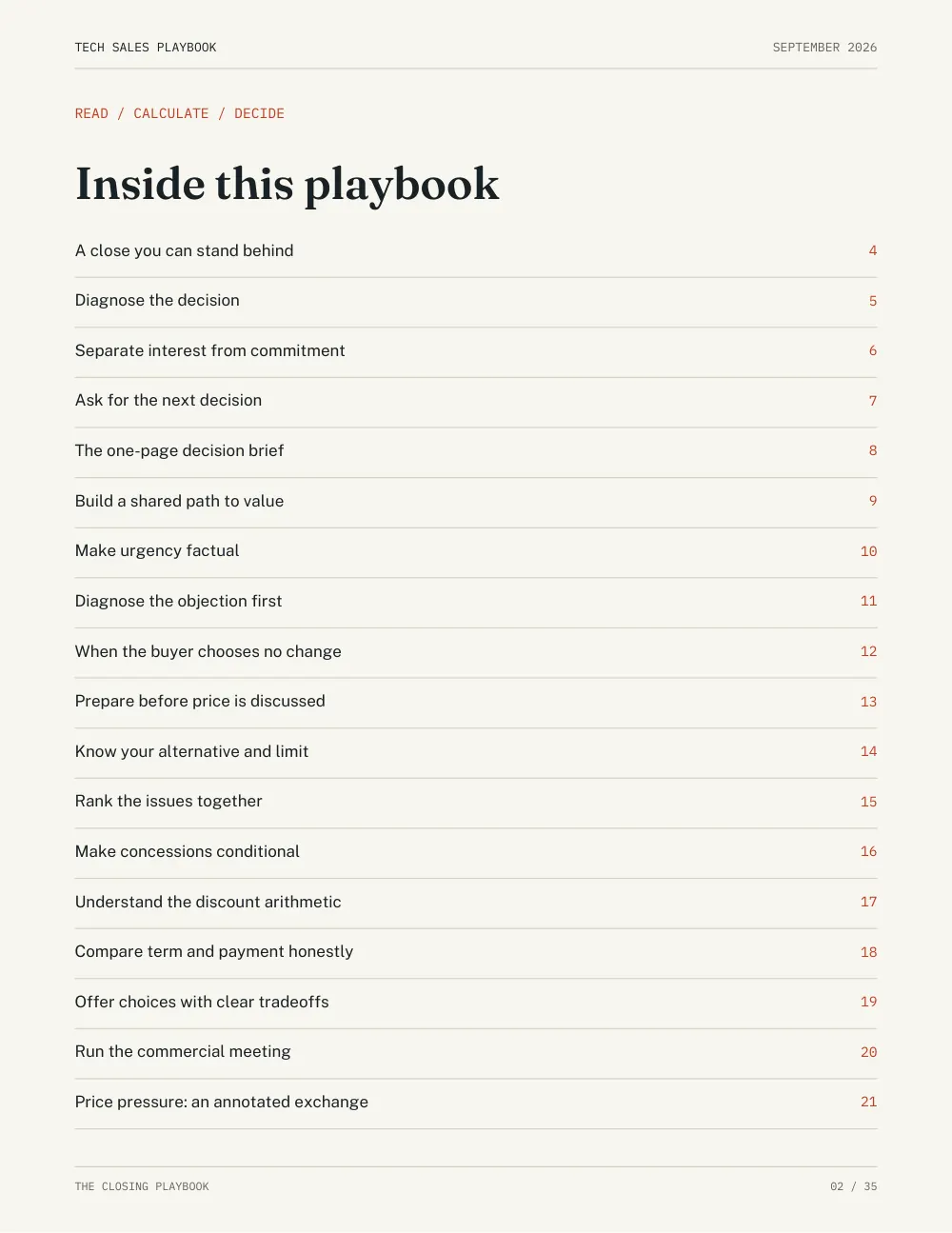
TECH SALES PLAYBOOK SEPTEMBER 2026 THE CLOSING PLAYBOOK 02 / 35 READ / CALCULATE / DECIDE Inside this playbook A close you can stand behind 4 Diagnose the decision 5 Separate interest from commitment 6 Ask for the next decision 7 The one-page decision brief 8 Build a shared path to value 9 Make urgency factual 10 Diagnose the objection first 11 When the buyer chooses no change 12 Prepare before price is discussed 13 Know your alternative and limit 14 Rank the issues together 15 Make concessions conditional 16 Understand the discount arithmetic 17 Compare term and payment honestly 18 Offer choices with clear tradeoffs 19 Run the commercial meeting 20 Price pressure: an annotated exchange 21
TECH SALES PLAYBOOK SEPTEMBER 2026 THE CLOSING PLAYBOOK 03 / 35 READ / CALCULATE / DECIDE Tools for the decision Handle the competitor comparison 22 Map the paper process 23 Resolve redlines through the right owner 24 Forecast the evidence you have 25 Recover a stalled agreement 26 Complete the signature check 27 Handoff without lost promises 28 Earn the expansion conversation 29 Harbor: the complete decision record 30 Coach the quality of the close 31 Worksheet: decision readiness 32 Worksheet: negotiation preparation 33 Worksheet: execution and handoff 34 Sources and edition notes 35
TECH SALES PLAYBOOK SEPTEMBER 2026 THE CLOSING PLAYBOOK 04 / 35 01 / START HERE A close you can stand behind A useful close leaves both parties able to explain what they agreed, why it matters and what happens next. The seller earns a decision by resolving the buyer's uncertainties, making the commercial choices explicit and coordinating the remaining work. A signature obtained through a claim your delivery team cannot honor creates a problem that outlives the quarter. This book is for B2B technology account executives moving opportunities from evaluation through commercial agreement. It also gives SDRs preparing for AE work a realistic practice environment. It assumes you already understand the buyer's problem and your product's actual capabilities. If those foundations are missing, return to discovery before negotiating. Choose your route Deal stalled: read the decision diagnosis, objections, no-decision and forecast modules. Identify the uncertainty before offering a concession. Price challenged: work through preparation, alternatives, discount economics and approved packages. Bring a written position to your manager. Verbal yes received: use the paper-process, signature and handoff modules. Establish owners and dependencies before promising a date. Practice session: use the annotated conversation, manager rubric and three worksheets at the back. The Harbor case, scripts, rubrics, prices and timelines are original fictional teaching material. They are not customer results or universal benchmarks. Framework definitions have linked sources; the operational tools are editorial applications. Adapt all proposals to your company's approval rules and the buyer's actual process. Your next action: write the buyer's decision in one sentence. Include the scope and unresolved conditions. If you cannot, the opportunity needs clarification before a closing line.
TECH SALES PLAYBOOK SEPTEMBER 2026 THE CLOSING PLAYBOOK 05 / 35 02 / READ THE OPPORTUNITY Diagnose the decision Start with the last thing the buyer actually agreed to do. A friendly conversation, a pricing request and a purchase approval are different events. Preserve those distinctions in your notes so the next meeting addresses the real decision. Use four questions to locate the gap: Does the buyer believe the problem deserves action? Does the proposed scope meet their criteria? Can the organization authorize the purchase? Can the parties execute the agreement and implementation? These are working questions, not a validated scoring model or a compulsory sequence. Buyer statement Useful follow-up We like the platform. Which requirements are satisfied, and which are still open? Send the agreement. Who needs to review it before anyone can authorize signature? The price is high. Compared with which budget, alternative or expected result? We should do this soon. What event makes timing matter, and who owns that date? In the Harbor case, a support director says the team prefers your workflow software. Finance has not approved spending, and security has not reviewed data access. Record product preference as confirmed. Record purchase authorization and security approval as unresolved. Calling the deal committed would conceal the exact work needed. Ask one focused question, listen, then update the next action. Do not run the entire diagnostic as an interrogation. If the buyer has already documented an answer, confirm it briefly and move forward. We have agreement on the workflow fit. Before we discuss final terms, I want to understand the finance and security decisions still ahead. Which one could change the scope?
TECH SALES PLAYBOOK SEPTEMBER 2026 THE CLOSING PLAYBOOK 06 / 35 03 / OBSERVABLE BUYER ACTION Separate interest from commitment A commitment has an action, an owner and a purpose. A scheduled meeting is useful when the relevant people intend to resolve a defined question. A meeting booked only because the seller asked again is weak evidence of buying progress. Describe commitments narrowly. A director agreeing to introduce finance is committing to an introduction, not guaranteeing budget approval. A security reviewer accepting documents is acknowledging receipt, not approving the vendor. This precision helps you recognize progress without exaggerating it. A practical commitment ladder Begin with information: a buyer confirms the problem, scope or decision criteria. Move to participation: the right colleague agrees to evaluate an open issue. Then seek a decision: the authorized owner accepts, rejects or conditions a proposal. Finally coordinate execution: the parties complete the required commercial and operational steps. Deals can move backward when scope changes. For each step, write the evidence and the next uncertainty. At Harbor, the director forwards the evaluation summary to the controller and schedules a budget review. That supports a finance conversation. It does not yet support a claim that funds are available. Could we ask the controller to review the two scope options with us? The decision would be whether either fits this year's approved spending, not whether she likes the demo. If the buyer declines the next step, ask what makes it premature. They may lack confidence, authority, time or a reason to act. Treat that answer as information. More pressure cannot supply a missing business case. Your objective is a useful decision, including a clear pause when a project is not ready.
TECH SALES PLAYBOOK SEPTEMBER 2026 THE CLOSING PLAYBOOK 07 / 35 04 / TRIAL CLOSES WITH A PURPOSE Ask for the next decision A trial close is a check on a specific condition. It should expose remaining work before a proposal becomes a surprise. Ask it after reviewing evidence, and make it easy for the buyer to disagree or add a condition. After an evaluation The test covered the routing and audit requirements you named. What remains unproven before you can recommend this scope? This question invites exceptions. If the buyer names an integration problem, write it into the evaluation rather than explaining why it should not matter. Ask who can judge the fix and what evidence would satisfy them. Before commercial work If the approved commercial terms fit your budget, what other decisions would still stand between this proposal and a purchase? The answer defines dependencies; it is not a binding promise. Avoid treating a conditional answer as a commitment to sign regardless of legal, security or organizational changes. When the decision is ready With the agreed scope and the review items resolved, are you ready to authorize this proposal? If so, let's confirm the signature and purchase-order steps with the people who own them. Pause after the question. Give the buyer time to answer without immediately adding a discount. If they decline, ask which condition remains unresolved and whether you should address it now or pause the opportunity. A direct decision request is appropriate when the buyer has the information and authority to answer. An assumptive line that pretends consent already exists can hide disagreement. Your script should make the decision easier to state, including a no. That makes the following action clearer for both sides.
TECH SALES PLAYBOOK SEPTEMBER 2026 THE CLOSING PLAYBOOK 08 / 35 05 / HELP THE BUYER EXPLAIN THE PURCHASE The one-page decision brief An internal supporter may need to explain the purchase to people who never attended your meetings. Offer a short, editable summary of the buyer's case. Ask the supporter to correct it before it circulates. Use their evidence and language, and mark your assumptions visibly. Field Harbor example - fictional Decision requested Approve the initial support-team workflow scope, subject to security and contract review. Current problem Escalations are routed manually; team leads report rework. Baseline measurement remains open. Evaluation evidence Routing and audit requirements passed the agreed test. Integration access needs security approval. Commercial choice Compare the full-team proposal with a smaller initial scope. Neither option is approved yet. Implementation owner Support operations manager; must confirm capacity before a start date is promised. Open conditions Finance approval, security scope, final terms and purchase-order process. Add the actual costs, exclusions and decision date when known. Link the supporting evaluation and approved proposal. Do not fill empty fields with invented savings or an executive quote you have not received. Ask the supporter: What would finance challenge? What would the implementation owner worry about? Which sentence would you remove because it overstates the evidence? Their corrections are useful preparation, not resistance to overcome. Keep internal seller limits, concession authority and forecast categories out of the buyer brief. Those belong in your preparation sheet. The buyer should receive a fair decision summary, not a copy of your sales strategy. Maintain a date and version so an old scope does not continue circulating after the proposal changes.
TECH SALES PLAYBOOK SEPTEMBER 2026 THE CLOSING PLAYBOOK 09 / 35 06 / THE MUTUAL ACTION PLAN Build a shared path to value Salesforce's mutual-action-plan guide describes a shared plan covering purchase, implementation and value, with work, timing and responsibility made explicit. The following is an original adaptation. It is useful only when the buyer accepts the work and owners. Begin with the outcome date and work backward with the responsible teams. Ask which steps can run together and which must wait. An owner should confirm an estimate before you place it in a customer-facing commitment. Label unconfirmed dates as targets. Work Owner and completion evidence Confirm scope Support director: approved requirements and exclusions. Review data access Buyer security and seller specialist: documented disposition of open items. Approve spending Controller: approved proposal version and funding source. Finalize agreement Authorized legal/commercial teams: agreed documents. Execute purchase Authorized signers and procurement: required signature and PO steps complete. Begin implementation Delivery owners: accepted handoff and scheduled kickoff. The plan must be allowed to change. If security needs a narrower integration, revise scope, price and implementation work together. Do not simply move the signature date while leaving the rest untouched. I drafted this from our conversation. Which owner or dependency is wrong? If the proposed start date is unrealistic, let's correct it before either team commits resources. Share the shortest version that helps the buyer act. A small purchase may need a few lines in email; a complex deal may need a maintained tracker. Neither format proves commitment on its own. Completion evidence does.
TECH SALES PLAYBOOK SEPTEMBER 2026 THE CLOSING PLAYBOOK 10 / 35 07 / WHY THIS DATE MATTERS Make urgency factual Separate three clocks: the buyer's business event, the time required to become operational and your commercial calendar. A seller's quarter end is not automatically a customer deadline. If a price approval expires, state the real condition without pretending the buyer's business will fail after that date. For a buyer deadline, ask what happens if it is missed, who owns the consequence and whether the date can move. Then ask delivery owners to assess the required preparation. Work backward from usable operation, not from a signature alone. At Harbor, the director wants the new workflow ready before a seasonal support surge. Delivery has not yet confirmed integration effort. The responsible next step is an implementation review. Offering a discount cannot make an unverified launch date feasible. Two honest timing messages The seasonal surge is your target. Our delivery lead needs to confirm the integration work before I can say whether that target is feasible. Can your operations owner join that review? This approved quote expires on the stated date. If your review needs longer, I can request a new approval. I cannot promise the same terms until that request is accepted. Use the second message only when the expiration and approval process are real. Do not manufacture scarcity, imply an unavailable implementation slot is reserved or repeatedly extend a supposedly final offer as a pressure device. When the buyer has no material reason to act now, acknowledge it. Agree on a relevant future trigger or close the active opportunity according to your team's rules. A clean pause is more useful than a permanent emergency manufactured by the seller.
TECH SALES PLAYBOOK SEPTEMBER 2026 THE CLOSING PLAYBOOK 11 / 35 08 / WHAT DOES TOO EXPENSIVE MEAN? Diagnose the objection first An objection is a statement with context missing. Before responding, identify what the buyer is comparing and what outcome they need. The same words can refer to affordability, value, procurement policy, perceived risk or a negotiation request. Meaning First useful move Available budget is lower Verify the limit, approval owner and whether smaller scope solves enough of the problem. Value is uncertain Revisit evidence and implementation assumptions; do not invent a stronger return. Alternative costs less Compare relevant scope, obligations and operating requirements fairly. Policy requires negotiation Ask what their review requires and prepare approved commercial options. Purchase feels risky Identify the specific failure concern and a proportionate way to assess it. When you say the price is too high, is the main issue available funding, the value you expect or the comparison with another option? Accept the buyer's own explanation even if it differs from this menu. Follow with a concrete question: What amount is approved? Which result is unproven? What scope is in the comparison? Ask only for information they are able and willing to share. Summarize before proposing a response. At Harbor, a controller explains that this year's spending limit is lower because another project was approved. That is not evidence that the buyer doubts product value. A narrower scope or later start may be relevant; a longer demo probably is not. If the buyer only wants a concession, acknowledge the request. You can explore it within authority without inventing an objection to justify a rehearsed answer.
TECH SALES PLAYBOOK SEPTEMBER 2026 THE CLOSING PLAYBOOK 12 / 35 09 / THE NO-DECISION PATH When the buyer chooses no change A buyer can reasonably decide to keep the current process. They may judge the implementation effort, spending or risk greater than the expected improvement. Your job is to understand that comparison and make sure the decision uses accurate information. Ask what makes the current approach acceptable and what would have to change to reopen the discussion. If the buyer has not measured the problem, offer a small measurement task they consider worthwhile. Do not turn an unsupported pain statement into a catastrophic cost-of-inaction claim. A useful no-decision conversation It sounds as though the team prefers the new workflow, but the change effort is larger than the benefit you can currently justify. Is that an accurate summary? Would a baseline measurement help you make the decision, or would that add work to a project you have already decided to pause? The second question gives the buyer a genuine exit. If they want to measure, agree on an owner, a method and the decision the measurement will inform. If they decline, record the pause and its reason. Do not label every delayed purchase as buyer indecision. A competing initiative, an unresolved security concern or a hiring freeze may be a substantive reason. Your CRM reason should describe the evidence, not criticize the buyer. For a future follow-up, agree on a trigger and permission: after a budget review, a contract renewal or completion of another project. A relevant reminder can reopen a real decision. Repeated generic checking-in messages do not create a business case. Honor requests to stop contact and your team's applicable communication rules.
TECH SALES PLAYBOOK SEPTEMBER 2026 THE CLOSING PLAYBOOK 13 / 35 10 / THE SELLER'S INTERNAL BRIEF Prepare before price is discussed Write a preparation sheet before the commercial meeting. Review it with the person who can approve exceptions. A seller who learns their own limits during a negotiation may make promises that cannot survive internal review. Record your target package, authorized options, escalation path and conditions that make a deal unacceptable. Include product scope, implementation capacity, term, payment timing and nonstandard obligations. A low subscription price is only one way an agreement can become unattractive or unworkable. The Harbor preparation note Buyer priority: a workable support rollout within approved spending; baseline impact remains incomplete. Seller target: full-team annual proposal at $48,000, plus $6,000 implementation. Fictional prices exclude taxes and other charges. Known limit: the AE can present standard terms; any discount or service change requires approval. Possible trade: smaller initial scope, subject to product and delivery review. Unacceptable promise: a guaranteed launch date before integration assessment. Escalation: sales manager for price, finance for payment structure, legal and delivery for their respective terms. Do not invent authority to sound decisive. Saying you need a specific approval is more credible than announcing an exception and retracting it later. You can be decisive about the process: explain what you will submit, who owns the answer and when you will update the buyer. Prepare questions as carefully as positions. What does the buyer value most? Which constraints are fixed? Which option could both sides actually execute? The sheet should make you more attentive during the conversation, not lock you into a script regardless of what you learn.
TECH SALES PLAYBOOK SEPTEMBER 2026 THE CLOSING PLAYBOOK 14 / 35 11 / BATNA WITHOUT BLUFFING Know your alternative and limit Harvard PON's BATNA explanation defines the best alternative to a negotiated agreement as what you would do if this agreement is not reached. It also stresses comparing alternatives on equivalent terms. A desired price is a target; it is not an alternative action. In an original seller example, the alternative might be to decline an unworkable implementation obligation and assign delivery capacity to other approved work. Do not count a speculative future customer as guaranteed replacement revenue. Assess availability, timing and uncertainty with your manager. Your reservation limit is the boundary beyond which you should not accept the package under your authority. It can include economics, obligations and operational constraints. Your company's approvers establish the actual limit; a worksheet cannot authorize an exception. Compare complete choices Harbor's alternative may be to continue manual routing for another quarter. That choice has ongoing work and delay, but it avoids immediate spending and implementation effort. Ask the buyer how they evaluate those tradeoffs. Do not assert that their alternative is worthless because it produces no commission for you. If we cannot agree on a workable scope this period, what will your team do instead? I want to compare our proposal against the real alternative. Improve your own alternative through sound preparation and pipeline work, not a fabricated threat. If you cannot accept a package, say which condition prevents agreement and whether an approved alternative exists. Avoid bluffing about competing buyers, unavailable approvals or a final price that you already intend to change.
TECH SALES PLAYBOOK SEPTEMBER 2026 THE CLOSING PLAYBOOK 15 / 35 12 / FIND WHAT EACH PARTY VALUES Rank the issues together A request for a lower price may coexist with a stronger need for predictable spending, less implementation work or a smaller initial commitment. Ask the buyer to rank the issues before assuming every concession must be financial. For each issue, distinguish the buyer's stated preference, your verified cost and the internal owner who can approve movement. Do not treat a service as free because it does not appear as a line item on the order form. It may consume scarce delivery capacity. Issue Question to resolve Initial scope Which team must be included for the project to be useful? Payment timing Is the constraint total spend, this period's cash or an internal purchasing rule? Term length What flexibility does the buyer need, and what obligation would a longer term create? Implementation Which tasks can each team actually own and complete? Support Which service level is necessary for the planned use? At Harbor, ask whether a smaller team would still let operations solve a meaningful part of the routing problem. If it would not, a cheaper small package is not a solution. If it would, obtain a defined scope and delivery estimate before presenting a price. Which matters more for this decision: the first-year spending level, the number of users at launch or the amount of setup your team owns? You can name a different constraint if those miss it. Keep a record of the answer. When you later present options, explain how each addresses the buyer's priorities and what it sacrifices. This makes a choice intelligible without pretending every package is equally good for everyone.
TECH SALES PLAYBOOK SEPTEMBER 2026 THE CLOSING PLAYBOOK 16 / 35 13 / GIVE AND GET Make concessions conditional Treat a concession as a proposed exchange with clear conditions. Explain what changes, what the buyer provides in return and which approvals remain necessary. The exchange should have business substance, such as a narrower scope or a different payment schedule. A buyer's vague promise to try harder is not a defined term. Before approval I can ask finance to review the annual-prepayment option. If they approve it, would that structure solve the constraint you described? I will send the complete terms before you decide. This tests relevance without promising the exception. Do not imply approval is automatic or ask the buyer to commit to unseen terms. After approval The approved option is the stated price for this scope with annual prepayment, subject to the attached terms. If the payment structure changes, we need to revisit the package rather than carry the discount over automatically. State all conditions together. Keep a concession log with the proposal version, approver, expiration if genuine and dependencies. If the buyer changes one element, review the entire package before accepting. Do not silently stack successive concessions from incompatible options. Avoid exchanging discounts for personal favors or promises that violate either party's procurement rules. Customer references and marketing participation require separate, appropriate consent; do not assume the buyer can grant them. An exchange can still be a poor deal. Evaluate the cost of what you give against the real value of what you receive. A longer contract with broad cancellation rights may provide less certainty than its headline term suggests. Send unfamiliar obligations to the responsible internal expert.
TECH SALES PLAYBOOK SEPTEMBER 2026 THE CLOSING PLAYBOOK 17 / 35 14 / THE PRICE WATERFALL Understand the discount arithmetic Use a common scope and period when comparing prices. Harbor's fictional annual subscription is $48,000. Implementation is a separate $6,000. Assume the discount applies only to subscription, with no taxes or other charges included. Subscription discount Annual subscription First-year total with implementation 0% $48,000 $54,000 10% $43,200 $49,200 15% $40,800 $46,800 20% $38,400 $44,400 At 15%, the reduction is $48,000 x 0.15 = $7,200. Subtracting that amount gives $40,800. Adding implementation gives $46,800. The $7,200 reduction is 13.3% of the original $54,000 first-year total when rounded to one decimal place. It is not a 15% discount on every charge. If you first reduce $48,000 by 10% and then reduce the remaining $43,200 by another 5%, the result is $41,040. The combined reduction is 14.5%, not 15%. State whether each discount is calculated from list price or the already-discounted price. For equal subscription revenue, replacing a 20% price cut would require 25% more identical units at the new unit price: 1 / 0.80 = 1.25. That arithmetic assumes the units can actually be sold and ignores cost changes. It does not prove a discount will create that volume or preserve profit. Before sending a quote, reconcile list price, each adjustment, final recurring charges, one-time charges and the period covered. Ask finance to resolve ambiguity rather than making the buyer discover it.
TECH SALES PLAYBOOK SEPTEMBER 2026 THE CLOSING PLAYBOOK 18 / 35 15 / ANNUAL VALUE IS NOT CASH COLLECTED Compare term and payment honestly Keep subscription value, total commitment and payment schedule separate. A two-year agreement can be billed annually. A large total contract value does not mean all cash arrives at signature, and a sales metric is not an accounting revenue-recognition conclusion. Consider two fictional proposals for the same defined subscription scope. Option A is one year at $48,000. Option B is two years at $44,000 per year, billed annually, with no cancellation right assumed for this arithmetic example. Actual rights must be read in the approved agreement. Option B has $88,000 in subscription charges across two years. Compared with two hypothetical years at $48,000, the nominal difference is $8,000. That comparison assumes the one-year option would renew at the same price, which is not guaranteed unless agreed. It ignores financing effects, taxes and other charges. If the $6,000 implementation charge applies once, Option B totals $94,000 across the term. With implementation invoiced alongside the first annual subscription, the first invoice would be $50,000 and the second $44,000 under the example schedule. The first invoice is not $94,000. Questions before proposing a longer term Does the buyer need flexibility because usage or headcount is uncertain? What renewal, increase, reduction and cancellation provisions are actually proposed? What does finance value about the payment schedule after considering credit and collection risk? Can delivery support the obligations for the entire term? Present longer commitments as obligations with tradeoffs. Do not describe them as automatic savings without stating the comparison and assumptions.
TECH SALES PLAYBOOK SEPTEMBER 2026 THE CLOSING PLAYBOOK 19 / 35 16 / APPROVED COMMERCIAL PACKAGES Offer choices with clear tradeoffs Harvard PON describes multiple equivalent simultaneous offers as differently structured proposals that are equally valuable to the proposer. Equivalence requires an assessment of value, not merely three rows in a pricing table. The original options below are not claimed to be equivalent; they demonstrate transparent choice. Fictional Harbor option Price and tradeoff Full team $48,000 annual subscription plus $6,000 implementation. Broadest initial scope. Smaller launch $36,000 annual subscription plus $4,000 implementation. Fewer users and a defined narrower workflow. Two-year full team $44,000 per year plus $6,000 implementation once. Greater commitment; annual billing in this example. Each option needs its own approved scope, exclusions and terms. Do not suggest that the smaller launch includes full-team functionality if the actual package does not. Do not present the longer term without making its obligations clear. Ask which option best addresses the buyer's constraints and why. Their answer may reveal that none works. If the smaller launch cannot meet the minimum operational need and the full team exceeds approved spending, acknowledge the gap rather than selling an unusable package. These options change scope or commitment as well as price. Which is closest to a workable decision, and what still prevents it from working? Send a comparison the buyer can retain. Prevent mixing by giving each option an identifier and a version date. If the buyer asks for the lowest price, broadest scope and shortest term together, treat that as a new proposal requiring review.
TECH SALES PLAYBOOK SEPTEMBER 2026 THE CLOSING PLAYBOOK 20 / 35 17 / A SIMPLE NEGOTIATION AGENDA Run the commercial meeting Open by confirming the decision the meeting should produce. Check whether the people present can make it or recommend it, and ask what they need to see. Do not assume a senior title grants authority over every term. A practical sequence First, restate the accepted scope and remaining conditions. Second, let the buyer explain priorities and constraints. Third, present the approved options and their tradeoffs. Fourth, capture changes without promising unauthorized exceptions. Finally, agree on the decision or the specific work needed for one. Bring the current proposal, evaluation summary and your internal preparation sheet. Keep the internal sheet private. Decide beforehand who answers product, implementation and commercial questions so the buyer does not receive conflicting commitments from your team. Today I suggest we confirm scope, compare the approved commercial options and identify any remaining approval work. Is there another decision you need from this conversation? When challenged, pause to calculate or consult. It is reasonable to say, I want to check that number before I answer. Do not fill silence by improving the offer before the buyer has responded to it. End with a read-back: the option under consideration, unresolved points, owners and next date. If the buyer selected nothing, say so. Afterward send a concise written record with the correct proposal version. An accurate recap is more valuable than a triumphant email that transforms an exploratory discussion into a purchase commitment. Review the meeting with your manager using observable moments: what new information emerged, which assumption changed and whether any statement requires correction. Fix an inaccurate promise promptly through the appropriate owner.
This is meant to be opened while you work. The sections are concrete enough to copy, practice, adapt, and reuse during applications, interviews, calls, and weekly execution.
Buyer decisions, uncertainty, and commitment
Trial close techniques throughout the cycle
Negotiation frameworks and tactics
Discount defense strategies
Creating urgency without being pushy
Contract and procurement navigation
Post-close expansion plays
Distinguish a next-step commitment from authorization.
Prepare concessions with explicit tradeoffs.
Coordinate procurement and signature responsibilities.
The sample exists so buyers can inspect the writing style, structure, and depth before purchase. If the sample feels useful, the full PDF continues with the same practical format.
What you are buying
Before you decide
Start with the question that matters to you. You can use the free material without making a purchase.
Try one relevant task first. If that resolves your immediate question, keep using the free resources. Inspect the book’s sample when you need more structured practice.
Try the related free resourceBuyer decisions, negotiation scripts, discount economics, and a clear path to signature.
Use this as a self-study routine, adjusting it to the material. Completing a session is not a certification or an assessment of hiring readiness.
Choose one book for a focused gap. Consider a bundle only if you will use its listed books; compare the exact contents and avoid paying twice for material you already own.
A PDF is self-directed preparation. Individual feedback on your own resume is a separate service with its own scope and availability.
Compare the resume serviceCheck the current price, included files, delivery instructions and refund terms before opening checkout.
Read the actual sample and file details on this page. If you need help with an order or access, contact support with your question rather than placing a second order.
Read purchase and refund termsAsk a product or access question$29 PDF download
$29 PDF download
$39 PDF download
$29 PDF download
$19 PDF download
$19 PDF download
$19 PDF download
$19 PDF download
$19 PDF download