Best For
- SDRs and BDRs
- Managers coaching development
Loading...
A 32-page field manual for moving from sales development to account executive work. Includes a skills gap review, manager conversations, supervised practice, evidence portfolios, interview preparation, a first-ninety-days plan, and three worksheets.
Build evidence of AE skills and prepare for the next-role conversation.
32 pages
Finished PDF playbook
20-page preview
Review the sample first
30-day guarantee
Instant access after checkout
Look inside
The full playbook runs 32 pages.
These 20 are the real thing, not a summary.
Page 1 / 20
Text from the same public sample shown above. Use the page images or PDF for diagrams, tables and original layout.
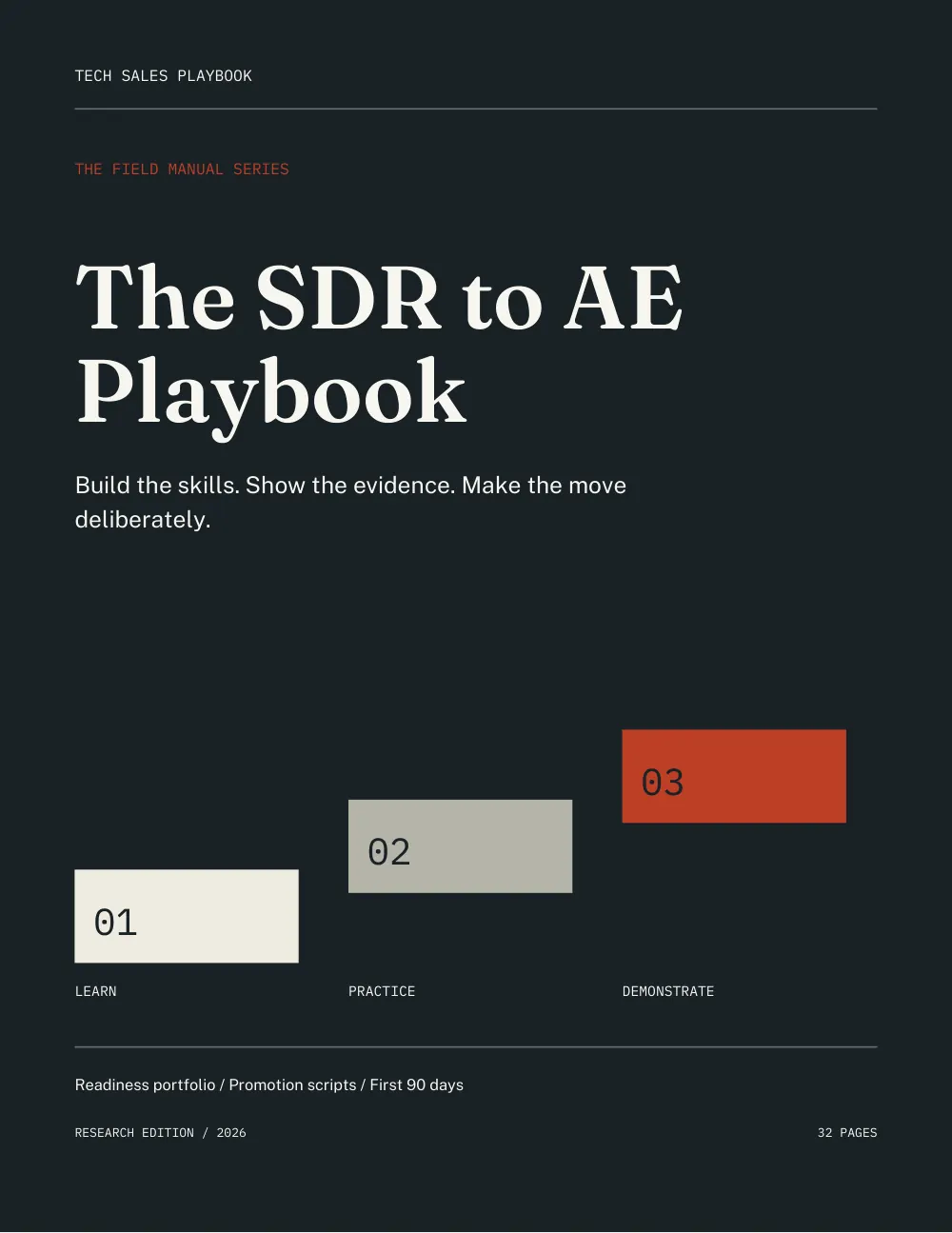
TECH SALES PLAYBOOK THE FIELD MANUAL SERIES The SDR to AE Playbook Build the skills. Show the evidence. Make the move deliberately. 01 LEARN 02 PRACTICE 03 DEMONSTRATE Readiness portfolio / Promotion scripts / First 90 days RESEARCH EDITION / 2026 32 PAGES
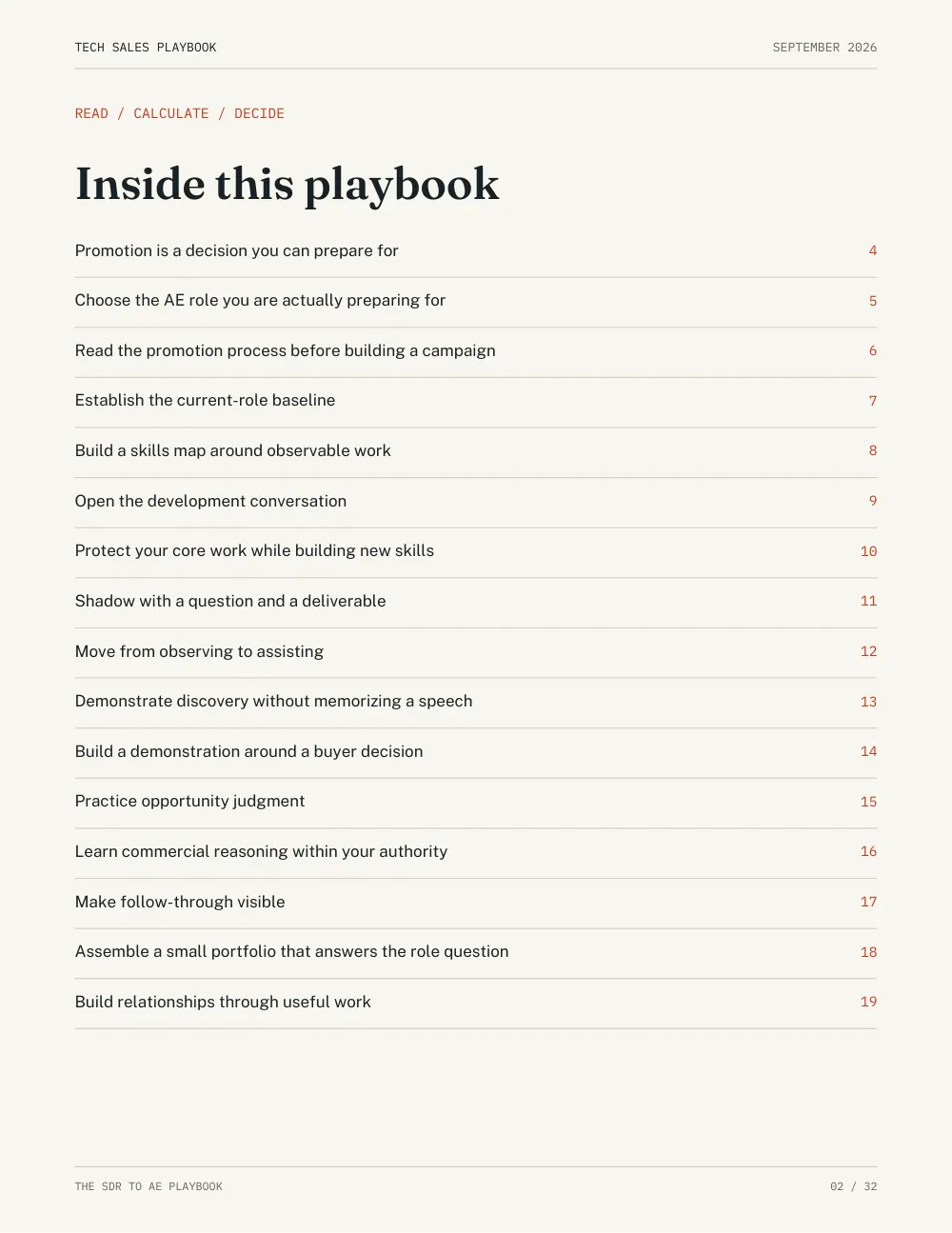
TECH SALES PLAYBOOK SEPTEMBER 2026 THE SDR TO AE PLAYBOOK 02 / 32 READ / CALCULATE / DECIDE Inside this playbook Promotion is a decision you can prepare for 4 Choose the AE role you are actually preparing for 5 Read the promotion process before building a campaign 6 Establish the current-role baseline 7 Build a skills map around observable work 8 Open the development conversation 9 Protect your core work while building new skills 10 Shadow with a question and a deliverable 11 Move from observing to assisting 12 Demonstrate discovery without memorizing a speech 13 Build a demonstration around a buyer decision 14 Practice opportunity judgment 15 Learn commercial reasoning within your authority 16 Make follow-through visible 17 Assemble a small portfolio that answers the role question 18 Build relationships through useful work 19
TECH SALES PLAYBOOK SEPTEMBER 2026 THE SDR TO AE PLAYBOOK 03 / 32 READ / CALCULATE / DECIDE Tools for the decision Run the promotion review as a business conversation 20 Respond when the answer is not yet 21 Evaluate an external move on the actual role 22 Answer the experience-gap question 23 Prepare a case interview with explicit assumptions 24 Plan the first 30 days around learning and alignment 25 Use days 31 to 60 to increase supervised ownership 26 Use days 61 to 90 to refine the operating system 27 Case file: Jordan separates readiness from timing 28 Worksheet: your readiness evidence map 29 Worksheet: turn feedback into a revised artifact 30 Worksheet: prepare the promotion decision 31 Sources and edition notes 32
TECH SALES PLAYBOOK SEPTEMBER 2026 THE SDR TO AE PLAYBOOK 04 / 32 FIELD GUIDE / START HERE Promotion is a decision you can prepare for Moving from SDR to account executive changes the work you are responsible for. You need to show that you can help a buyer evaluate a decision, manage an opportunity over time and coordinate the people involved. Strong prospecting remains useful; it is not the entire AE job. This playbook helps SDRs and BDRs prepare for an internal move or an external AE interview. It also covers the first 90 days after a move. The goal is a credible evidence portfolio and a clear development agreement, not a promise of promotion by a particular month. Three separate questions Performance: are you meeting the expectations of your current role? Readiness: can you demonstrate the capabilities required in the target role? Opportunity: is an appropriate position available, and how is it filled? You can be strong in one area and constrained in another. Understanding which question is unresolved makes your next action more useful. How to work through the book Start with your employer's actual AE role description. Complete the skills map, agree on a development project, and build a small portfolio of reviewed work. Use the promotion conversation and interview sections when the evidence is ready. Adapt the ramp plan once you know the new role's expectations. All people, companies, targets and calculations in the cases are fictional. The schedules, scripts and rubrics are original working tools. They do not establish a universal promotion standard or guarantee a hiring outcome. Research reviewed September 2026. Company-specific sources illustrate role and process distinctions; they are not rules for every employer.
TECH SALES PLAYBOOK SEPTEMBER 2026 THE SDR TO AE PLAYBOOK 05 / 32 01 / DEFINE THE DESTINATION Choose the AE role you are actually preparing for An AE title can describe very different work. A rep handling short inbound evaluations needs a different starting portfolio from someone managing complex outbound enterprise opportunities. Choose a target with enough detail to guide practice. Salesforce's role overview describes BDR work around prospecting and qualification, while AEs lead sales conversations and demonstrations and work toward closing. Treat that as a broad role distinction, then inspect the actual job. Salesforce Trailhead: sales roles Dimension What to establish Customer segment Which buyers and account sizes? Pipeline source Inbound, self-sourced, SDR-supported or mixed? Sales motion New business, expansion or renewal responsibility? Evaluation complexity Typical stakeholders and technical work? Ownership Which stages and tasks belong to the AE? Support Available technical, operational and customer resources? A useful target statement "I am preparing for a commercial new-business AE role selling our current product, with SDR-supported pipeline and responsibility from discovery through handoff." That statement is more actionable than "I want to close." It tells you which conversations to observe, which skills to practice and which hiring manager should evaluate your work. Check the fit Ask an AE what the difficult parts of the job are, including the work between calls. If you dislike maintaining records, coordinating follow-ups or navigating uncertainty, investigate that before treating the title as the obvious next step.
TECH SALES PLAYBOOK SEPTEMBER 2026 THE SDR TO AE PLAYBOOK 06 / 32 01 / DEFINE THE DESTINATION Read the promotion process before building a campaign Ask how the organization makes promotion decisions. Identify eligibility requirements, application steps, decision-makers, assessment criteria and whether an approved opening is required. GitLab's published career guidance provides a concrete example: progression can depend on performance, management endorsement, training and a formal application or interview, with business need also affecting availability. Its detailed requirements vary by transition. This is one employer's process, not a universal tenure rule. GitLab: sales development and role guidance. Questions for your manager "What written criteria apply to the AE role I am targeting?" "Who decides whether I am ready, and what evidence do they use?" "Is there an approved role, an expected opening, or only a possible future path?" "What is the process for applying, and when should we review my progress?" Separate eligibility from selection Meeting a tenure or attainment requirement may make you eligible to apply. It does not necessarily mean you have been selected. Ask what happens after eligibility is established. When no written process exists Propose a short development agreement with the manager and relevant hiring lead. Record the skills to demonstrate and the review date. Be clear that the agreement is about evaluation unless an authorized person explicitly commits to something more. Replace "They said I am next" with a record of who said what, which role they meant and what still needs to happen.
TECH SALES PLAYBOOK SEPTEMBER 2026 THE SDR TO AE PLAYBOOK 07 / 32 02 / BUILD A CREDIBLE FOUNDATION Establish the current-role baseline Make your SDR performance understandable before asking a manager to assess your next-role readiness. Include the target, actual result, period and the rules used to count the result. GitLab's public SDR role guidance includes accepted-opportunity attainment and pipeline measures among its indicators. That illustrates why activity alone may not describe the contribution a company values. Use your own employer's definitions. GitLab: performance indicators Fictional quarterly record Measure Target Actual Interpretation Accepted opportunities 24 27 112.5% of this target Meetings held Not shown 36 Context; not the quota basis Meetings booked Not shown 45 Context for attendance Held-to-accepted Not a target 27 / 36 = 75% Defined conversion for this period This example does not imply that 75% is a benchmark or that all accepted opportunities will become revenue. It also does not establish an individual's contribution to a later closed deal. Add the context that matters Note ramp status, territory changes, leave, changed definitions and team contributions where relevant. Explain a miss with facts and corrective action, not excuses or omitted periods. Strong performance evidence is reproducible. Another person should be able to understand the numerator, denominator and time period without asking you to reinterpret the chart. Keep customer and compensation records in approved systems. Use anonymized summaries when preparing a personal portfolio.
TECH SALES PLAYBOOK SEPTEMBER 2026 THE SDR TO AE PLAYBOOK 08 / 32 02 / BUILD A CREDIBLE FOUNDATION Build a skills map around observable work Translate the target role into things a reviewer can observe. "Commercial mindset" is too vague unless you agree on what it looks like in a real task. Capability Possible evidence Reviewer Discovery Simulated or approved live-call segment AE manager Demonstration Buyer-specific workflow presentation AE or solutions lead Opportunity judgment Written deal review with unknowns AE manager Communication Buyer recap and next-step plan Assigned AE Commercial reasoning Scope and price scenario Authorized manager Execution Accurate CRM example and follow-through Manager or operations These are original suggestions. Agree on acceptable evidence and recording or sharing permissions first. Use four practical status labels Not attempted; practiced with feedback; demonstrated under supervision; demonstrated independently within authorized scope. These describe observed work, not probabilities of success. Identify the highest-leverage gap If you can present well but cannot distinguish buyer facts from assumptions, another presentation may add little. Choose the gap that most limits confidence in your ability to handle the target role. Finish the map with a decision For each priority gap, assign one task, one reviewer and a review date. A large list of courses without a plan for demonstrating the skill is a learning backlog, not a readiness argument. Ask: "What would you need to see me do to change this status from practiced to demonstrated?"
TECH SALES PLAYBOOK SEPTEMBER 2026 THE SDR TO AE PLAYBOOK 09 / 32 02 / BUILD A CREDIBLE FOUNDATION Open the development conversation Make the request specific enough that your manager can respond constructively. Explain the role you are targeting, acknowledge current responsibilities and propose a bounded way to build evidence. "I want to prepare for a commercial AE role. I have pulled together my current performance and a first skills map. I would like your feedback on the gaps and on one development project I can complete without neglecting my SDR commitments. Could we agree on the evidence to produce and a date to review it?" Bring three items Your current performance summary, the target role description and a proposed development task. Keep the first meeting focused on alignment rather than presenting a large portfolio nobody asked you to build. Ask for a clear response Does the manager support the target direction? Which skills need work? Who else should assess readiness? Is there a realistic opportunity in the organization, or is the timing unknown? Capture the agreement Send a brief recap: "We agreed that I will practice the discovery summary and produce an opportunity review for [scenario]. [Reviewer] will assess it against [criteria] by [date]. My SDR priorities remain [agreed responsibilities]." If the manager disagrees with the target, ask what drives the concern. It may be a skills gap, role fit, staffing need or a lack of available positions. Those require different responses. The first conversation should produce a development decision, not force an immediate promotion promise.
TECH SALES PLAYBOOK SEPTEMBER 2026 THE SDR TO AE PLAYBOOK 10 / 32 03 / CREATE RELEVANT EXPERIENCE Protect your core work while building new skills Development work is more credible when it fits an agreed workload. Quietly abandoning SDR responsibilities to shadow AEs can damage the performance record you need for the move. Propose a small weekly allocation For example, request one approved observation, one practice block and one short feedback session. The exact time depends on workload and manager agreement. Do not assume the schedule below is a universal standard. Activity Fictional time budget Output Observe one selected call 30 minutes Notes on one skill Practice the same skill 30 minutes Revised work sample Review with coach 15 minutes One next adjustment Total 75 minutes A completed learning loop Define the tradeoff openly If a development assignment becomes larger, ask which work should move. Do not hide the cost or assume you should perform two full jobs indefinitely to prove commitment. Watch the leading signals Are current-role follow-ups slipping? Are you attending calls without learning a specific skill? Are coaches waiting on work you promised? Adjust the plan before missed commitments become a pattern. Keep a short progress log Record the task, feedback, revision and next application. Time spent is context; improved work is the evidence. A useful week ends with one demonstrated improvement. Several hours of passive observation can leave you with less evidence than one focused rehearsal and review.
TECH SALES PLAYBOOK SEPTEMBER 2026 THE SDR TO AE PLAYBOOK 11 / 32 03 / CREATE RELEVANT EXPERIENCE Shadow with a question and a deliverable Before observing a call, ask the AE what decision the meeting is intended to advance and which behavior you should study. Get any required approval for attendance, notes or recordings. Observation brief "I am working on how to summarize discovery and agree on next steps. Could I observe the final part of your next appropriate call and send you a short analysis afterward? I will follow your guidance on participation and handling the notes." During the call Track the buyer's problem, the evidence the AE tests and how the next question relates to the answer. Note what the AE leaves unresolved. Do not interrupt to demonstrate your knowledge unless invited to contribute. Debrief with the AE What were you trying to learn at that moment? Which answer changed your plan? What risk remains after this conversation? Why was that next step useful for the buyer? What would you have done if the answer had been different? Produce something reviewable Write a short buyer recap or an evidence map, then compare it with the AE's interpretation. Differences are valuable. You may have heard an expression of interest where the AE heard an untested assumption. Shadowing becomes development when you move from watching a skilled person to explaining and practicing the decisions behind their behavior. Keep the learning artifact internal unless you have explicit permission to share it elsewhere. Customer confidentiality continues to apply when the work is part of a promotion portfolio.
TECH SALES PLAYBOOK SEPTEMBER 2026 THE SDR TO AE PLAYBOOK 12 / 32 03 / CREATE RELEVANT EXPERIENCE Move from observing to assisting Ask for a narrow task with clear boundaries before asking to run an entire opportunity. The task should help the AE and expose you to the target skill without creating confusion for the buyer. Assistance task Boundary to agree Evidence of useful work Prepare account context Approved sources and scope Relevant, accurate brief Draft buyer recap AE reviews before sending Facts, unknowns and actions separated Lead one discovery segment AE retains meeting ownership Buyer problem clarified Build a demo scenario Approved capabilities only Scenario matches buyer criteria Maintain agreed action log Authorized system access Owners and statuses accurate Ask for the standard "What would a good version look like, what should I avoid, and when would you like to review it?" Do not borrow authority Assisting does not authorize you to promise pricing, delivery dates, product capabilities or contract changes. Escalate those questions to the responsible person. Do not contact the buyer independently unless the owner has agreed. Close the loop After the task, ask what was useful and what needed correction. Revise the artifact, then document your actual contribution. "Drafted the recap and incorporated AE feedback" is different from "managed the deal." A bounded task gives your reviewer evidence of judgment as well as skill: you know where your responsibility begins and ends. Increase ownership when the reviewer has seen reliable execution, not simply because you attended several calls.
TECH SALES PLAYBOOK SEPTEMBER 2026 THE SDR TO AE PLAYBOOK 13 / 32 03 / CREATE RELEVANT EXPERIENCE Demonstrate discovery without memorizing a speech For a readiness assessment, ask the reviewer to give you a buyer scenario with information you do not know in advance. Your task is to investigate, not recite a predetermined sequence. Suggested practice brief A fictional operations manager says handoffs are becoming unreliable. You have 15 minutes to understand a recent example, the consequence and the next useful evaluation step. The partner chooses whether the underlying issue is missing data, unclear ownership or scheduling. Evidence the reviewer can inspect You agreed on a useful purpose for the conversation. Your follow-ups responded to the buyer's actual answers. You distinguished a general complaint from a concrete problem. You labeled estimates and unresolved assumptions. Your summary gave the buyer a chance to correct you. Your proposed next step addressed a real unknown. A coachable mistake If you pitch too early, recover: "I jumped ahead. Before suggesting a solution, could we clarify what happened in the last case?" Then change your behavior. An explanation of why you made the mistake is less useful than a better next question. Capture the work honestly Label the artifact as a simulation, list the scenario and note the feedback. Do not present a rehearsal as a customer engagement. If using an approved real-call segment, identify the scope you personally led. Your readiness evidence is the quality of your reasoning under changing information, not how confidently you deliver the first prepared minute.
TECH SALES PLAYBOOK SEPTEMBER 2026 THE SDR TO AE PLAYBOOK 14 / 32 03 / CREATE RELEVANT EXPERIENCE Build a demonstration around a buyer decision A product tour shows what exists. A buyer-specific demonstration helps someone evaluate whether a capability addresses their requirement. Practice the latter. HubSpot's inbound-sales curriculum includes understanding buyer context and delivering personalized presentations. Use that as a learning resource, then demonstrate the skill with your own approved scenario. A course completion alone is not evidence of independent selling ability. HubSpot Academy: inbound sales A compact demo assignment Select one buyer problem, one relevant workflow and two evaluation questions. Ask a reviewer to interrupt with a realistic concern. Finish by checking what the buyer learned and what still needs verification. Element Fictional example Buyer problem Unclear owner when a handoff is incomplete Workflow Route an exception to the responsible person Evaluation question Can the user see the next action? Limitation to verify Integration with the buyer's current system Stay inside the evidence Use approved product behavior and data. If the scenario requires something the product cannot do, name the gap. If you need a specialist to answer a technical question, explain that next step rather than improvising a promise. Review the recording or notes Did each screen relate to the buyer's question? Did you pause for evaluation? Could the reviewer tell the difference between demonstrated functionality and an assumption? The portfolio artifact should include the scenario brief and the unresolved questions, not only a polished presentation.
TECH SALES PLAYBOOK SEPTEMBER 2026 THE SDR TO AE PLAYBOOK 15 / 32 03 / CREATE RELEVANT EXPERIENCE Practice opportunity judgment An AE needs to decide what work an opportunity deserves and why. Build a short review that explains the buyer's situation, the evidence supporting progress and the risks still open. Original opportunity-review format Area What to state Problem Specific buyer situation and supporting example Importance Buyer-described impact and priority Fit Relevant capability and known limitations People Participants, authority and missing perspectives Process Next decision and dependencies Risk Most important assumption that could fail Action Work that could resolve the uncertainty Fictional judgment call The contact likes the demonstration, but no operational owner has validated the workflow and no investment process is known. A weak review calls the deal "hot." A stronger review recommends a working session with the appropriate owner before spending time on a detailed proposal. Ask for a challenge Have the manager change one fact: the contact leaves, the budget owner rejects the timing, or a required capability is unavailable. Explain how that changes your recommendation. Keep forecast labels grounded Use your employer's definitions for stages and forecast categories. Do not invent a probability because a deal feels promising. A simulation can test your judgment without pretending you own a live forecast. A good review makes it easy for the manager to disagree with a specific assumption. That is more useful than a confident summary with no inspectable reasoning.
TECH SALES PLAYBOOK SEPTEMBER 2026 THE SDR TO AE PLAYBOOK 16 / 32 03 / CREATE RELEVANT EXPERIENCE Learn commercial reasoning within your authority You do not need to grant real discounts to practice a commercial conversation. Use an approved fictional price and scope scenario. Your task is to understand the buyer's concern and compare authorized options. Fictional price exercise A subscription is $24,000 annually for a defined scope. A buyer asks for 20% off. That would reduce annual price by $4,800 to $19,200. The arithmetic is straightforward; the reason for the request is still unknown. Ask whether the concern is available budget, perceived value, payment timing or unused scope. Then identify which options your company would permit. A smaller scope, different start date or payment arrangement may address a different problem from a discount. What the reviewer should observe You clarify the concern before offering a concession. You know which terms require approval. You compare the whole proposed package, not just one number. You avoid inventing deadlines or competitor claims. You record the proposed terms accurately. A safe practice response "Before I suggest an option, could we clarify whether the issue is the annual amount or paying it upfront? I can then check which approved alternatives address that constraint." Keep the contribution honest If you helped prepare options for an AE, say that. Do not claim to have negotiated a contract you did not own or have authority to change. Commercial readiness includes knowing when to ask for approval. Confidence without boundaries creates risk for the buyer and your team.
TECH SALES PLAYBOOK SEPTEMBER 2026 THE SDR TO AE PLAYBOOK 17 / 32 03 / CREATE RELEVANT EXPERIENCE Make follow-through visible An impressive call can be undermined by an inaccurate recap or a missed commitment. Treat execution as a skill you can demonstrate deliberately. A small execution sample Use an approved scenario to create a meeting recap, CRM note and action log. They should tell the same story. The recap is buyer-facing; the internal note can include qualification uncertainty and your recommendation. Item Quality check Buyer recap Accurate facts, assumptions and agreed actions CRM note Clear evidence, source, date and unresolved risk Action log Owner, due date, status and completion evidence Follow-up Sent through the agreed channel at the agreed time Spot a contradiction If the buyer said they would check availability, the action log should not say "meeting confirmed." If the analyst has not validated the estimate, the CRM should not call the value calculation verified. Show a revision Include one example where feedback improved your record. Explain what was wrong and how you prevented the same mistake in the next task. That shows learning more clearly than a folder of flawless-looking documents with no context. Protect confidentiality Keep real customer work in approved systems. For an external interview, create an analogous fictional sample rather than exporting internal records. Describe the skill and your contribution without exposing information you are not authorized to share. Reliable follow-through is observable. A manager should be able to see what you promised, what you delivered and how you handled a change.
TECH SALES PLAYBOOK SEPTEMBER 2026 THE SDR TO AE PLAYBOOK 18 / 32 04 / PRESENT THE EVIDENCE Assemble a small portfolio that answers the role question Build the portfolio around the target role's criteria. A reviewer should not have to infer why an artifact matters or search through dozens of files. Suggested portfolio index Artifact Question it helps answer Performance brief Is the current-role contribution clear? Skills map Which AE capabilities have been assessed? Discovery sample Can the candidate investigate and summarize? Demo scenario Can they connect capability to buyer criteria? Opportunity review Can they reason about risk and next actions? Execution sample Can they maintain accurate commitments and records? Add a short note to each artifact State the context, your exact contribution, whether it was simulated or live, the reviewer and date, the feedback, and what changed afterward. Link to approved internal records where appropriate. Show the limits If you have not owned a contract negotiation or a complete sales cycle, say so. Explain the supervised work and practice you have done and the support you would need initially. Inflating experience can create expectations you cannot meet. Keep it reviewable Use a one-page index and concise artifacts. The purpose is to make evidence accessible, not to impress through volume. Remove duplicated examples that show the same skill without adding new information. Portfolio test: for every file, finish the sentence "This demonstrates ___ because ___." If you cannot, improve the annotation or leave the file out.
TECH SALES PLAYBOOK SEPTEMBER 2026 THE SDR TO AE PLAYBOOK 19 / 32 04 / PRESENT THE EVIDENCE Build relationships through useful work Internal visibility can help the right people understand your work, but visibility without substance is fragile. Build relationships by being reliable, asking focused questions and making a useful contribution. Three different roles A coach helps you improve a skill. A manager evaluates your current work and development. A sponsor may advocate for you when a role is considered. One person can play several roles, but do not assume that friendly encouragement means active sponsorship. A useful request "I am preparing for the commercial AE role and working on opportunity judgment. Could you review this one-page fictional case against the criteria your team uses? I would value the two changes that would make the analysis stronger." This is easier to evaluate than a broad request to "mentor me" with no context or boundary. Earn a specific endorsement After working together, ask whether the reviewer would be comfortable describing the skill they observed. Do not script exaggerated praise or pressure someone to endorse work they did not see. Keep your manager informed Coordinate development relationships rather than making surprise requests that appear to bypass the process. If you encounter conflicting expectations, bring the criteria together and ask which standard governs the role. A strong internal reputation is an accumulation of accurate promises and useful delivery. Treat a relationship as a working partnership, not a shortcut around readiness.
TECH SALES PLAYBOOK SEPTEMBER 2026 THE SDR TO AE PLAYBOOK 20 / 32 04 / PRESENT THE EVIDENCE Run the promotion review as a business conversation When you have the agreed evidence, request a review tied to the actual process. State the role, show the work and ask for a clear assessment of readiness and opportunity. "I would like to review my readiness for the commercial AE role. We agreed on three gaps: discovery, opportunity judgment and buyer follow-through. Here is the assessed work for each, including the feedback and revisions. I would like your view on whether I meet the current criteria and what the next step in the application process should be." A focused meeting structure Begin with current-role performance. Show the two or three artifacts that address the most important gaps. Discuss any untested responsibilities. Then ask about the role, decision process and next date. Ask for a specific outcome Ready to apply; more evidence needed; a different target role recommended; or no available role despite readiness. These are different decisions. Avoid leaving with only "keep doing what you are doing." Record the result Send a factual recap of the assessment, remaining gap, owner and review date. Do not write that a promotion was promised if the discussion only established eligibility or support for applying. The argument is not "I have waited long enough." It is "Here is the evidence against the role's criteria, and here is the decision I am asking you to make." Tenure may matter under the policy. It should be represented accurately alongside performance, readiness and available opportunity.
This is meant to be opened while you work. The sections are concrete enough to copy, practice, adapt, and reuse during applications, interviews, calls, and weekly execution.
Timeline: When to push for promotion
Skills gap analysis framework
Shadow and assist strategies
Building your internal brand
The promotion conversation playbook
AE interview preparation
First 90 days as a new AE
Identify skill gaps against the actual role.
Align supervised practice with your manager.
Present a portfolio with clear ownership.
The sample exists so buyers can inspect the writing style, structure, and depth before purchase. If the sample feels useful, the full PDF continues with the same practical format.
What you are buying
Before you decide
Start with the question that matters to you. You can use the free material without making a purchase.
Try one relevant task first. If that resolves your immediate question, keep using the free resources. Inspect the book’s sample when you need more structured practice.
Try the related free resourceBuild evidence of AE skills and prepare for the next-role conversation.
Use this as a self-study routine, adjusting it to the material. Completing a session is not a certification or an assessment of hiring readiness.
Choose one book for a focused gap. Consider a bundle only if you will use its listed books; compare the exact contents and avoid paying twice for material you already own.
A PDF is self-directed preparation. Individual feedback on your own resume is a separate service with its own scope and availability.
Compare the resume serviceCheck the current price, included files, delivery instructions and refund terms before opening checkout.
Read the actual sample and file details on this page. If you need help with an order or access, contact support with your question rather than placing a second order.
Read purchase and refund termsAsk a product or access question$29 PDF download
$29 PDF download
$39 PDF download
$29 PDF download
$19 PDF download
$19 PDF download
$19 PDF download
$19 PDF download
$19 PDF download